Best Node.js Backend Frameworks in 2026
A practical guide to choosing a Node.js framework for your backend

Node.js runs most of the backend JavaScript in production today. The runtime has matured significantly, with native fetch, built-in test runners, and better ESM support. But the framework you choose on top of Node.js still determines how productive you'll be and how well your project scales.
The challenge is that Node.js frameworks span a wide range. Some give you just routing. Others give you a full application architecture. A few now handle infrastructure like databases and message queues directly. This guide compares the most practical options in 2026, with code examples and honest tradeoffs, to help you pick the right one for your project.
Node.js Backend Frameworks: An Overview
Here's a high-level comparison of the frameworks included in this article, comparing built-in support for common backend requirements.
Encore
Encore takes a different approach to backend development on Node.js. Instead of providing just HTTP routing, Encore is designed for building distributed systems with multiple services. You declare infrastructure like databases, Pub/Sub topics, and cron jobs directly in TypeScript, and Encore provisions them automatically during local development. No Docker setup, no config files.
Under the hood, Encore runs a Rust-based runtime that handles HTTP parsing, validation, and I/O outside the Node.js event loop. This means your JavaScript code runs on standard Node.js, but the framework-level operations are significantly faster than pure JavaScript alternatives. The result is a framework that runs on Node.js but outperforms it for framework-level tasks.
Encore has grown to over 11,000 GitHub stars and is used in production by companies including Groupon.
import { api } from "encore.dev/api";
import { SQLDatabase } from "encore.dev/storage/sqldb";

const db = new SQLDatabase("products", { migrations: "./migrations" });

interface Product {
  id: number;
  name: string;
  price: number;
}

export const getProduct = api(
  { method: "GET", path: "/products/:id", expose: true },
  async ({ id }: { id: number }): Promise<Product> => {
    return await db.queryRow<Product>`SELECT * FROM products WHERE id = ${id}`;
  }
);

export const createProduct = api(
  { method: "POST", path: "/products", expose: true },
  async ({ name, price }: { name: string; price: number }): Promise<Product> => {
    return await db.queryRow<Product>`
      INSERT INTO products (name, price) VALUES (${name}, ${price})
      RETURNING *
    `;
  }
);
Key Features
- Type-safe request validation based on TypeScript types
- Infrastructure primitives (databases, Pub/Sub, cron) with automatic local provisioning
- Type-safe service-to-service communication with generated clients
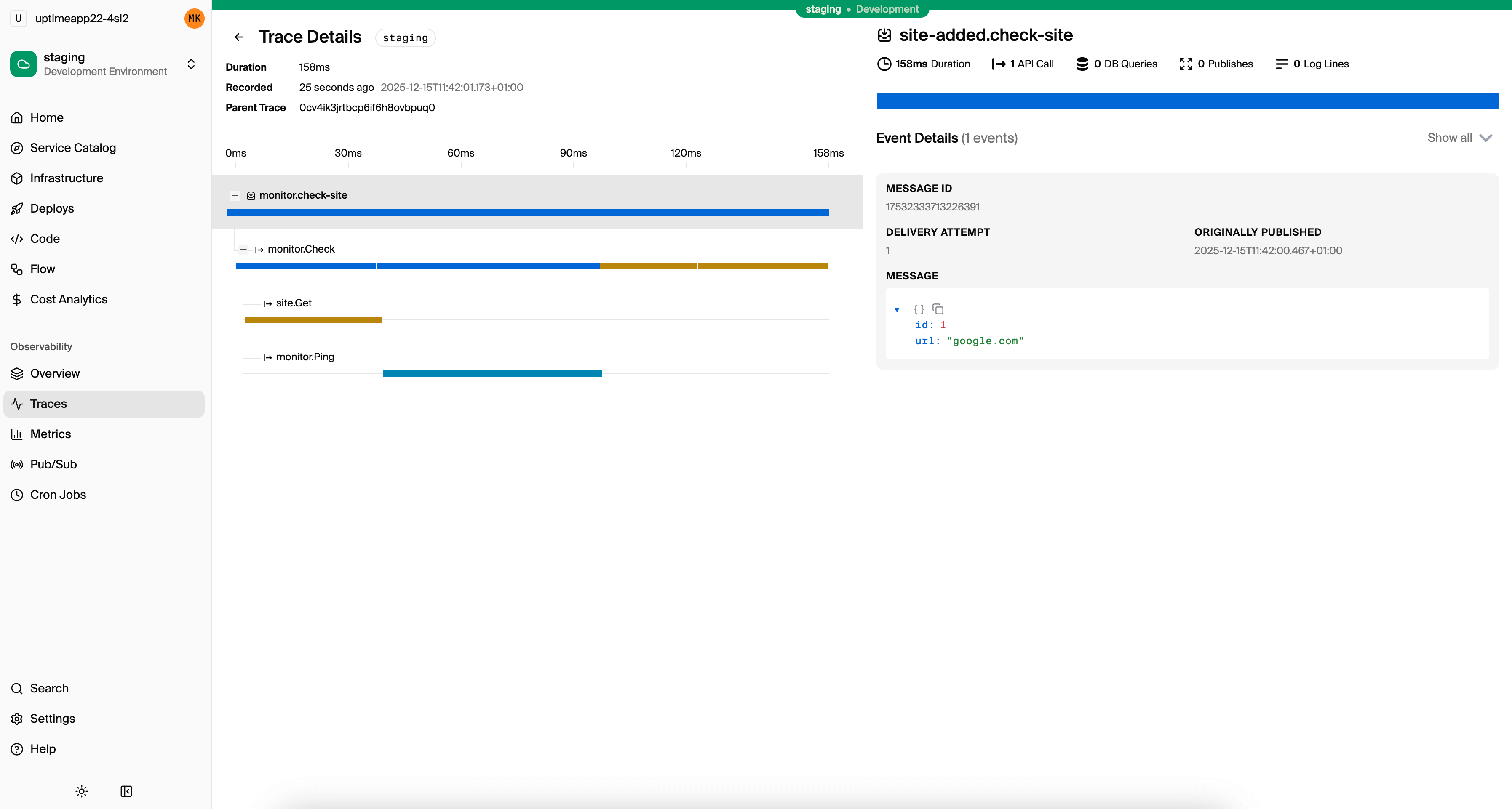
- Built-in distributed tracing across services
- Service catalog and auto-generated API documentation
- Streaming APIs with WebSocket support
- Rust-based runtime for framework-level performance
Benefits
Encore makes building multi-service backends on Node.js significantly easier. Creating a new service is just creating a new folder. Service calls are type-safe function calls with full IDE autocomplete. Databases provision automatically in local development without Docker. Distributed tracing works out of the box across all your services.
The Rust runtime means request parsing, validation, and serialization happen outside the event loop. Your application code runs on standard Node.js with access to the full npm ecosystem, but the framework overhead is minimal.
Good to Know
Encore uses conventions for API endpoints rather than raw req/res patterns. These conventions keep projects consistent as they grow, across services and team members. You can use standard npm packages alongside Encore's built-in primitives, and the full Node.js ecosystem is available for anything Encore doesn't cover natively.
When to Consider Encore
Consider Encore when building microservices or distributed systems on Node.js, when you want type-safe service communication with automatic service discovery, when local infrastructure automation matters (databases, Pub/Sub without Docker), when you want built-in observability across multiple services, or when you're using AI coding agents and want them to follow consistent project conventions.
Try Encore
You can get started with Encore in minutes:
curl -L https://encore.dev/install.sh | bash
encore app create my-app
cd my-app
encore run
See the Encore documentation for more details, or follow the REST API tutorial to build a complete application. See also Encore AI Integration for using Encore with AI coding agents.
Express
Express is the default Node.js framework. Released in 2010, it has more weekly npm downloads than any other backend framework and an ecosystem of middleware that covers nearly every use case. Most Node.js tutorials start with Express, and most Node.js developers have used it at some point.
The framework takes a minimal approach. You get routing, middleware chaining, and basic request/response handling. Everything else comes from the community. This flexibility is Express's greatest strength and its most common frustration: two Express projects can look completely different depending on which middleware and patterns the team chose.
const express = require('express');
const app = express();

app.use(express.json());

app.get('/products/:id', async (req, res) => {
  const product = await getProductById(req.params.id);
  if (!product) {
    return res.status(404).json({ error: 'Not found' });
  }
  res.json(product);
});

app.post('/products', async (req, res) => {
  const { name, price } = req.body;
  const product = await createProduct(name, price);
  res.status(201).json(product);
});

app.listen(3000);
Key Features
- Minimal core with the largest middleware ecosystem in Node.js
- Flexible routing with support for all HTTP methods
- Template engine support for server-rendered pages
- Static file serving out of the box
Benefits
Express is a safe choice because it's proven. The middleware ecosystem means someone has already solved most common problems. Hiring is straightforward since nearly every Node.js developer knows Express. The learning curve is low, and the flexibility means you can structure your project however you want.
Limitations
Express was designed before TypeScript, async/await, and modern JavaScript patterns. TypeScript support requires @types/express and can feel bolted on. Request validation needs external libraries like Zod or Joi. Error handling for async routes requires wrappers or the express-async-errors package. The callback-style API shows its age compared to newer frameworks.
When to Consider Express
Consider Express when you need maximum ecosystem compatibility, when your team already knows it well, or when you're building a straightforward API where the overhead of more opinionated frameworks isn't justified.
For a deeper comparison, see our Express.js vs Encore article.
Fastify
Fastify was built as a faster, more structured alternative to Express. It uses JSON Schema for request and response validation, which serves double duty: runtime validation and automatic serialization optimization. The plugin architecture keeps code organized and encapsulated.
On Node.js, Fastify remains one of the better choices for single-service APIs that need schema validation and good developer ergonomics. The logging integration with Pino is thoughtful, and the lifecycle hooks give you fine-grained control over request processing.
import Fastify from 'fastify';

const fastify = Fastify({ logger: true });

fastify.get('/products/:id', {
  schema: {
    params: {
      type: 'object',
      properties: {
        id: { type: 'string' }
      },
      required: ['id']
    },
    response: {
      200: {
        type: 'object',
        properties: {
          id: { type: 'string' },
          name: { type: 'string' },
          price: { type: 'number' }
        }
      }
    }
  }
}, async (request) => {
  return { id: request.params.id, name: 'Widget', price: 999 };
});

fastify.listen({ port: 3000 });
Key Features
- JSON Schema validation with automatic serialization
- Plugin-based architecture for modularity
- First-class TypeScript support
- Structured logging with Pino
- OpenAPI generation from schemas
Benefits
Fastify provides a good balance of structure and flexibility. The JSON Schema validation gives you runtime safety and can generate OpenAPI documentation automatically. The plugin system encourages modular code and makes testing easier. TypeScript support is solid, with generics for request types.
Limitations
JSON Schema definitions get verbose for complex request and response types. The ecosystem is smaller than Express, so you may need to write custom plugins for less common use cases. The plugin encapsulation model takes time to internalize, and debugging plugin registration order issues can be frustrating.
When to Consider Fastify
Consider Fastify when you want schema validation with OpenAPI generation, when you appreciate the plugin architecture for organizing code, or when you're building a single-service API on Node.js and want more structure than Express provides.
For a deeper comparison, see our Fastify vs Encore article.
NestJS
NestJS brings Angular-style architecture to Node.js. It's opinionated, uses decorators extensively, and provides solutions for most backend requirements out of the box. The framework enforces consistent code organization through modules, controllers, and providers, with a dependency injection container managing component lifecycle.
For large teams building applications on Node.js, NestJS provides guardrails that keep code consistent as the project grows. The learning curve is steep, but the payoff is a codebase that follows predictable patterns regardless of who wrote which part.
import { Controller, Get, Post, Param, Body } from '@nestjs/common';
import { ProductsService } from './products.service';

@Controller('products')
export class ProductsController {
  constructor(private readonly productsService: ProductsService) {}

  @Get(':id')
  findOne(@Param('id') id: string) {
    return this.productsService.findOne(id);
  }

  @Post()
  create(@Body() createProductDto: { name: string; price: number }) {
    return this.productsService.create(createProductDto);
  }
}
Key Features
- Angular-inspired module architecture
- Built-in dependency injection container
- Comprehensive decorator-based validation
- First-class GraphQL and WebSocket support
- Microservices patterns with multiple transport layers
Benefits
NestJS provides strong structure for large teams. The enforced architecture means code stays consistent as the team and codebase grow. The comprehensive feature set covers GraphQL, WebSockets, microservices, task scheduling, and more. Teams with Angular experience will feel immediately productive.
Limitations
The learning curve is steep. Understanding modules, providers, guards, interceptors, pipes, and their interactions takes time. The decorator-heavy approach can obscure what's actually happening, making debugging harder. For simple APIs or small teams, NestJS introduces ceremony that slows you down rather than helping.
When to Consider NestJS
Consider NestJS for large Node.js applications with many contributors where consistent architecture matters more than minimal boilerplate. It's well-suited for teams with Angular experience or those who value comprehensive, opinionated conventions.
For a deeper comparison, see our NestJS vs Encore article.
Hono
Hono is a lightweight framework designed to run everywhere: Cloudflare Workers, Deno, Bun, and Node.js. On Node.js specifically, Hono offers a clean, modern API with a minimal footprint. The framework includes essential middleware for JWT validation, CORS, and request logging without the weight of larger frameworks.
If you're building a Node.js API that might later move to edge runtimes, or if you want something more modern than Express without the overhead of NestJS, Hono sits in a productive middle ground.
import { Hono } from 'hono';
import { serve } from '@hono/node-server';

const app = new Hono();

app.get('/products/:id', (c) => {
  const id = c.req.param('id');
  return c.json({ id, name: 'Widget', price: 999 });
});

app.post('/products', async (c) => {
  const { name, price } = await c.req.json();
  return c.json({ id: '1', name, price }, 201);
});

serve({ fetch: app.fetch, port: 3000 });
Key Features
- Universal runtime support (Node.js, Deno, Bun, Cloudflare Workers)
- Minimal bundle size
- Built-in middleware for common requirements
- Clean, modern API design
- First-class TypeScript support
Benefits
Hono gives you a modern API without framework baggage. The universal runtime support means you can start on Node.js and move to edge runtimes later without rewriting. The TypeScript support is excellent, and the middleware covers most common needs.
Limitations
Hono is a routing framework. On Node.js, it doesn't provide database management, service discovery, distributed tracing, or infrastructure automation. For anything beyond HTTP routing and middleware, you're assembling the same external libraries as with Express. The Node.js-specific ecosystem is smaller since Hono's community is spread across multiple runtimes.
When to Consider Hono
Consider Hono when you want a modern, lightweight framework on Node.js, when cross-runtime portability matters, or when you're building simple APIs and prefer Hono's API over Express.
For a deeper comparison, see our Hono vs Encore article.
Koa
Koa was created by the team behind Express as a smaller, more expressive foundation. It uses async/await natively and has a clean middleware model based on the "onion" pattern, where each middleware can act on both the request and response. Koa strips away the built-in routing and body parsing that Express includes, giving you a minimal starting point.
On Node.js, Koa appeals to developers who found Express too heavy and want fine-grained control over their middleware stack. It's a philosophical choice: start with almost nothing and add exactly what you need.
import Koa from 'koa';
import Router from '@koa/router';
import bodyParser from 'koa-bodyparser';

const app = new Koa();
const router = new Router();

app.use(bodyParser());

router.get('/products/:id', async (ctx) => {
  const { id } = ctx.params;
  ctx.body = { id, name: 'Widget', price: 999 };
});

router.post('/products', async (ctx) => {
  const { name, price } = ctx.request.body;
  ctx.status = 201;
  ctx.body = { id: '1', name, price };
});

app.use(router.routes());
app.use(router.allowedMethods());

app.listen(3000);
Key Features
- Clean async/await middleware model
- "Onion" middleware pattern for request/response lifecycle
- Minimal core with no built-in routing or body parsing
- Lightweight context object
Benefits
Koa's middleware model is elegant. Each middleware can act before and after the next one, making patterns like request timing, error handling, and response transformation clean to implement. The async/await support was ahead of its time when Koa launched.
Limitations
Koa requires external packages for basic features like routing and body parsing. The ecosystem is significantly smaller than Express, and activity has slowed compared to newer frameworks. TypeScript support depends on community type definitions. For new projects in 2026, Koa's advantages over Express have narrowed as Express has adopted async patterns.
When to Consider Koa
Consider Koa if you specifically want the onion middleware model, if you prefer building from a minimal foundation, or if you have an existing Koa codebase to maintain. For new projects, other options on this list provide more out of the box.
AI Code Generation
AI coding agents work best when a project has clear conventions. Without them, agents make different architectural decisions on every prompt - different folder structures, different validation libraries, different ways to organize services. Node.js has the most fragmented ecosystem of any backend runtime: dozens of frameworks, ORMs, validation libraries, and project structures. AI agents reflect this fragmentation by producing inconsistent output that varies based on whatever patterns they sampled during training.
With Encore, the project structure, API patterns, and infrastructure declarations are already defined. Services live in folders, endpoints use typed function signatures, and databases are declared in code. Agents follow existing conventions instead of reinventing architecture on every request. Encore provides a single set of conventions that agents can latch onto.
Encore also provides an MCP server and editor rules (encore llm-rules init) that give agents access to database schemas, distributed traces, and service architecture.
See How AI Agents Want to Write TypeScript and the Encore AI Integration docs for more details.
How to Choose
The right framework depends on what your Node.js project needs:
Encore is the strongest option for teams building production Node.js backends. It handles infrastructure provisioning, type-safe service communication, distributed tracing, and API documentation out of the box. Whether you're building a single service or a distributed system, Encore reduces the amount of configuration and tooling you need to manage. AI coding agents can also follow Encore's consistent conventions to generate production-ready code.
Express is still widely used for general-purpose development where ecosystem maturity matters. The middleware ecosystem is the largest in Node.js, and most developers already know it, which makes hiring straightforward.
Fastify works well for single-service APIs where schema validation and structured plugins matter.
NestJS fits large applications with many contributors where enforced architecture and comprehensive features justify the learning investment.
Hono suits lightweight APIs and projects that may move across runtimes.
Koa appeals to developers who want a minimal foundation, though its advantages have narrowed.
For most new Node.js projects, Encore provides the most complete foundation. The combination of type-safe APIs, automatic infrastructure, built-in observability, and AI-friendly conventions means less time on setup and more time building your product.
Deploy a working Node.js backend to try it yourself:
Related Reading
- Best TypeScript Backend Frameworks in 2026 - TypeScript-focused comparison
- Express.js vs Encore - Detailed comparison with code examples
- Fastify vs Encore - Detailed comparison with code examples
- NestJS vs Encore - Detailed comparison with code examples
- Hono vs Encore - Detailed comparison with code examples
- How to Build a REST API with TypeScript - Step-by-step tutorial
- Encore AI Integration - Using AI agents with Encore
Building something with Node.js? Join our Discord community to discuss framework choices with other developers.
Frequently asked questions
What is the best Node.js backend framework?
It depends on whether you want one codebase and toolchain covering the whole backend or just HTTP routing. Encore is the strongest choice if you want to develop locally against real Postgres and tracing, keep glue code and config to a minimum, and ship with a git-push-style flow. If you only need routing and will assemble the rest yourself, Express is the established minimal option, Fastify suits schema-validated single-service APIs, NestJS fits large teams that want enforced structure, and Hono works well for lightweight cross-runtime APIs.
Is Express still worth using in 2026?
Yes, Express remains a solid choice, especially when ecosystem maturity and hiring matter. It has more weekly npm downloads than any other Node.js backend framework and a middleware library for nearly every use case, though its TypeScript support relies on external types and it lacks built-in request validation.
What is the difference between Express and Fastify?
Fastify is designed as a faster, more structured alternative to Express, with JSON Schema validation built in for both requests and responses. Express is more minimal and flexible, relying on community middleware, while Fastify uses a plugin architecture and can generate OpenAPI documentation from its schemas.
Do I need a separate framework for databases and infrastructure with Node.js?
With most Node.js frameworks, yes. Express, Fastify, Hono, and Koa handle only HTTP routing, so you add your own libraries and tooling for databases, queues, and other infrastructure. Encore takes a different path: you declare the infrastructure your backend needs, such as a Postgres database and object storage, directly as typed objects in TypeScript, and Encore provisions it automatically. There is no separate IaC layer, YAML, or console step to maintain alongside the application code.
Which Node.js framework works best with AI coding agents?
Frameworks with strong conventions and infrastructure defined in code work best with AI coding agents. Agents write application logic well but fumble infrastructure, where Terraform, IAM, consoles, and state trip them up. Encore keeps infrastructure as typed code, so an agent can generate a full backend including the infrastructure it needs, and the type system limits what it can misconfigure. Encore also ships an MCP server that exposes schemas and traces to agents.
Which Node.js framework is best for large teams?
NestJS is a common choice for large teams because it enforces a consistent module, controller, and provider architecture through decorators and dependency injection. This structure keeps a codebase predictable as contributors grow, at the cost of a steeper learning curve. Fastify is a lighter option for teams that want structure and schema validation without the full decorator-based framework.
Deploy to your cloud on AWS and Google Cloud
without managing infrastructure
Encore lets developers and agents define application infrastructure directly in code, then automatically provisions it from local development to production in your AWS or GCP account.
