NestJS vs Encore.ts in 2026
Comparing enterprise-grade Node.js frameworks for building backends

NestJS and Encore.ts are both TypeScript-first backend frameworks, but they take fundamentally different approaches. NestJS brings Angular-style architecture with decorators and dependency injection. Encore.ts focuses on distributed systems with infrastructure automation and type-safe service communication.
For most backend projects, Encore.ts offers a more streamlined developer experience with less boilerplate and built-in infrastructure. NestJS may suit teams with existing Angular expertise who prefer its patterns.
Quick Comparison
The Basics: Defining an API
Let's start with a simple REST endpoint that returns a user. This comparison highlights the architectural differences between the two frameworks.
NestJS
// users/users.controller.ts
import { Controller, Get, Param } from '@nestjs/common';
import { UsersService } from './users.service';

@Controller('users')
export class UsersController {
  constructor(private readonly usersService: UsersService) {}

  @Get(':id')
  findOne(@Param('id') id: string) {
    return this.usersService.findOne(id);
  }
}

// users/users.service.ts
import { Injectable } from '@nestjs/common';

@Injectable()
export class UsersService {
  findOne(id: string) {
    return { id, name: 'John' };
  }
}

// users/users.module.ts
import { Module } from '@nestjs/common';
import { UsersController } from './users.controller';
import { UsersService } from './users.service';

@Module({
  controllers: [UsersController],
  providers: [UsersService],
})
export class UsersModule {}
NestJS uses decorators to define routes, controllers, and services. You need to wire everything together with modules, and the dependency injection system manages instantiation. This structure provides clear separation of concerns but requires more files for simple endpoints.
Encore.ts
users/users.ts// users/api.ts
import { api } from "encore.dev/api";

interface User {
  id: string;
  name: string;
}

export const getUser = api(
  { method: "GET", path: "/users/:id", expose: true },
  async ({ id }: { id: string }): Promise<User> => {
    return { id, name: "John" };
  }
);
Encore uses a declarative approach. You define the endpoint with its types, and Encore handles routing, validation, and server setup. A service is simply a folder with an encore.service.ts file. This reduces boilerplate while maintaining type safety.
Verdict: NestJS requires more files and boilerplate for the same functionality. Encore is more concise while maintaining type safety. Most teams prefer less ceremony.
Type Safety and Validation
Both frameworks provide validation, but through different mechanisms. The approach you prefer often depends on your team's background and the complexity of your validation requirements.
NestJS
NestJS uses class-validator decorators:
import { Controller, Post, Body } from '@nestjs/common';
import { IsEmail, IsString, MinLength } from 'class-validator';

class CreateUserDto {
  @IsEmail()
  email: string;

  @IsString()
  @MinLength(1)
  name: string;
}

@Controller('users')
export class UsersController {
  @Post()
  create(@Body() createUserDto: CreateUserDto) {
    // createUserDto is validated
    return { id: 1, ...createUserDto };
  }
}
You define validation rules as decorators on DTO classes. NestJS validates incoming requests automatically when using the ValidationPipe. This requires maintaining separate DTO classes with decorator metadata alongside your TypeScript types.
Encore.ts
users/users.tsimport { api } from "encore.dev/api";

interface CreateUserRequest {
  email: string;
  name: string;
}

interface User {
  id: number;
  email: string;
  name: string;
}

export const createUser = api(
  { method: "POST", path: "/users", expose: true },
  async (req: CreateUserRequest): Promise<User> => {
    // req is already validated based on TypeScript types
    return { id: 1, email: req.email, name: req.name };
  }
);
Encore validates requests automatically based on your TypeScript interfaces. No decorators, no separate DTO classes. Your types serve as the single source of truth for both validation and documentation. For more complex validation, you can use built-in validation rules:
service.tsimport { api } from "encore.dev/api";
import { MinLen, IsEmail } from "encore.dev/validate";

interface CreateUserRequest {
  email: string & IsEmail;
  name: string & MinLen<1>;
}
Verdict: Encore validation is more concise—your TypeScript types serve as the single source of truth. NestJS requires maintaining separate DTO classes with decorator metadata.
Dependency Injection
This is where the philosophical differences are most apparent. NestJS treats DI as a core architectural pattern, while Encore takes a simpler approach.
NestJS
Dependency injection is central to NestJS:
import { Injectable, Inject } from '@nestjs/common';

@Injectable()
export class UsersService {
  constructor(
    @Inject('DATABASE') private database: Database,
    private configService: ConfigService,
  ) {}

  async findOne(id: string) {
    const connectionString = this.configService.get('DATABASE_URL');
    return this.database.query('SELECT * FROM users WHERE id = $1', [id]);
  }
}
The DI container manages lifecycle, scopes, and dependencies. This makes testing easier since you can mock dependencies, and it enforces loose coupling between components. However, it adds complexity and requires understanding the container's behavior.
Encore.ts
Encore takes a simpler approach. Infrastructure is declared at the module level:
import { api } from "encore.dev/api";
import { SQLDatabase } from "encore.dev/storage/sqldb";

// Provisions RDS on AWS or Cloud SQL on GCP with sensible defaults (uses Docker Postgres locally).
const db = new SQLDatabase("users", { migrations: "./migrations" });

export const getUser = api(
  { method: "GET", path: "/users/:id", expose: true },
  async ({ id }: { id: string }) => {
    return await db.queryRow`SELECT * FROM users WHERE id = ${id}`;
  }
);
Infrastructure primitives are module-level constants. For testing, Encore provides test utilities that let you mock services and databases without a DI container. This approach is simpler to understand but may feel less structured for teams used to enterprise patterns.
Verdict: NestJS's DI system adds complexity that most projects don't need. Encore's simpler approach works well for typical use cases without the learning curve.
Database Integration
Both frameworks support databases, but with different levels of automation.
NestJS
NestJS supports multiple ORMs through modules:
// app.module.ts
import { Module } from '@nestjs/common';
import { TypeOrmModule } from '@nestjs/typeorm';
import { User } from './users/user.entity';

@Module({
  imports: [
    TypeOrmModule.forRoot({
      type: 'postgres',
      host: process.env.DB_HOST,
      port: parseInt(process.env.DB_PORT),
      username: process.env.DB_USER,
      password: process.env.DB_PASSWORD,
      database: process.env.DB_NAME,
      entities: [User],
      synchronize: false,
    }),
    TypeOrmModule.forFeature([User]),
  ],
})
export class AppModule {}
You configure the database connection, manage connection strings, and handle migrations separately. TypeORM, Prisma, and other ORMs are well-supported. This gives you flexibility but requires more setup, especially for local development where you need to run your own database.
Encore.ts
import { SQLDatabase } from "encore.dev/storage/sqldb";

// Provisions RDS on AWS or Cloud SQL on GCP with sensible defaults (uses Docker Postgres locally).
const db = new SQLDatabase("users", {
  migrations: "./migrations",
});
Encore provisions PostgreSQL automatically during local development, with no Docker configuration, connection strings, or environment variables to manage. Migrations run on startup. You can also use any ORM like Prisma or Drizzle if you prefer, while still benefiting from automatic local provisioning.
Verdict: Both work with any ORM. Encore provides automation that significantly reduces setup time, especially for local development. NestJS requires manual database configuration.
Microservices and Service Communication
This is where the frameworks differ most significantly. If you're building a distributed system, this section is critical.
NestJS
NestJS supports microservices through transport layers:
// orders/orders.controller.ts
import { Controller, Inject, Post, Body } from '@nestjs/common';
import { ClientProxy } from '@nestjs/microservices';

@Controller('orders')
export class OrdersController {
  constructor(@Inject('USERS_SERVICE') private usersClient: ClientProxy) {}

  @Post()
  async create(@Body() createOrderDto: CreateOrderDto) {
    // Call users service via message transport
    const user = await this.usersClient
      .send({ cmd: 'get_user' }, createOrderDto.userId)
      .toPromise();

    // Create order...
    return { orderId: 1, user };
  }
}
You configure transports (TCP, Redis, RabbitMQ, Kafka, etc.), handle serialization, and manage service discovery separately. This requires significant infrastructure setup and introduces runtime type uncertainty.
Encore.ts
orders/orders.ts// orders/api.ts
import { api } from "encore.dev/api";
import { users } from "~encore/clients";

export const createOrder = api(
  { method: "POST", path: "/orders", expose: true },
  async (req: CreateOrderRequest) => {
    // Type-safe call, automatic service discovery
    const user = await users.getUser({ id: req.userId });

    // Create order...
    return { orderId: 1, user };
  }
);
Service calls look like function calls. Encore generates type-safe clients from your API definitions, handles service discovery automatically, and correlates distributed traces across service boundaries. You get a service catalog showing your architecture and how services communicate.
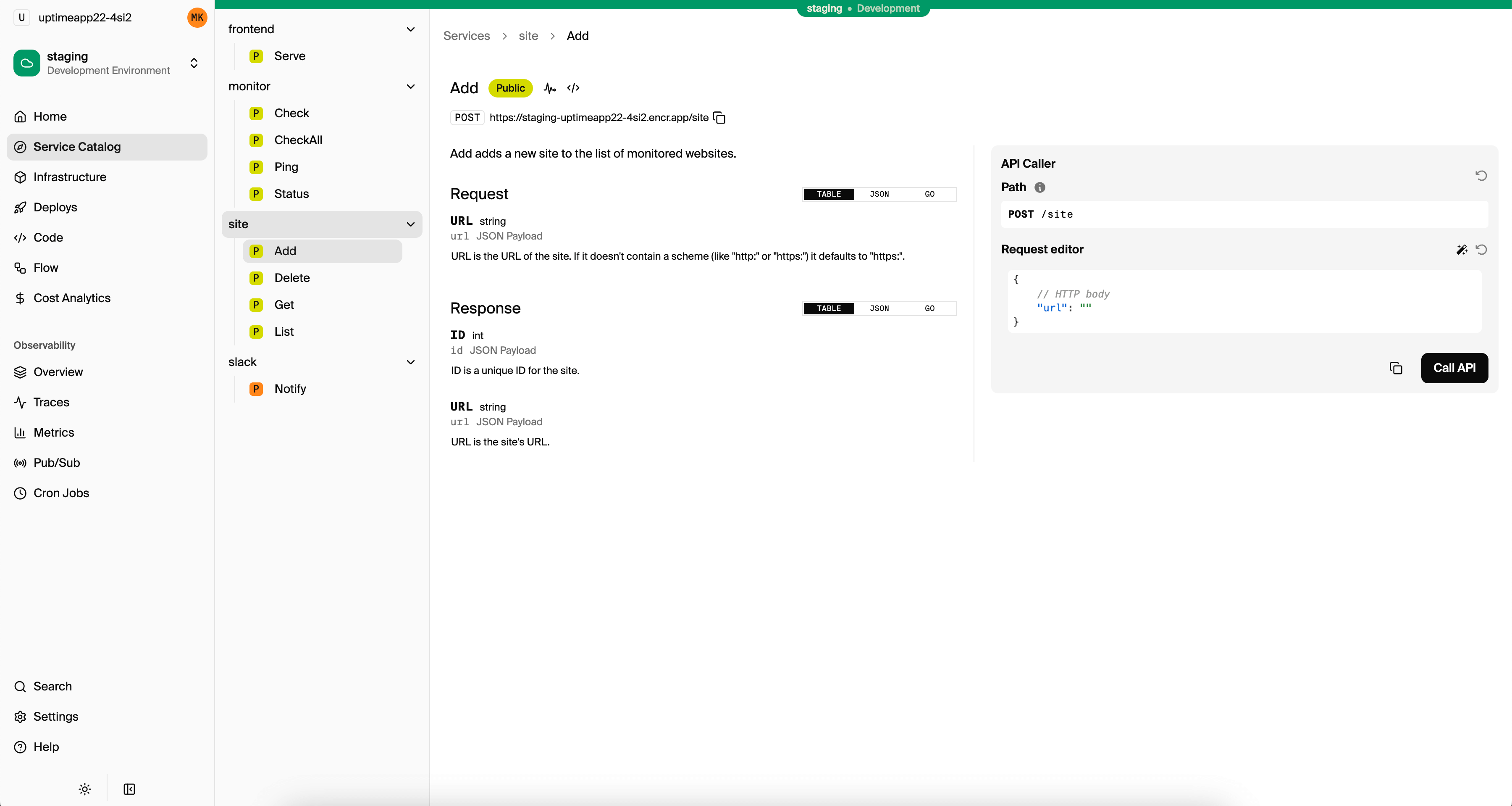
Verdict: Encore makes microservices feel like a monolith to develop, with type-safe calls and zero configuration for service discovery. NestJS requires manual setup for service communication, IAM policies, and observability. For distributed systems, Encore significantly reduces complexity.
Observability
Production systems need observability. The difference here is significant.
NestJS
NestJS requires manual observability setup:
import { Injectable, NestInterceptor, ExecutionContext, CallHandler } from '@nestjs/common';
import { Observable } from 'rxjs';
import { tap } from 'rxjs/operators';
import { trace } from '@opentelemetry/api';

@Injectable()
export class TracingInterceptor implements NestInterceptor {
  intercept(context: ExecutionContext, next: CallHandler): Observable<any> {
    const tracer = trace.getTracer('my-service');
    const span = tracer.startSpan('request');

    return next.handle().pipe(
      tap({
        next: () => span.end(),
        error: (err) => {
          span.recordException(err);
          span.end();
        },
      }),
    );
  }
}
You configure OpenTelemetry, set up exporters, create interceptors, and wire everything together. You also need to configure log aggregation, metrics collection, and dashboard setup. This is standard for most frameworks, but it represents significant initial investment.
Encore.ts
users/users.tsimport { api } from "encore.dev/api";
import log from "encore.dev/log";

export const getUser = api(
  { method: "GET", path: "/users/:id", expose: true },
  async ({ id }: { id: string }) => {
    log.info("fetching user", { userId: id });
    // Every database query, API call, and service call is traced automatically
    return { id, name: "John" };
  }
);
Distributed tracing works out of the box. Database queries, service calls, and Pub/Sub messages all appear in traces automatically. You get a local development dashboard with tracing included. For production deployments with the Encore platform, you also get metrics, alerting, and integrations with Grafana and Datadog.
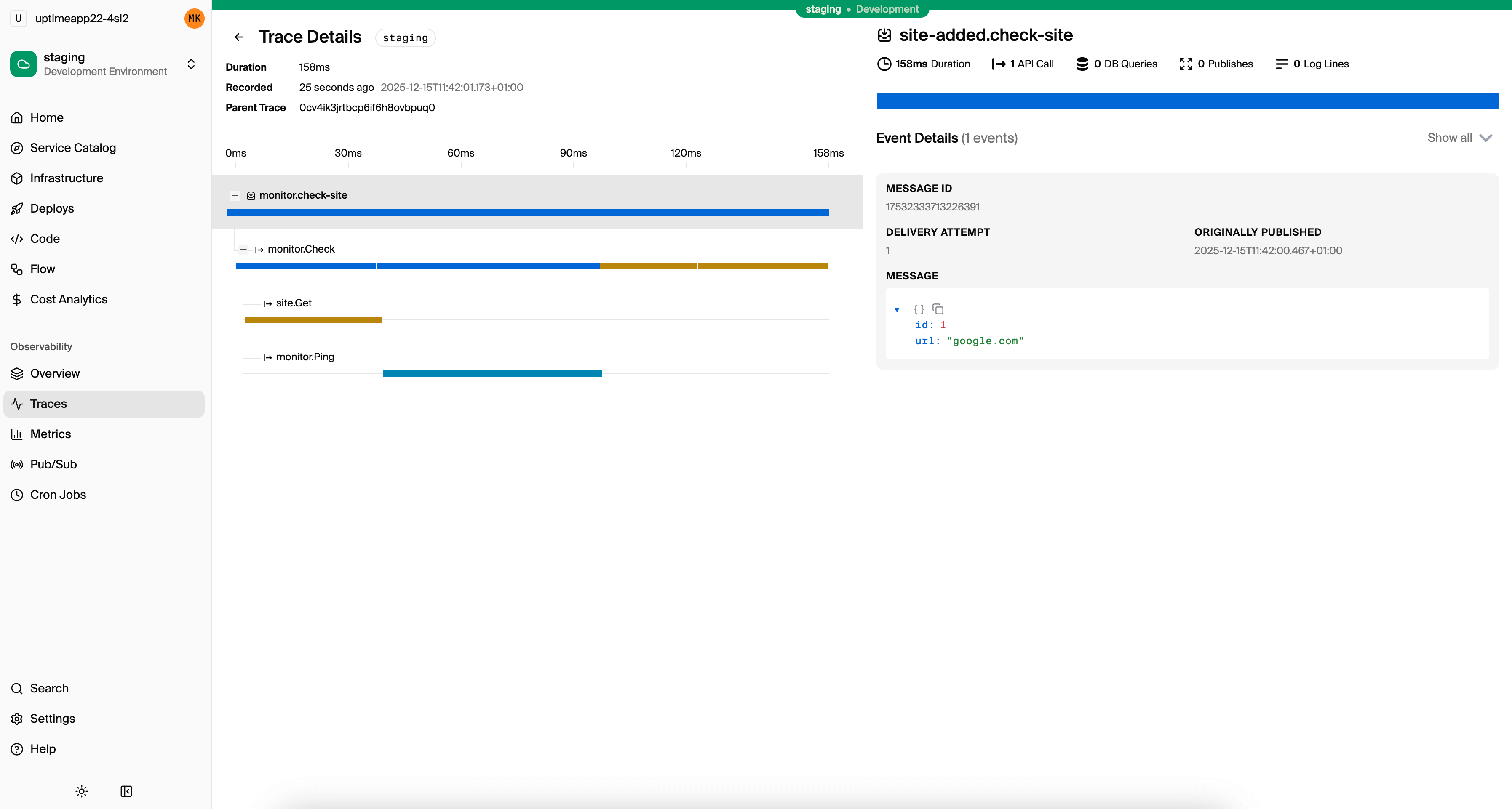
Verdict: Encore provides built-in observability without configuration, saving days of setup. NestJS requires significant investment but offers more customization options for teams with specific observability requirements.
Learning Curve
NestJS
NestJS has a steep learning curve. You need to understand:
- Decorators and metadata
- Dependency injection and providers
- Modules and module organization
- Guards, interceptors, pipes, and filters
- Exception filters and error handling
- Various transport layers for microservices
The official documentation is comprehensive, but there's a lot to learn before you're productive. Teams with Angular experience will ramp up faster.
Encore.ts
Encore has a gentler learning curve. The core concepts are:
- APIs defined with the
api()function - Services as folders with
encore.service.ts - Infrastructure primitives (databases, Pub/Sub, cron) as TypeScript objects
If you know TypeScript, you can be productive quickly. The patterns scale as you need them, and the documentation focuses on practical examples.
Verdict: NestJS requires more upfront investment but provides extensive architectural patterns. Encore is faster to learn and lets you ship quickly while maintaining production-quality standards.
AI Code Generation
TypeScript's backend ecosystem has more competing options at every layer than almost any other language, and AI agents will use a different combination of ORM, validation, and auth approach on every prompt. The problem isn't that there's no structure available, it's that there are too many valid structures to choose from.
NestJS
NestJS has more structure than most TypeScript frameworks. The controller/service/module pattern provides a consistent scaffold, so an agent asked to "add an order creation endpoint" will reliably generate a controller, a service class, and a module registration. Where things diverge is the infrastructure layer: the agent still has to decide which ORM to use (TypeORM, Prisma, MikroORM), how to configure it (synchronize vs migrations, connection settings), which config approach to follow (ConfigModule, environment variables, custom providers), and how to implement auth guards. NestJS solves the application structure problem, but the infrastructure decisions still vary between prompts.
// An agent asked to "add an order creation endpoint" will consistently generate:
// - An OrdersController with @Post() decorator
// - An OrdersService with @Injectable()
// - An OrdersModule wiring them together
//
// But the infrastructure decisions still vary:
// - TypeORM entity or Prisma model or MikroORM schema
// - ConfigModule.forRoot() or process.env directly
// - A custom AuthGuard or @nestjs/passport setup
// - Different DI token names and provider patterns
Encore.ts
With Encore, the project's API patterns, infrastructure declarations, and service structure are already defined. The agent reads the existing conventions and writes code that follows them. A prompt to "add an order creation endpoint" produces an api() function with typed request/response interfaces and a database call using the existing SQLDatabase declaration, not a new architecture.
orders/orders.ts// The agent sees existing patterns and follows them:
export const create = api(
  { expose: true, auth: true, method: "POST", path: "/orders" },
  async (req: CreateOrderRequest): Promise<Order> => {
    // Business logic only — the agent doesn't reinvent the structure
    const order = await db.queryRow<Order>`
      INSERT INTO orders (customer_id, total)
      VALUES (${req.customerId}, ${req.total})
      RETURNING id, customer_id as "customerId", total
    `;
    return order!;
  }
);
Encore also provides an MCP server and editor rules (encore llm-rules init) that give agents access to database schemas, distributed traces, and service architecture. This means agents can generate queries that match your actual tables, debug with real request data, and verify their own work. Read more in How AI Agents Want to Write TypeScript.
Verdict: NestJS provides consistent application structure through its controller/service/module pattern, which helps agents produce predictable scaffolding. But the infrastructure decisions (ORM, config, auth implementation) still vary between prompts. Encore gives agents both the application conventions and the infrastructure patterns to follow, plus live system context through MCP, which leads to more consistent, deployable code.
How to Choose
Start at the top and follow the first question you can answer with a yes:
Do you want infrastructure provisioned from your code, without building a DevOps team internally?
 EncoreInfrastructure automation in your own AWS or GCP accountEncoreInfrastructure automation in your own AWS or GCP account
Are you building several services that share databases, Pub/Sub, or cron jobs?
EncoreType-safe service calls and built-in tracingEncoreType-safe service calls and built-in tracingAre you building a GraphQL API and want first-class support?
 NestJSBuilt-in GraphQL moduleNestJSBuilt-in GraphQL module
Does your team have Angular experience and want formal DI, guards, and interceptors?
NestJSFamiliar Angular-style patternsNestJSFamiliar Angular-style patternsDo you need specific message transports like Kafka or RabbitMQ with full control?
NestJSPluggable microservice transportsNestJSPluggable microservice transportsDo you need high request throughput from a Node.js backend?
EncoreRust-based runtime with 9x the throughput of Express.jsEncoreRust-based runtime with 9x the throughput of Express.jsEncoreMinimal boilerplate with native TypeScript typesThe throughput figure comes from our performance benchmark.
When to Choose NestJS
NestJS makes sense when:
- Your team has Angular experience and wants familiar patterns
- You need formal dependency injection for testing and modularity
- You're building a GraphQL API and want first-class support
- You value extensive enterprise patterns like guards, interceptors, and filters
- You need specific message transports like Kafka or RabbitMQ with full control
When to Choose Encore.ts
Encore.ts makes sense when:
- You're building microservices or distributed systems and want type-safe service communication
- You want local infrastructure automation (databases and Pub/Sub without writing Docker Compose files)
- You want built-in observability without configuring OpenTelemetry
- You prefer minimal boilerplate and native TypeScript types
- You're building enterprise applications and want to move fast without sacrificing quality
- You want infrastructure-aware code that AI agents can generate and deploy (with guardrails)
- You want to deploy to your own AWS or GCP account without managing the infrastructure yourself, or self-host with Docker
Getting Started
The best way to decide is to try both:
- NestJS First Steps
- Encore.ts Quickstart
- Encore AI Integration for using Encore with AI coding agents
You might also find our guide to Best TypeScript Backend Frameworks helpful for understanding how both compare to other options, or our Express.js vs Encore.ts comparison if you're coming from Express.
Try Encore.ts
Run in your terminal to get started locally.
Have questions about choosing a framework? Join our Discord community where developers discuss architecture decisions daily.
Deploy to your cloud on AWS and Google Cloud
without managing infrastructure
Encore lets developers and agents define application infrastructure directly in code, then automatically provisions it from local development to production in your AWS or GCP account.
