Express.js vs Encore.ts in 2026
Comparing the most popular Node.js framework with a modern alternative

Express.js has been the go-to Node.js framework for over a decade. It's minimal, flexible, and battle-tested. But the backend landscape has evolved, and newer frameworks like Encore.ts take a different approach, trading some flexibility for built-in type safety and infrastructure automation.
So which one should you use? Let's break it down with real code examples and honest tradeoffs.
Quick Comparison
The Basics: Defining an API
Let's start with something simple: a REST endpoint that returns a greeting.
Express.js
import express from 'express';

const app = express();
app.use(express.json());

app.get('/hello/:name', (req, res) => {
  res.json({ message: `Hello, ${req.params.name}!` });
});

app.listen(3000, () => {
  console.log('Server running on port 3000');
});
Express gives you the building blocks. You wire up middleware, define routes, and start the server yourself.
Encore.ts
hello/hello.tsimport { api } from "encore.dev/api";

interface HelloResponse {
  message: string;
}

export const hello = api(
  { method: "GET", path: "/hello/:name", expose: true },
  async ({ name }: { name: string }): Promise<HelloResponse> => {
    return { message: `Hello, ${name}!` };
  }
);
Encore uses a declarative approach. You define the endpoint with its types, and Encore handles the server, routing, and request validation.
Verdict: Encore is more concise with automatic type validation. Express requires more boilerplate and manual setup.
Type Safety and Validation
This is where the approaches diverge significantly.
Express.js
Express doesn't validate requests by default. You typically add a validation library:
import express from 'express';
import { z } from 'zod';

const app = express();
app.use(express.json());

const CreateUserSchema = z.object({
  email: z.string().email(),
  name: z.string().min(1),
});

app.post('/users', (req, res) => {
  const result = CreateUserSchema.safeParse(req.body);

  if (!result.success) {
    return res.status(400).json({ error: result.error });
  }

  const { email, name } = result.data;
  // Create user...
  res.json({ id: 1, email, name });
});
You need to:
- Choose a validation library (Zod, Joi, class-validator, etc.)
- Define schemas separately from your types
- Manually validate in each handler
- Keep schemas and TypeScript types in sync
Encore.ts
users/users.tsimport { api } from "encore.dev/api";

interface CreateUserRequest {
  email: string;
  name: string;
}

interface User {
  id: number;
  email: string;
  name: string;
}

export const createUser = api(
  { method: "POST", path: "/users", expose: true },
  async (req: CreateUserRequest): Promise<User> => {
    // req is already validated and typed
    return { id: 1, email: req.email, name: req.name };
  }
);
Encore validates requests automatically based on your TypeScript types. Invalid requests get rejected before your handler runs. No extra libraries, no manual validation. You can also use built-in validation rules for more complex constraints like min/max values and string formats.
Verdict: If type safety and automatic validation matter to you, Encore has a clear advantage. Express gives you flexibility to choose your validation approach.
Database Integration
Express.js
Express doesn't include database support. You pick an ORM or query builder:
import express from 'express';
import { Pool } from 'pg';

const pool = new Pool({
  connectionString: process.env.DATABASE_URL,
});

const app = express();

app.get('/users/:id', async (req, res) => {
  try {
    const result = await pool.query(
      'SELECT id, email, name FROM users WHERE id = $1',
      [req.params.id]
    );

    if (result.rows.length === 0) {
      return res.status(404).json({ error: 'User not found' });
    }

    res.json(result.rows[0]);
  } catch (error) {
    res.status(500).json({ error: 'Database error' });
  }
});
You also need to:
- Set up the database yourself (locally and in production)
- Manage connection strings and secrets
- Handle migrations separately
- Configure connection pooling
Encore.ts
users/users.tsimport { api } from "encore.dev/api";
import { SQLDatabase } from "encore.dev/storage/sqldb";

const db = new SQLDatabase("users", {
  migrations: "./migrations",
});

interface User {
  id: number;
  email: string;
  name: string;
}

export const getUser = api(
  { method: "GET", path: "/users/:id", expose: true },
  async ({ id }: { id: number }): Promise<User> => {
    const user = await db.queryRow<User>`
      SELECT id, email, name FROM users WHERE id = ${id}
    `;
    if (!user) {
      throw new Error("User not found");
    }
    return user;
  }
);
Encore automatically provisions PostgreSQL databases locally during development (no Docker configuration required) and runs migrations on startup. Connection pooling is handled for you.
You can also use any database or ORM you prefer. Encore's database primitives provide automation for PostgreSQL, but you're free to connect to MySQL, MongoDB, or any other database using standard drivers. See the database documentation for details.
Verdict: Both frameworks work with any database. Encore provides additional automation for PostgreSQL that reduces setup time, especially in local development.
Middleware and Authentication
Express.js
Express uses a middleware pattern for authentication:
import express from 'express';
import jwt from 'jsonwebtoken';

const app = express();

// Middleware for authentication
const authenticate = (req, res, next) => {
  const token = req.headers.authorization?.replace('Bearer ', '');

  if (!token) {
    return res.status(401).json({ error: 'No token provided' });
  }

  try {
    const decoded = jwt.verify(token, process.env.JWT_SECRET);
    req.user = decoded;
    next();
  } catch (error) {
    res.status(401).json({ error: 'Invalid token' });
  }
};

// Apply to specific routes
app.get('/profile', authenticate, (req, res) => {
  res.json({ userId: req.user.id });
});

// Or apply globally
app.use('/api', authenticate);
You can use any authentication strategy, but you handle the implementation yourself.
Encore.ts
Encore supports general-purpose middleware for cross-cutting concerns, plus a specialized auth handler for authentication:
profile/profile.tsimport { api, Gateway, middleware } from "encore.dev/api";
import { authHandler } from "encore.dev/auth";
import { Header } from "encore.dev/api";

// General middleware for logging, rate limiting, etc.
const loggingMiddleware = middleware({}, async (req, next) => {
  const start = Date.now();
  const resp = await next(req);
  console.log(`Request took ${Date.now() - start}ms`);
  return resp;
});

// Auth handler for authentication
interface AuthParams {
  authorization: Header<"Authorization">;
}

interface AuthData {
  userId: string;
}

const auth = authHandler<AuthParams, AuthData>(async (params) => {
  const token = params.authorization.replace("Bearer ", "");
  const userId = await validateToken(token);
  return { userId };
});

export const gateway = new Gateway({ authHandler: auth });

// Protected endpoint - just add auth: true
export const getProfile = api(
  { method: "GET", path: "/profile", auth: true, expose: true },
  async (): Promise<{ userId: string }> => {
    const { userId } = getAuthData()!;
    return { userId };
  }
);
Encore's middleware works similarly to Express middleware for general use cases. The auth handler is a specialized middleware that centralizes authentication at the gateway level. Endpoints opt-in with auth: true, and the auth data is type-safe and available throughout your request.
Verdict: Encore provides structured authentication with type-safe auth data propagation across services. Express requires manual implementation.
Observability
This is where Encore really shines compared to Express.
Express.js
Getting production-ready observability requires significant setup:
import express from 'express';
import { trace } from '@opentelemetry/api';
import promClient from 'prom-client';

const app = express();
const tracer = trace.getTracer('my-service');

// Request logging middleware
app.use((req, res, next) => {
  const start = Date.now();
  res.on('finish', () => {
    console.log(`${req.method} ${req.path} ${res.statusCode} ${Date.now() - start}ms`);
  });
  next();
});

// Manual tracing
app.get('/users/:id', async (req, res) => {
  const span = tracer.startSpan('getUser');
  try {
    // Your logic here
    span.end();
    res.json({ /* ... */ });
  } catch (error) {
    span.recordException(error);
    span.end();
    res.status(500).json({ error: 'Internal error' });
  }
});
You need to configure:
- Logging infrastructure
- OpenTelemetry or similar tracing
- Prometheus/metrics collection
- Log aggregation (ELK, Datadog, etc.)
- Dashboard setup
Encore.ts
users/users.tsimport { api } from "encore.dev/api";
import log from "encore.dev/log";

export const getUser = api(
  { method: "GET", path: "/users/:id", expose: true },
  async ({ id }: { id: number }) => {
    log.info("fetching user", { userId: id });
    // Every database query, API call, and service call
    // is automatically traced
    return { /* ... */ };
  }
);
That's it. Every request is traced end-to-end. Database queries show up in traces. Service-to-service calls are correlated. You get a local development dashboard with tracing out of the box. For production deployments with the Encore platform, you also get metrics, alerting, and integrations with Grafana and Datadog.
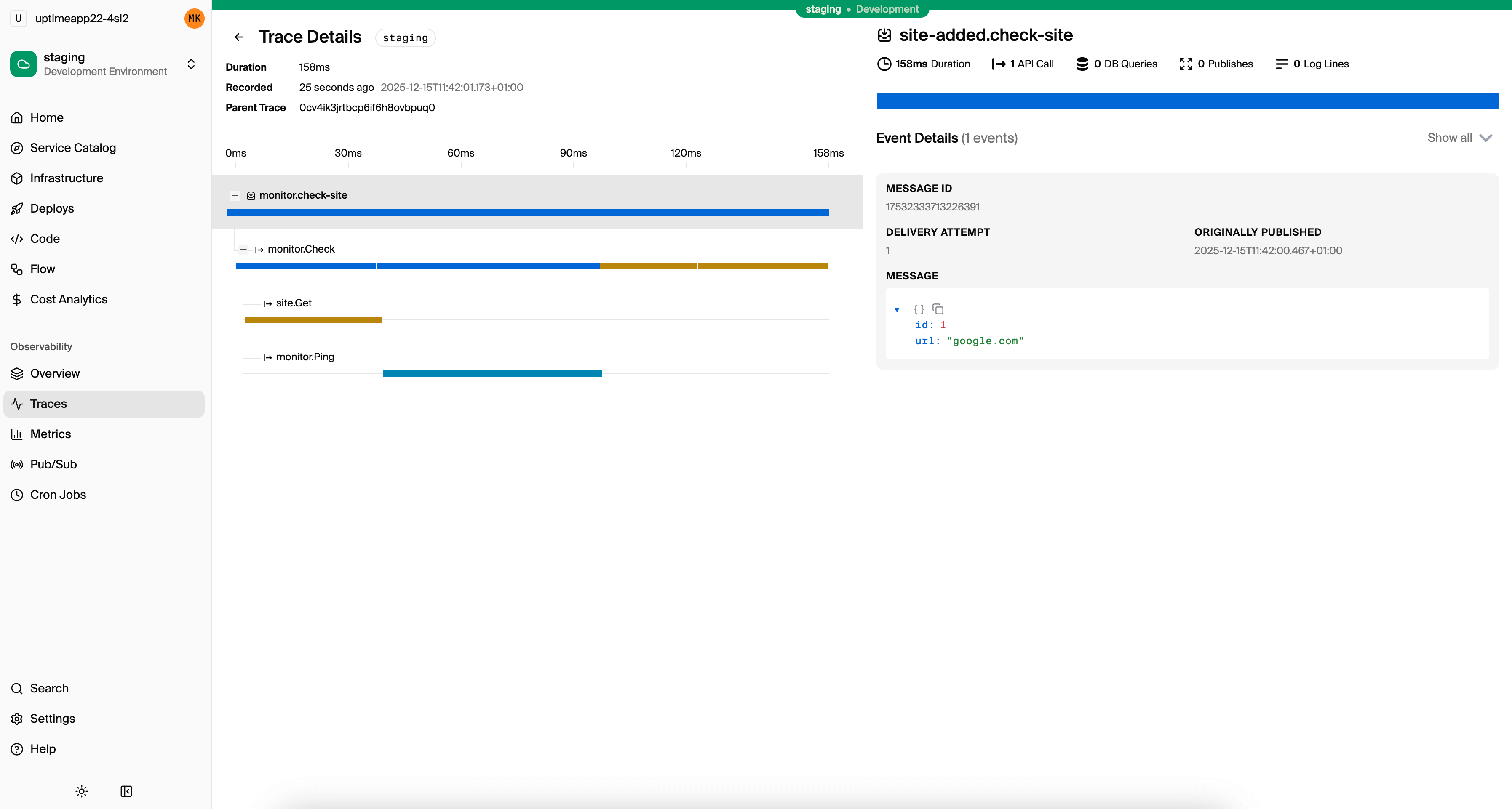
Verdict: If observability is important (and it should be), Encore saves you days or weeks of setup. Express gives you full control but requires significant investment.
Microservices and Service Communication
Building distributed systems is where the approaches differ most significantly.
Express.js
Building microservices with Express means setting up service discovery, inter-service communication, and distributed tracing yourself:
// users-service/index.ts
import express from 'express';
const app = express();

app.get('/users/:id', async (req, res) => {
  // ...
});

app.listen(3001);

// orders-service/index.ts
import express from 'express';
import axios from 'axios';

const app = express();

app.post('/orders', async (req, res) => {
  // Call users service - you manage the URL
  const user = await axios.get(
    `${process.env.USERS_SERVICE_URL}/users/${req.body.userId}`
  );
  // ...
});

app.listen(3002);
You handle service URLs, network errors, retries, and distributed tracing correlation.
Encore.ts
orders/orders.ts// users/encore.service.ts
import { Service } from "encore.dev/service";
export default new Service("users");

// users/api.ts
export const get = api(/* ... */);

// orders/api.ts
import { users } from "~encore/clients";

export const create = api(
  { method: "POST", path: "/orders", expose: true },
  async (req: CreateOrderRequest) => {
    // Type-safe call, automatic tracing, no URL management
    const user = await users.get({ id: req.userId });
    // ...
  }
);
Service calls look like function calls. Encore handles service discovery, generates type-safe clients, and correlates distributed traces automatically. You get a service catalog showing your architecture, API documentation, and how services communicate.
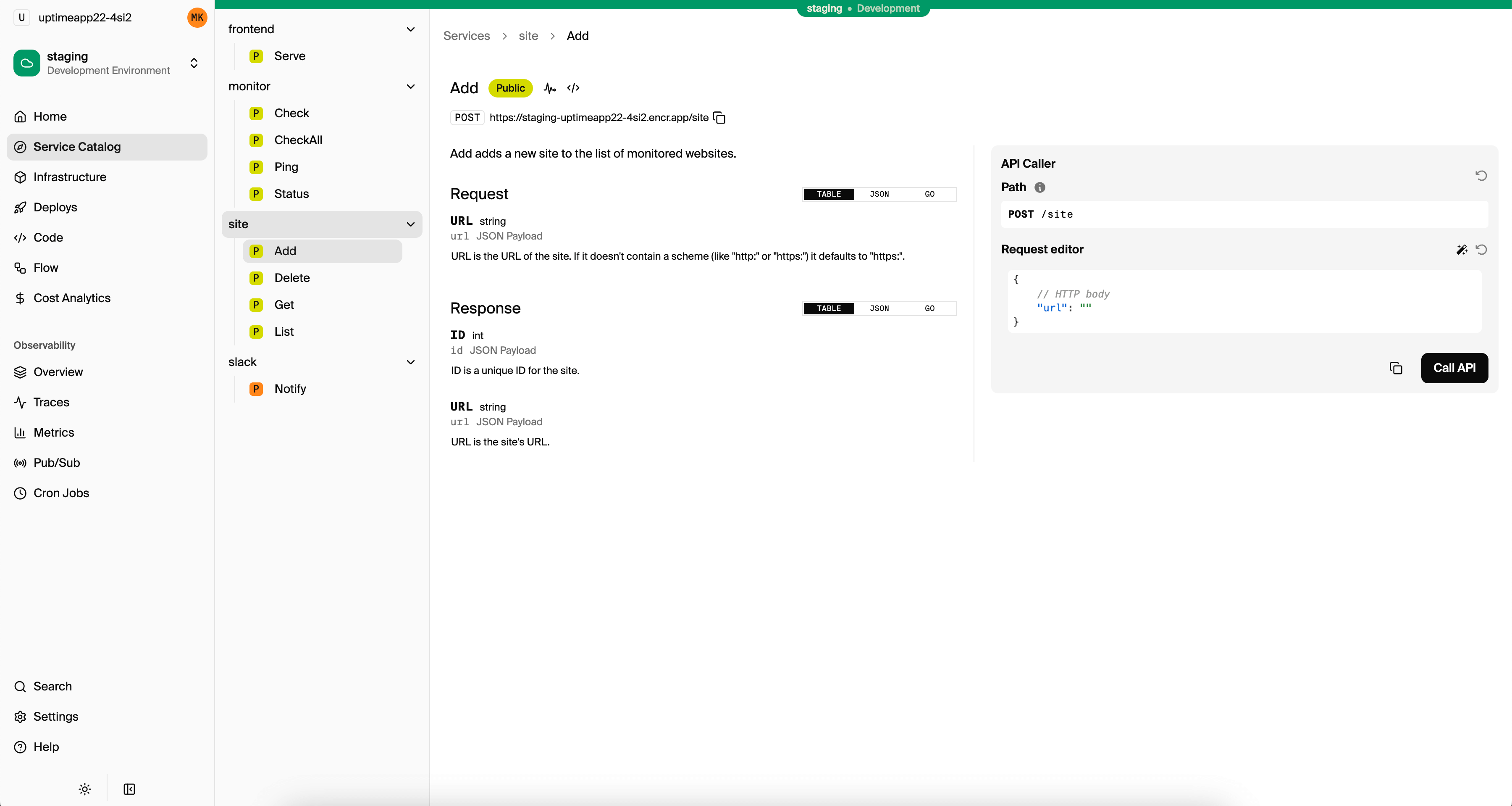
Verdict: If you're building microservices or distributed systems, Encore removes significant complexity with type-safe service communication and automatic service discovery. Express works but requires more infrastructure setup.
AI Code Generation
TypeScript's backend ecosystem has more competing options at every layer than almost any other language, and AI agents will use a different combination of framework, ORM, validation library, and auth approach on every prompt. The problem isn't that there's no structure available, it's that there are too many valid structures to choose from.
Express.js
Express is minimal by design, which means the agent has to fill in every layer beyond routing: validation (Zod, Joi, or manual checks), database access (Prisma, Drizzle, Knex, or raw pg), authentication (Passport, custom JWT, session-based), project structure (controllers, services, flat files), and config management. Three prompts produce three different stacks, all of them valid Express code, none of them consistent with each other.
// An agent asked to "add an order creation endpoint" might generate:
// - Express with Zod validation, or Joi, or manual checks
// - A Prisma call, a Drizzle query, or a raw pg Pool connection
// - Custom error handling middleware or inline try/catch
// - Passport auth or a hand-rolled JWT check
// - A different project structure each time
// All of which varies between prompts
Encore.ts
With Encore, the project's API patterns, infrastructure declarations, and service structure are already defined. The agent reads the existing conventions and writes code that follows them. A prompt to "add an order creation endpoint" produces an api() function with typed request/response interfaces and a database call using the existing SQLDatabase declaration, not a new architecture.
orders/orders.ts// The agent sees existing patterns and follows them:
export const create = api(
  { expose: true, auth: true, method: "POST", path: "/orders" },
  async (req: CreateOrderRequest): Promise<Order> => {
    // Business logic only — the agent doesn't reinvent the structure
    const order = await db.queryRow<Order>`
      INSERT INTO orders (customer_id, total)
      VALUES (${req.customerId}, ${req.total})
      RETURNING id, customer_id as "customerId", total
    `;
    return order!;
  }
);
Encore also provides an MCP server and editor rules (encore llm-rules init) that give agents access to database schemas, distributed traces, and service architecture. This means agents can generate queries that match your actual tables, debug with real request data, and verify their own work. Read more in How AI Agents Want to Write TypeScript.
Verdict: Express leaves every infrastructure decision to the agent, which means the output varies across prompts and developers. Encore gives agents a single set of conventions for APIs, databases, and infrastructure, plus live system context through MCP, which produces consistent, deployable code.
How to Choose
Start at the top and follow the first question you can answer with a yes:
Do you want infrastructure provisioned from your code, without building a DevOps team internally?
 EncoreInfrastructure automation in your own AWS or GCP accountEncoreInfrastructure automation in your own AWS or GCP account
Are you building several services that share databases, Pub/Sub, or cron jobs?
EncoreType-safe service calls and built-in tracingEncoreType-safe service calls and built-in tracingDo you need high request throughput from a Node.js backend?
EncoreRust-based runtime with 9x the throughput of Express.jsEncoreRust-based runtime with 9x the throughput of Express.jsAre you building a simple, single-service API on infrastructure and pipelines you already run?
 Express.jsMinimal and flexible, with the largest middleware ecosystemExpress.jsMinimal and flexible, with the largest middleware ecosystemEncoreNew backends: types as validation and built-in observability
Encore's Rust-based runtime handles requests and validation outside the Node.js event loop, which in our benchmarks gives it 9x the throughput of Express.js.
Requests/sec
Encore is open source with 12,000+ GitHub stars. It provisions infrastructure in your own AWS or GCP account, or you can build Docker images and deploy anywhere.
Migrating from Express to Encore
If you're considering a migration, the approaches are different enough that it's not a simple port. However, your business logic can often be preserved. Encore provides a migration guide that walks through the process step by step.
The key differences to adapt:
- Replace Express routes with Encore API definitions
- Move validation from Zod/Joi to TypeScript types
- Replace manual database setup with Encore's SQLDatabase
- Remove OpenTelemetry configuration (it's automatic)
Getting Started
The best way to decide is to try both with a small project:
- Express.js Getting Started
- Encore.ts Quickstart
- Encore AI Integration for using Encore with AI coding agents
You can also check out the Encore.ts tutorial to build a complete REST API with a database.
Or install the CLI and create a starter app:
Run in your terminal to get started locally.
Have questions about choosing a framework? Join our Discord community where developers discuss architecture decisions daily.
Deploy to your cloud on AWS and Google Cloud
without managing infrastructure
Encore lets developers and agents define application infrastructure directly in code, then automatically provisions it from local development to production in your AWS or GCP account.
