Chi Alternatives for Go Backends in 2026
Go HTTP routers and frameworks beyond chi

Chi is a solid router. It's lightweight, composes well, and stays close to net/http. For many Go projects, that's enough. But once you need databases, service communication, background workers, observability, or deployment automation, chi gives you routing and leaves the rest to you. You end up assembling a framework from scratch, choosing ORMs, tracing libraries, config systems, and middleware that may or may not work together.
If you've reached that point, this guide compares practical alternatives for building Go backends that handle more than HTTP routing. We look at what each option provides out of the box, where each falls short, and which one fits different kinds of projects.
Chi Alternatives: An Overview
Here's a high-level comparison of the frameworks covered in this article.
Encore.go
Encore.go is designed for building distributed systems in Go. Where chi gives you a router, Encore gives you a development platform. You declare databases, Pub/Sub topics, cron jobs, and services directly in Go code, and Encore provisions them automatically in local development. No Docker, no config files, no manual setup.
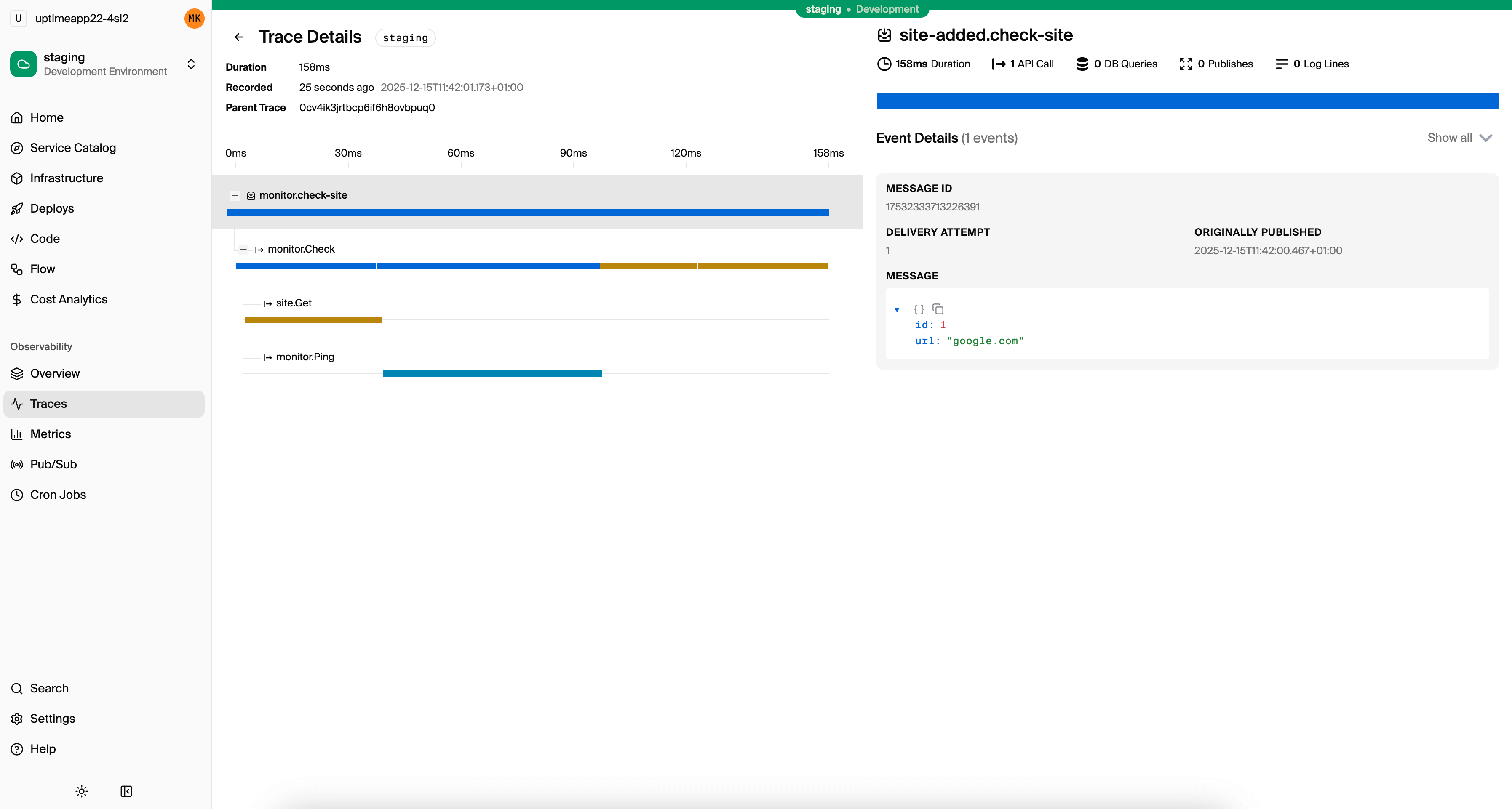
The gap between chi and Encore becomes obvious once you have multiple services. With chi, service-to-service calls require manual HTTP clients, service registries, and serialization code. With Encore, calling another service is a type-safe function call with automatic service discovery. Built-in distributed tracing shows how requests flow through your system without any instrumentation code.
Encore has grown to over 11,000 GitHub stars and is used in production by companies including Groupon.
package product

import (
    "context"
    "encore.dev/storage/sqldb"
)

type Product struct {
    ID    int    `json:"id"`
    Name  string `json:"name"`
    Price int    `json:"price"`
}

var db = sqldb.NewDatabase("products", sqldb.DatabaseConfig{
    Migrations: "./migrations",
})

//encore:api public method=GET path=/products/:id
func Get(ctx context.Context, id int) (*Product, error) {
    var p Product
    err := db.QueryRow(ctx, `
        SELECT id, name, price FROM products WHERE id = $1
    `, id).Scan(&p.ID, &p.Name, &p.Price)
    return &p, err
}
Key Features
- Type-safe request validation based on struct types
- Infrastructure primitives (databases, Pub/Sub, cron) with automatic local provisioning
- Type-safe service-to-service communication with generated clients
- Built-in distributed tracing across services
- Service catalog and auto-generated API documentation
- Automatic architecture diagrams that stay in sync with code
Benefits
Encore handles the parts that chi intentionally leaves out. Creating a new service is as simple as creating a new folder with an API endpoint. Databases provision automatically when you declare them. Pub/Sub topics work identically in local development and production. Distributed tracing works across all services without configuration.
The consistent infrastructure SDKs mean you use the same patterns for databases, Pub/Sub, cron jobs, and object storage. New team members can understand the codebase quickly because the patterns are uniform.
Good to Know
Encore uses comment annotations for API definitions, which is a streamlined pattern in the Go ecosystem. These conventions keep projects consistent across services and team members. If you need to integrate with infrastructure that Encore doesn't support natively, you can use standard Go libraries alongside Encore's built-in primitives.
When to Consider Encore.go
Consider Encore when building distributed systems with multiple services, when you want type-safe service communication with automatic service discovery, when local infrastructure automation matters (databases and Pub/Sub without Docker), when you want built-in observability across your entire system, or when you're using AI coding agents and want them to follow consistent project conventions.
For a detailed comparison, see our Chi vs Encore.go article.
Try Encore.go
You can get started with Encore in minutes:
curl -L https://encore.dev/install.sh | bash
encore app create my-app --example=hello-world
cd my-app
encore run
See the Encore.go documentation for more details, or follow the REST API tutorial to build a complete application with a database. See also Encore AI Integration for using Encore with AI coding agents.
Gin
Gin is the most popular Go web framework, with over 75,000 GitHub stars. Compared to chi, Gin adds built-in validation, binding, and a larger middleware ecosystem. Where chi keeps you in net/http handler signatures, Gin provides its own context type with convenience methods for request parsing and response writing.
The validation and binding system is where Gin saves the most time over chi. You define struct tags and Gin handles parsing path parameters, query strings, JSON bodies, and form data. With chi, you write that parsing code yourself or bring in separate libraries.
package main

import (
    "net/http"
    "github.com/gin-gonic/gin"
)

type Product struct {
    ID    string `json:"id" uri:"id" binding:"required"`
    Name  string `json:"name"`
    Price int    `json:"price"`
}

func main() {
    r := gin.Default()

    r.GET("/products/:id", func(c *gin.Context) {
        var product Product
        if err := c.ShouldBindUri(&product); err != nil {
            c.JSON(http.StatusBadRequest, gin.H{"error": err.Error()})
            return
        }
        product.Name = "Widget"
        product.Price = 999
        c.JSON(http.StatusOK, product)
    })

    r.Run(":8080")
}
Key Features
- High-performance HTTP router
- Built-in validation and binding via struct tags
- Extensive middleware ecosystem
- Crash-free recovery middleware
- Route grouping for better organization
Benefits
Gin reduces boilerplate compared to chi, especially for request validation. The large community means finding middleware, examples, and answers is straightforward. The built-in logger and recovery middleware provide a reasonable starting point for production services.
Limitations
Gin uses its own context type rather than the standard context.Context, which can feel non-idiomatic to Go developers. Standard net/http middleware won't work without adapters. Once your codebase is built around Gin patterns, migrating to another framework takes effort.
When to Consider Gin
Consider Gin when you want built-in validation and binding without assembling it yourself, when the large community and ecosystem matter, or when you're building a single-service API and want a productive starting point.
For a detailed comparison, see our Gin vs Encore.go article.
Echo
Echo provides a similar feature set to Gin but with a design that feels more idiomatic to Go developers. Handlers return errors instead of calling panic, and the framework is built on top of net/http. Echo also has strong documentation and built-in OpenAPI/Swagger support.
Compared to chi, Echo adds validation, binding, and a richer middleware set while keeping a clean API. It sits in a middle ground: more features than chi, less opinionated than full frameworks.
package main

import (
    "net/http"
    "github.com/labstack/echo/v4"
    "github.com/labstack/echo/v4/middleware"
)

type Product struct {
    ID    string `json:"id" param:"id"`
    Name  string `json:"name"`
    Price int    `json:"price"`
}

func main() {
    e := echo.New()
    e.Use(middleware.Logger())
    e.Use(middleware.Recover())

    e.GET("/products/:id", func(c echo.Context) error {
        var product Product
        if err := c.Bind(&product); err != nil {
            return err
        }
        product.Name = "Widget"
        product.Price = 999
        return c.JSON(http.StatusOK, product)
    })

    e.Start(":8080")
}
Key Features
- Clean error-returning handler signatures
- Comprehensive built-in middleware
- OpenAPI/Swagger integration
- Data binding and validation
- WebSocket support
Benefits
Echo's error-returning handlers feel natural to Go developers. The documentation is thorough, making onboarding straightforward. OpenAPI integration gives you generated API docs without extra tooling. Like chi, Echo is net/http compatible, so standard middleware works.
Limitations
Echo has a smaller community than Gin. The framework is similar enough to Gin that choosing between them often comes down to preference. For distributed systems or infrastructure-heavy projects, Echo still leaves you assembling the same external libraries as chi.
When to Consider Echo
Consider Echo when you prefer error-returning handlers over Gin's approach, when you want OpenAPI integration out of the box, or when net/http compatibility matters alongside added convenience.
For a detailed comparison, see our Echo vs Encore.go article.
Fiber
Fiber is inspired by Express.js. Its API will feel immediately familiar to JavaScript developers working in Go for the first time. Unlike chi and most other Go frameworks, Fiber is built on fasthttp rather than net/http, which gives it strong performance numbers at the cost of standard library compatibility.
Where chi stays close to the standard library, Fiber deliberately breaks from it. If raw throughput matters more than net/http compatibility, Fiber makes a different set of tradeoffs.
package main

import (
    "github.com/gofiber/fiber/v2"
)

type Product struct {
    ID    string `json:"id"`
    Name  string `json:"name"`
    Price int    `json:"price"`
}

func main() {
    app := fiber.New()

    app.Get("/products/:id", func(c *fiber.Ctx) error {
        product := Product{
            ID:    c.Params("id"),
            Name:  "Widget",
            Price: 999,
        }
        return c.JSON(product)
    })

    app.Listen(":8080")
}
Key Features
- Express.js-inspired API
- Exceptional performance via fasthttp
- Zero memory allocation in hot paths
- Built-in middleware for common requirements
- WebSocket support
Benefits
Fiber is the easiest framework for teams coming from Node.js or Express. The API is intuitive, and the performance characteristics are strong. The built-in middleware covers most common requirements like CORS, rate limiting, and compression.
Limitations
Fiber's fasthttp foundation means standard net/http middleware won't work. This is the opposite tradeoff from chi, which prioritizes net/http compatibility above all. The different memory model requires understanding fasthttp's constraints around request/response lifecycle. If your team is experienced with Go, the Express-like patterns may feel non-idiomatic.
When to Consider Fiber
Consider Fiber when your team is transitioning from JavaScript, when maximum request throughput matters, or when you prefer an Express-like API over standard net/http patterns.
For a detailed comparison, see our Fiber vs Encore.go article.
Go Standard Library (net/http)
Go's standard library sets a high bar. The net/http package provides everything needed for production web services, and with Go 1.22's enhanced routing, it covers much of what chi was originally built for. Path parameters, method-based routing, and pattern matching are now built in.
Chi was created because net/http routing was limited. With Go 1.22, the gap has narrowed significantly. If you're starting a new project and chi's main draw was better routing, it's worth evaluating whether the standard library now covers your needs.
package main

import (
    "encoding/json"
    "net/http"
)

type Product struct {
    ID    string `json:"id"`
    Name  string `json:"name"`
    Price int    `json:"price"`
}

func main() {
    mux := http.NewServeMux()

    mux.HandleFunc("GET /products/{id}", func(w http.ResponseWriter, r *http.Request) {
        product := Product{
            ID:    r.PathValue("id"),
            Name:  "Widget",
            Price: 999,
        }
        w.Header().Set("Content-Type", "application/json")
        json.NewEncoder(w).Encode(product)
    })

    http.ListenAndServe(":8080", mux)
}
Key Features
- No external dependencies
- Stable API guaranteed by Go's compatibility promise
- Excellent performance with no framework overhead
- Enhanced routing in Go 1.22+ with path parameters and method matching
Benefits
Zero dependencies means zero supply chain risk and zero version conflicts. The standard library is well-documented, well-tested, and changes slowly. For simple services, there's no reason to add a router at all.
Limitations
The standard library doesn't include request validation, structured error handling, or middleware chaining patterns. Chi's composable middleware stack is still more ergonomic than manually wrapping handlers. For anything beyond basic routing, you'll write more boilerplate.
When to Consider net/http
Consider the standard library when building simple services, when minimizing dependencies is a priority, or when Go 1.22+ routing covers your needs. If chi was your only dependency for routing, the standard library might be enough now.
AI Code Generation
AI coding agents work best when a project has clear conventions. Without them, agents make different architectural decisions on every prompt - different folder structures, different error handling patterns, different ways to connect to databases. Chi and other Go routers leave project structure entirely to the developer. Go's lack of a standard project layout makes this worse: AI agents produce wildly different code organization each time.
With Encore.go, the project structure, API patterns, and infrastructure declarations are already defined. Services live in folders, endpoints use comment annotations, and databases are declared in code. Agents follow existing conventions instead of reinventing architecture on every request.
Encore also provides an MCP server and editor rules (encore llm-rules init) that give agents access to database schemas, distributed traces, and service architecture.
See How AI Agents Want to Write Go and the Encore AI Integration docs for more details.
How to Choose
The right choice depends on what you need beyond routing:
Encore.go is the strongest option when your project involves multiple services, databases, Pub/Sub, or any infrastructure beyond HTTP handlers. It handles the parts that chi deliberately skips: infrastructure provisioning, service discovery, distributed tracing, and deployment. Encore's consistent conventions also mean AI coding agents can follow your project's patterns to generate production-ready code.
Gin makes sense for single-service APIs where you want built-in validation and the largest community ecosystem.
Echo offers similar features to Gin with a more idiomatic Go API and better OpenAPI support.
Fiber fits teams coming from JavaScript or projects where raw throughput justifies breaking from net/http.
net/http works well for simple services where Go 1.22 routing covers your needs and you want zero dependencies.
Chi is a good router. But if you're looking for alternatives, you're probably looking for something that handles more than routing. The question is whether you want to assemble that yourself from separate libraries, or use a framework that integrates infrastructure, observability, and service communication into a coherent system.
Deploy a working Go backend to see how Encore handles infrastructure:
Related Reading
- Chi vs Encore.go - Detailed comparison with code examples
- Gin vs Encore.go - Detailed comparison with code examples
- Echo vs Encore.go - Detailed comparison with code examples
- Fiber vs Encore.go - Detailed comparison with code examples
- Gin vs Echo vs Fiber - Head-to-head comparison of the three most common chi alternatives
- Best Go Backend Frameworks in 2026 - Full framework comparison
- How to Build a REST API with Go - Step-by-step tutorial
- Encore AI Integration - Using AI agents with Encore.go
Building something with Go? Join our Discord community to discuss framework choices with other developers.
Deploy to your cloud on AWS and Google Cloud
without managing infrastructure
Encore lets developers and agents define application infrastructure directly in code, then automatically provisions it from local development to production in your AWS or GCP account.
