Fiber vs Encore.go in 2026
Express-inspired performance versus infrastructure-from-code

Fiber is a Go web framework built on top of fasthttp and designed to feel familiar to developers coming from Express.js in Node.js. It prioritizes raw HTTP performance and a low learning curve for JavaScript developers making the switch to Go. Encore.go takes a fundamentally different approach, treating infrastructure as part of the application code and providing type-safe service communication and built-in observability for distributed systems.
Both are Go frameworks, but they solve different problems. Fiber is focused on fast HTTP handling for individual services, while Encore is focused on the full lifecycle of backend systems: databases, Pub/Sub, service communication, observability, and cloud deployment. This article compares them with real code so you can decide which fits your project.
Quick Comparison
The Basics: Defining an API
Let's start with a simple REST endpoint that returns a greeting.
Fiber

package main

import (
    "github.com/gofiber/fiber/v2"
)

type Response struct {
    Message string `json:"message"`
}

func main() {
    app := fiber.New()

    app.Get("/hello/:name", func(c *fiber.Ctx) error {
        name := c.Params("name")
        return c.JSON(Response{
            Message: "Hello, " + name + "!",
        })
    })

    app.Listen(":3000")
}
Fiber's API will feel immediately familiar if you've used Express. You create an app, define routes with HTTP methods, and use the context object to read parameters and send responses. The callback-style handler with c *fiber.Ctx mirrors Express's (req, res) pattern.
Encore.go

hello/hello.gopackage hello

import "context"

type Response struct {
    Message string `json:"message"`
}

//encore:api public method=GET path=/hello/:name
func Hello(ctx context.Context, name string) (*Response, error) {
    return &Response{Message: "Hello, " + name + "!"}, nil
}
Encore uses a comment annotation to mark a regular Go function as an API endpoint. Path parameters are extracted into typed function arguments automatically. There's no app setup, no router configuration, and no manual JSON serialization. Encore's tooling handles all of that at compile time.
Verdict: Fiber is more familiar to Express developers. Encore is more concise and handles routing, serialization, and validation without boilerplate. If you're coming from Node.js, Fiber's API will feel like home. If you want less ceremony, Encore removes most of the wiring code.
Performance
Performance is one of Fiber's primary selling points, so it's worth looking at this carefully.
Fiber
Fiber is built on fasthttp, which takes a different approach from Go's standard net/http package. Instead of allocating a new goroutine and request object for every incoming request, fasthttp reuses objects from a pool, reducing garbage collection pressure. For pure HTTP benchmarks, this translates to significantly higher throughput and lower latency than net/http-based frameworks.
In practice, Fiber regularly tops Go framework benchmarks for JSON serialization, plaintext responses, and simple database queries. If your workload is a high-throughput API proxy, a rate limiter sitting in front of other services, or any scenario where raw request handling speed dominates, Fiber's architecture pays off.
The tradeoff is real though. Because fasthttp pools and reuses request and response objects, you can't hold references to c.Body() or c.Params() after the handler returns without copying them. This is a subtle but important constraint that can introduce bugs if you're not careful.
Encore.go
Encore takes a different approach to performance. Rather than replacing the HTTP library, Encore.go runs on Go's standard net/http and uses compile-time code generation to avoid reflection and unnecessary allocations in request handling. The Go code you write gets analyzed at build time, and Encore generates optimized request decoding, validation, and response encoding specific to your types.
This means Encore's performance comes from a different place: you won't match Fiber's raw fasthttp throughput on a microbenchmark of JSON-in, JSON-out, but real applications spend most of their time in database queries, service calls, and business logic. Encore optimizes the full request lifecycle, including infrastructure access, rather than just the HTTP layer.
Verdict: Fiber has the edge for raw HTTP throughput thanks to fasthttp. Encore optimizes differently, focusing on the full request lifecycle with compile-time code generation on top of net/http. For microbenchmarks, Fiber wins. For real-world applications with databases and service calls, the difference narrows significantly and Encore's infrastructure optimizations can matter more than HTTP parsing speed.
Database Integration
Fiber
Fiber doesn't include database support. You bring your own driver or ORM, which is standard for most Go web frameworks.
package main

import (
    "database/sql"
    "github.com/gofiber/fiber/v2"
    _ "github.com/lib/pq"
)

type User struct {
    ID   int    `json:"id"`
    Name string `json:"name"`
}

var db *sql.DB

func main() {
    var err error
    db, err = sql.Open("postgres", "postgres://user:pass@localhost/mydb?sslmode=disable")
    if err != nil {
        panic(err)
    }

    app := fiber.New()

    app.Get("/users/:id", func(c *fiber.Ctx) error {
        id := c.Params("id")
        var user User
        err := db.QueryRow("SELECT id, name FROM users WHERE id = $1", id).Scan(&user.ID, &user.Name)
        if err != nil {
            return c.Status(fiber.StatusNotFound).JSON(fiber.Map{"error": "User not found"})
        }
        return c.JSON(user)
    })

    app.Listen(":3000")
}
You can also use GORM, sqlx, or any other Go database library. The setup is up to you: connection strings, pooling configuration, local database provisioning, and migration tooling are all your responsibility.
Encore.go
user/user.gopackage user

import (
    "context"
    "encore.dev/storage/sqldb"
)

type User struct {
    ID   int    `json:"id"`
    Name string `json:"name"`
}

var db = sqldb.NewDatabase("users", sqldb.DatabaseConfig{
    Migrations: "./migrations",
})

//encore:api public method=GET path=/users/:id
func Get(ctx context.Context, id int) (*User, error) {
    var user User
    err := db.QueryRow(ctx, `
        SELECT id, name FROM users WHERE id = $1
    `, id).Scan(&user.ID, &user.Name)
    return &user, err
}
When you run encore run, Encore provisions a local PostgreSQL database, runs your migrations, and manages the connection pool. You don't write Docker Compose files, configure connection strings, or manage credentials. In production, Encore provisions RDS or Cloud SQL in your own AWS or GCP account.
Encore also provides built-in primitives for Pub/Sub, cron jobs, caching, and object storage:
import (
    "encore.dev/pubsub"
    "encore.dev/cron"
    "encore.dev/storage/objects"
)

type UserCreatedEvent struct {
    UserID int
}

var UserCreated = pubsub.NewTopic[*UserCreatedEvent]("user-created", pubsub.TopicConfig{
    DeliveryGuarantee: pubsub.AtLeastOnce,
})

var _ = cron.NewJob("daily-cleanup", cron.JobConfig{
    Title:    "Daily cleanup",
    Every:    24 * cron.Hour,
    Endpoint: Cleanup,
})

var Uploads = objects.NewBucket("uploads", objects.BucketConfig{})
Verdict: Fiber gives you full control over your database setup and lets you choose any ORM or driver. Encore automates provisioning and manages the full lifecycle, which saves real time especially during local development and when deploying to production. If you already have a database setup you're happy with, Fiber's flexibility is fine. If you want to skip the infrastructure plumbing, Encore handles it for you.
Middleware and Authentication
Fiber
Fiber's middleware system closely mirrors Express. You can apply middleware globally, to route groups, or to individual routes.
package main

import (
    "fmt"
    "strings"
    "time"

    "github.com/gofiber/fiber/v2"
    "github.com/gofiber/fiber/v2/middleware/cors"
    "github.com/gofiber/fiber/v2/middleware/logger"
    jwtware "github.com/gofiber/contrib/jwt"
    "github.com/golang-jwt/jwt/v5"
)

func main() {
    app := fiber.New()

    // Built-in middleware
    app.Use(logger.New())
    app.Use(cors.New())

    // JWT authentication for /api routes
    api := app.Group("/api")
    api.Use(jwtware.New(jwtware.Config{
        SigningKey: jwtware.SigningKey{Key: []byte("secret")},
    }))

    api.Get("/profile", func(c *fiber.Ctx) error {
        token := c.Locals("user").(*jwt.Token)
        claims := token.Claims.(jwt.MapClaims)
        return c.JSON(fiber.Map{
            "userId": claims["sub"],
        })
    })

    // Custom middleware
    app.Use(func(c *fiber.Ctx) error {
        start := time.Now()
        err := c.Next()
        fmt.Printf("%s %s - %v\n", c.Method(), c.Path(), time.Since(start))
        return err
    })

    app.Listen(":3000")
}
Fiber includes middleware for logging, CORS, rate limiting, compression, caching, and more. The c.Next() pattern is the same as Express, which makes it easy to compose middleware chains. Third-party middleware is available for JWT, sessions, and other common needs.
One thing to be aware of: because Fiber uses fasthttp rather than net/http, standard Go HTTP middleware (anything that wraps http.Handler) won't work directly. You need Fiber-specific middleware or adapters.
Encore.go
Encore separates general-purpose middleware from authentication, treating auth as a first-class concept.
auth/auth.gopackage auth

import (
    "context"
    "encore.dev/beta/auth"
)

type AuthData struct {
    UserID string
}

type AuthParams struct {
    Authorization string `header:"Authorization"`
}

//encore:authhandler
func Authenticate(ctx context.Context, p *AuthParams) (auth.UID, *AuthData, error) {
    token := strings.TrimPrefix(p.Authorization, "Bearer ")
    userID, err := validateToken(ctx, token)
    if err != nil {
        return "", nil, err
    }
    return auth.UID(userID), &AuthData{UserID: userID}, nil
}
Then endpoints opt into authentication:
profile/profile.gopackage profile

import (
    "context"
    "encore.dev/beta/auth"
)

//encore:api auth method=GET path=/profile
func GetProfile(ctx context.Context) (*Profile, error) {
    userData := auth.Data().(*AuthData)
    // userData.UserID is available and type-safe
    return &Profile{UserID: userData.UserID}, nil
}
The auth handler runs automatically for any endpoint marked with auth. Auth data propagates through service-to-service calls, so if service A calls service B, the auth context is available in both without passing tokens manually.
For general middleware, Encore supports middleware functions that run before and after request handling, similar to other frameworks. Since Encore is net/http compatible, standard Go middleware libraries work without modification.
Verdict: Fiber's middleware feels natural to Express developers and has a good selection of built-in options. The fasthttp dependency means standard Go middleware won't work, which limits the ecosystem somewhat. Encore's auth handler is more structured, with type-safe auth data that propagates across services automatically. For single-service APIs, Fiber's middleware is convenient. For multi-service systems, Encore's auth propagation removes a significant source of complexity.
Observability
Fiber
Fiber includes a basic logger middleware, but production observability requires additional setup.
package main

import (
    "github.com/gofiber/fiber/v2"
    "github.com/gofiber/fiber/v2/middleware/logger"
    "github.com/gofiber/fiber/v2/middleware/monitor"
)

func main() {
    app := fiber.New()

    // Request logging
    app.Use(logger.New())

    // Basic metrics dashboard
    app.Get("/metrics", monitor.New())

    app.Listen(":3000")
}
For distributed tracing, you'd integrate OpenTelemetry or a vendor-specific SDK. This means configuring exporters, instrumenting database calls, and correlating traces across services manually. The monitor middleware provides a simple metrics page, but for production you'd want Prometheus, Grafana, or a managed observability platform.
Encore.go
user/user.gopackage user

import (
    "context"
    "encore.dev/rlog"
)

//encore:api public method=GET path=/users/:id
func Get(ctx context.Context, id int) (*User, error) {
    rlog.Info("fetching user", "userId", id)
    // Database queries and service calls are traced automatically
    return getFromDB(ctx, id)
}
Every request is traced end-to-end without any configuration. Database queries, Pub/Sub operations, and service-to-service calls appear in traces automatically. The local development dashboard at localhost:9400 shows traces, logs, and API documentation in real time.
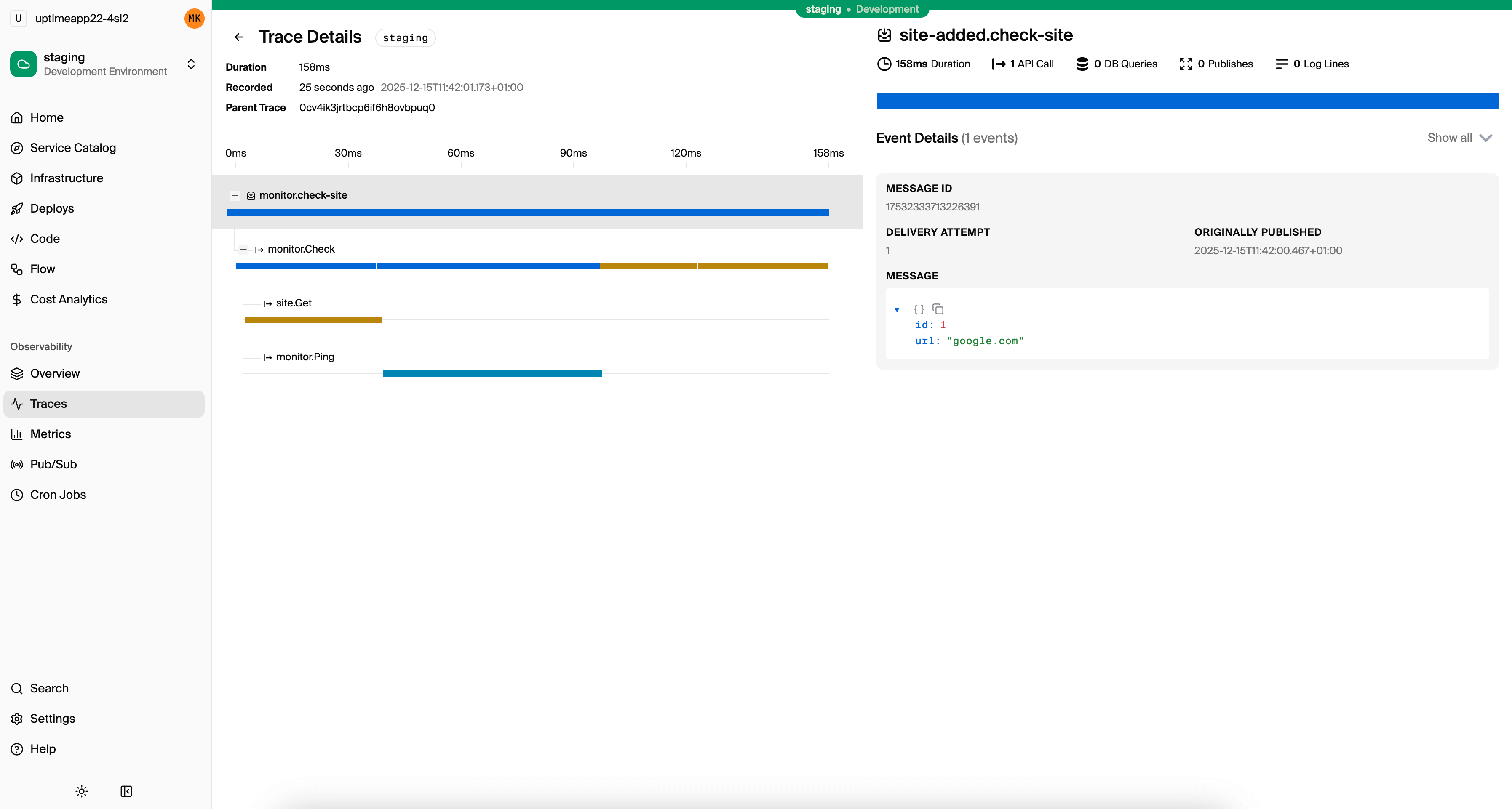
For production deployments with the Encore platform, you get metrics, alerting, and integrations with Grafana and Datadog without writing any instrumentation code.
Verdict: Fiber gives you basic logging and a simple metrics page out of the box, but production observability is on you. Encore provides distributed tracing, structured logging, and metrics with zero configuration. If observability is important to your system, and for any production service it should be, Encore saves significant setup and maintenance effort.
Microservices and Service Communication
This is where Fiber and Encore diverge the most, because they were designed for different use cases.
Fiber
Fiber is designed for building individual HTTP services. When you need multiple services to communicate, you handle it manually.
// users-service/main.go
package main

import "github.com/gofiber/fiber/v2"

func main() {
    app := fiber.New()

    app.Get("/users/:id", func(c *fiber.Ctx) error {
        id := c.Params("id")
        return c.JSON(fiber.Map{"id": id, "name": "John"})
    })

    app.Listen(":3001")
}

// orders-service/main.go
package main

import (
    "encoding/json"
    "fmt"
    "net/http"
    "github.com/gofiber/fiber/v2"
)

func main() {
    app := fiber.New()

    app.Post("/orders", func(c *fiber.Ctx) error {
        var body struct {
            UserID string `json:"userId"`
        }
        if err := c.BodyParser(&body); err != nil {
            return err
        }

        // Manual HTTP call to users service
        resp, err := http.Get(fmt.Sprintf("http://localhost:3001/users/%s", body.UserID))
        if err != nil {
            return c.Status(500).JSON(fiber.Map{"error": "Failed to fetch user"})
        }
        defer resp.Body.Close()

        var user map[string]interface{}
        json.NewDecoder(resp.Body).Decode(&user)

        return c.JSON(fiber.Map{"orderId": 1, "user": user})
    })

    app.Listen(":3002")
}
You manage service URLs (often through environment variables), handle network errors, implement retries, and deal with serialization/deserialization between services. There's no type safety across service boundaries, so a change to one service's API can break callers silently.
Encore.go
users/users.go// users/users.go
package users

import "context"

type User struct {
    ID   string `json:"id"`
    Name string `json:"name"`
}

//encore:api public method=GET path=/users/:id
func Get(ctx context.Context, id string) (*User, error) {
    return &User{ID: id, Name: "John"}, nil
}

// orders/orders.go
package orders

import (
    "context"
    "encore.app/users"
)

type Order struct {
    OrderID int        `json:"orderId"`
    User    *users.User `json:"user"`
}

type CreateOrderRequest struct {
    UserID string `json:"userId"`
}

//encore:api public method=POST path=/orders
func Create(ctx context.Context, req *CreateOrderRequest) (*Order, error) {
    // Type-safe function call, automatically traced
    user, err := users.Get(ctx, req.UserID)
    if err != nil {
        return nil, err
    }
    return &Order{OrderID: 1, User: user}, nil
}
Service calls look like regular Go function calls. Encore generates the client code at compile time, so if the users.Get function signature changes, the orders package won't compile. Service discovery is automatic, both locally and in production, so there are no URLs to configure.
Encore also provides a service catalog that visualizes your architecture and auto-generates API documentation from your code.
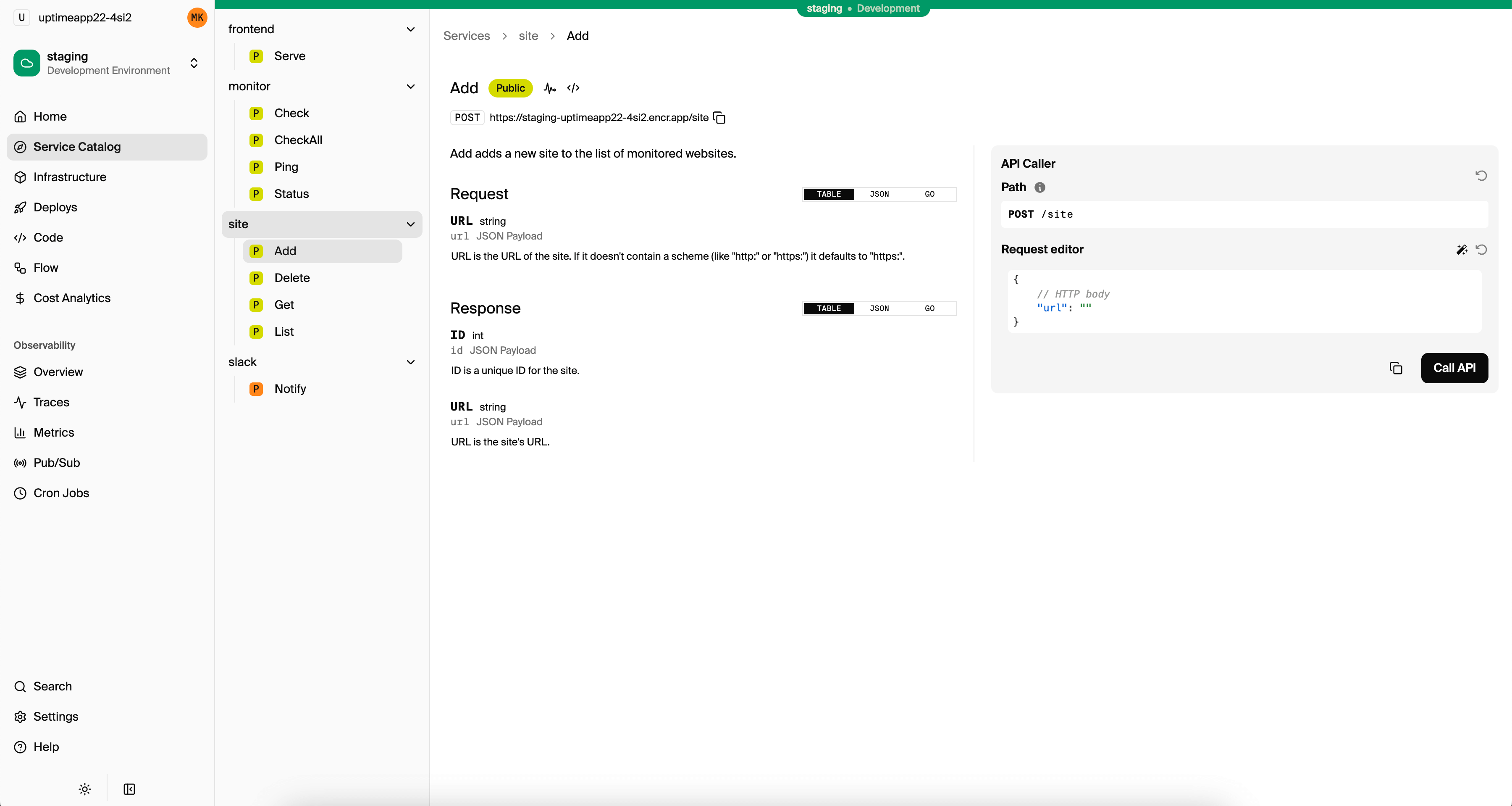
Verdict: Fiber is built for individual services, and when you need multiple services to talk to each other, the integration work is on you. Encore is built for exactly this scenario, with type-safe service calls, automatic service discovery, and distributed tracing across service boundaries. If your project is a single service, Fiber handles it well. If you're building a system with multiple services, Encore removes a substantial amount of complexity.
The fasthttp Question
This deserves its own section because it's the most consequential technical decision behind Fiber.
Fiber's use of fasthttp instead of net/http gives it strong benchmark numbers, but it comes with real tradeoffs:
-
Standard Go HTTP middleware won't work. Anything built on
http.Handlerorhttp.HandlerFunc, which includes a large chunk of the Go ecosystem, needs a Fiber-specific adapter or a rewrite. Libraries like Alice, Gorilla handlers, and many OpenTelemetry integrations expect net/http types. -
Request/response objects are pooled and reused. You can't safely hold a reference to
c.Body(),c.Params(), or other request data after the handler returns. You need to copy values explicitly withc.Body()returning[]bytethat gets reused. This is a common source of bugs for developers new to Fiber. -
HTTP/2 support is limited. fasthttp has experimental HTTP/2 support, but it's not as mature as net/http's implementation.
-
Some Go libraries assume net/http. gRPC, the standard
httptestpackage for testing, and various client libraries are built on net/http. Using them with Fiber requires workarounds.
None of these are dealbreakers for the right use case. If you're building a high-throughput API gateway or a single-purpose service where raw performance matters and you don't need the broader net/http ecosystem, the tradeoff makes sense.
Encore.go is built on net/http, so all standard Go middleware and libraries work without modification. The performance optimization happens at a different layer, through compile-time code generation, rather than by replacing the HTTP implementation.
AI Code Generation
Go has strong opinions about many things, but how you structure a backend isn't one of them. That's usually fine for developers, but AI agents are the inverse: good at filling in details once a structure exists, bad at deciding what that structure should be.
Fiber
When an AI agent writes code for a Fiber project, it has to make architectural decisions on every prompt: how to handle fasthttp's context pooling (remembering to copy values before the handler returns), whether to use c.BodyParser or manual parsing, which Fiber-specific middleware to apply, how to manage the incompatibility with net/http libraries. The output works, but it varies between prompts, and the agent spends most of its effort on plumbing rather than your actual business logic.
// An agent asked to "add an order creation endpoint" might generate:
// - A new route with BodyParser or a different parsing approach each time
// - Fiber-specific middleware instead of standard net/http middleware
// - Response handling via c.JSON, c.Status().JSON, or c.SendString inconsistently
// - References to c.Body() or c.Params() that aren't copied before the handler returns
// - A database connection pool initialized with a different pattern
Encore.go
With Encore, the project's API patterns, infrastructure declarations, and service structure are already defined. The agent reads the existing conventions and writes code that follows them. A prompt to "add an order creation endpoint" produces a function with an //encore:api annotation and a database call using the existing sqldb declaration, not a new architecture.
orders/orders.go// The agent sees existing patterns and follows them:
//encore:api auth method=POST path=/orders
func Create(ctx context.Context, req *CreateOrderRequest) (*Order, error) {
    // Business logic only — the agent doesn't reinvent the structure
    var order Order
    err := db.QueryRow(ctx,
        "INSERT INTO orders (customer_id, total) VALUES ($1, $2) RETURNING id, customer_id, total",
        req.CustomerID, req.Total,
    ).Scan(&order.ID, &order.CustomerID, &order.Total)
    return &order, err
}
Encore also provides an MCP server and editor rules (encore llm-rules init) that give agents access to database schemas, distributed traces, and service architecture. This means agents can generate queries that match your actual tables, debug with real request data, and verify their own work. Read more in How AI Agents Want to Write Go.
Verdict: Fiber requires the agent to make architectural decisions on every prompt, including fasthttp-specific concerns like context pooling that are easy to get wrong. Encore gives agents conventions to follow and live system context through MCP, which leads to more consistent, deployable code.
How to Choose
Start at the top and follow the first question you can answer with a yes:
Do you want infrastructure provisioned from your code, without building a DevOps team internally?
EncoreInfrastructure automation in your own AWS or GCP accountEncoreInfrastructure automation in your own AWS or GCP accountAre you building several services that share databases, Pub/Sub, or cron jobs?
EncoreType-safe service calls and built-in tracingEncoreType-safe service calls and built-in tracingDo you rely on standard net/http middleware or libraries?
EncoreBuilt on net/http, so standard Go libraries workEncoreBuilt on net/http, so standard Go libraries workComing from Express.js, or is raw HTTP throughput your bottleneck?
FiberExpress-style API on fasthttpFiberExpress-style API on fasthttpFiberA lightweight framework for a single-service APIGetting Started
Try both with a small project to see which tradeoffs matter for your situation:
- Fiber Getting Started
- Encore.go Quickstart
- Encore.go REST API Tutorial to build a complete application with a database
See also: Best Go Backend Frameworks for a broader comparison of the Go framework landscape.
Encore is open source with 12,000+ GitHub stars. Besides deploying to your own AWS or GCP account, you can build Docker images and deploy anywhere. To try it, install the CLI and create a starter app:
Run in your terminal to get started locally.
Have questions about choosing a Go framework? Join our Discord community where developers discuss architecture decisions daily.
Deploy to your cloud on AWS and Google Cloud
without managing infrastructure
Encore lets developers and agents define application infrastructure directly in code, then automatically provisions it from local development to production in your AWS or GCP account.
