Gin vs Encore.go in 2026
Comparing Go's most popular web framework with an infrastructure-from-code approach

Gin is the most popular Go web framework, with over 75,000 GitHub stars and years of production use behind it. It's fast, minimal, and well-documented. Encore.go takes a different approach entirely, treating infrastructure as part of the framework rather than something you bolt on after the fact.
Both are good tools. The question is which set of tradeoffs fits what you're building. Let's compare them with real code and honest assessments.
Quick Comparison
The Basics: Defining an API
Let's start with a simple endpoint: a greeting that takes a name from the path.
Gin
 Gin
Ginpackage main
import (
"net/http"
"github.com/gin-gonic/gin"
)
func main() {
r := gin.Default()
r.GET("/hello/:name", func(c *gin.Context) {
name := c.Param("name")
c.JSON(http.StatusOK, gin.H{
"message": "Hello, " + name + "!",
})
})
r.Run(":8080")
}
Gin gives you a router, a context object for reading parameters and writing responses, and default middleware for logging and recovery. You wire up the server yourself.
Encore.go

hello/hello.gopackage hello

import "context"

type Response struct {
    Message string `json:"message"`
}

//encore:api public method=GET path=/hello/:name
func Hello(ctx context.Context, name string) (*Response, error) {
    return &Response{Message: "Hello, " + name + "!"}, nil
}
Encore uses a comment annotation to declare the endpoint. The function signature defines the API contract: path parameters become function arguments, and the return type is the response. Encore handles the server, routing, serialization, and request validation.
Verdict: Gin is familiar and straightforward. Encore is more concise and gives you a typed API contract from the function signature, but the comment annotation pattern is unique and takes a moment to learn.
Type Safety and Validation
Request validation is where you start to see the philosophical difference between the two frameworks.
Gin
Gin uses struct tags with a binding/validation layer built on go-playground/validator:
type CreateUserRequest struct {
    Email string `json:"email" binding:"required,email"`
    Name  string `json:"name" binding:"required,min=1"`
    Age   int    `json:"age" binding:"required,gte=0,lte=150"`
}

r.POST("/users", func(c *gin.Context) {
    var req CreateUserRequest
    if err := c.ShouldBindJSON(&req); err != nil {
        c.JSON(http.StatusBadRequest, gin.H{"error": err.Error()})
        return
    }

    // req is validated, proceed
    c.JSON(http.StatusOK, gin.H{
        "id":    1,
        "email": req.Email,
        "name":  req.Name,
    })
})
This works well for runtime validation. You define constraints through struct tags, call ShouldBindJSON, and check for errors. The validation library supports custom validators and cross-field validation. The downside is that validation happens at runtime, and the struct tags can get verbose for complex rules.
Encore.go
users/users.gopackage users

import "context"

type CreateUserRequest struct {
    Email string `json:"email"`
    Name  string `json:"name"`
    Age   int    `json:"age"`
}

type User struct {
    ID    int    `json:"id"`
    Email string `json:"email"`
    Name  string `json:"name"`
}

//encore:api public method=POST path=/users
func CreateUser(ctx context.Context, req *CreateUserRequest) (*User, error) {
    // req is already parsed and type-checked
    return &User{ID: 1, Email: req.Email, Name: req.Name}, nil
}
Encore validates requests based on Go types at compile time. If the request body doesn't match the struct, it's rejected before your handler runs. You don't need binding tags or manual validation calls for type conformance. For more complex business rules, you'd still write validation logic in the handler, same as you would anywhere.
Verdict: Gin gives you fine-grained runtime validation through struct tags, which is useful for complex constraints like email format or numeric ranges. Encore handles type-level validation automatically with less boilerplate. If you need detailed field-level constraints in Encore, you write that logic explicitly. Both approaches are reasonable, they just sit at different points on the convenience-control spectrum.
Database Integration
Gin
Gin is a routing framework, so database integration is entirely up to you. Most teams reach for database/sql with a driver, or an ORM like GORM:
package main

import (
    "database/sql"
    "net/http"
    "os"

    "github.com/gin-gonic/gin"
    _ "github.com/lib/pq"
)

var db *sql.DB

func main() {
    var err error
    db, err = sql.Open("postgres", os.Getenv("DATABASE_URL"))
    if err != nil {
        panic(err)
    }

    r := gin.Default()

    r.GET("/users/:id", func(c *gin.Context) {
        id := c.Param("id")

        var user struct {
            ID    int    `json:"id"`
            Email string `json:"email"`
            Name  string `json:"name"`
        }

        err := db.QueryRow(
            "SELECT id, email, name FROM users WHERE id = $1", id,
        ).Scan(&user.ID, &user.Email, &user.Name)

        if err == sql.ErrNoRows {
            c.JSON(http.StatusNotFound, gin.H{"error": "User not found"})
            return
        }
        if err != nil {
            c.JSON(http.StatusInternalServerError, gin.H{"error": "Database error"})
            return
        }

        c.JSON(http.StatusOK, user)
    })

    r.Run(":8080")
}
You manage connection strings, run your own migration tool, set up a local PostgreSQL instance (usually via Docker), and handle connection pooling configuration. It's straightforward but involves a fair amount of setup, especially for local development.
Encore.go
users/users.gopackage users

import (
    "context"
    "encore.dev/storage/sqldb"
)

type User struct {
    ID    int    `json:"id"`
    Email string `json:"email"`
    Name  string `json:"name"`
}

var db = sqldb.NewDatabase("users", sqldb.DatabaseConfig{
    Migrations: "./migrations",
})

//encore:api public method=GET path=/users/:id
func Get(ctx context.Context, id int) (*User, error) {
    var user User
    err := db.QueryRow(ctx,
        "SELECT id, email, name FROM users WHERE id = $1", id,
    ).Scan(&user.ID, &user.Email, &user.Name)
    if err != nil {
        return nil, err
    }
    return &user, nil
}
Encore provisions a PostgreSQL database automatically when you run encore run. Migrations run on startup. There's no Docker Compose file to write, no connection string to manage, and connection pooling is handled for you. In production, Encore provisions the database in your own AWS or GCP account with sensible defaults.
The query interface mirrors database/sql, so the learning curve is minimal if you already know Go's standard database patterns. You can also use any ORM or database driver alongside Encore's primitives if you prefer.
Verdict: Both use familiar Go database patterns at the query level. Gin lets you choose your own database and tooling. Encore reduces setup time significantly by handling provisioning, migrations, and connection management, which is especially valuable during local development and when onboarding new team members.
Middleware and Authentication
Gin
Gin has a clean middleware model. You write functions that call c.Next() to proceed down the chain:
func AuthMiddleware() gin.HandlerFunc {
    return func(c *gin.Context) {
        token := c.GetHeader("Authorization")
        if token == "" {
            c.JSON(http.StatusUnauthorized, gin.H{"error": "No token provided"})
            c.Abort()
            return
        }

        userID, err := validateToken(token)
        if err != nil {
            c.JSON(http.StatusUnauthorized, gin.H{"error": "Invalid token"})
            c.Abort()
            return
        }

        c.Set("userID", userID)
        c.Next()
    }
}

func main() {
    r := gin.Default()

    // Apply to a group of routes
    authorized := r.Group("/api")
    authorized.Use(AuthMiddleware())
    {
        authorized.POST("/orders", func(c *gin.Context) {
            userID := c.GetString("userID")
            // Create order...
            c.JSON(http.StatusOK, gin.H{"userID": userID})
        })
    }
}
Gin's middleware is flexible and easy to reason about. You can apply it globally, to route groups, or to individual routes. The tradeoff is that auth data flows through c.Set/c.Get with string keys, which means no compile-time type checking on the auth data itself.
Encore.go
Encore separates authentication from general middleware. You define an auth handler that runs before protected endpoints:
auth/auth.gopackage auth

import (
    "context"
    "encore.dev/beta/auth"
)

type AuthParams struct {
    Authorization string `header:"Authorization"`
}

type AuthData struct {
    UserID string
}

//encore:authhandler
func Authenticate(ctx context.Context, p *AuthParams) (auth.UID, *AuthData, error) {
    userID, err := validateToken(p.Authorization)
    if err != nil {
        return "", nil, err
    }
    return auth.UID(userID), &AuthData{UserID: userID}, nil
}
Then any endpoint that needs authentication simply declares it:
orders/orders.go//encore:api auth method=POST path=/orders
func CreateOrder(ctx context.Context, req *CreateOrderRequest) (*Order, error) {
    // Auth data is available via auth.Data()
    userData := auth.Data().(*AuthData)
    // Create order...
}
The auth annotation on the endpoint tells Encore to run the auth handler before calling your function. Auth data is typed and available throughout the request without string key lookups.
Verdict: Gin's middleware is more flexible, you can compose any chain of middleware in any order and apply it at any granularity. Encore's auth handler is more structured, giving you type-safe auth data propagation across services, which becomes increasingly valuable in distributed systems where auth context needs to flow between services.
Observability
This is the area where the two frameworks differ most dramatically.
Gin
Getting production-ready observability with Gin means assembling several tools:
package main

import (
    "net/http"
    "time"

    "github.com/gin-gonic/gin"
    "go.opentelemetry.io/otel"
    "go.opentelemetry.io/otel/trace"
)

var tracer trace.Tracer

func init() {
    tracer = otel.Tracer("my-service")
}

func TracingMiddleware() gin.HandlerFunc {
    return func(c *gin.Context) {
        ctx, span := tracer.Start(c.Request.Context(), c.FullPath())
        defer span.End()

        c.Request = c.Request.WithContext(ctx)
        c.Next()

        span.SetAttributes(
            // Add status code, request details, etc.
        )
    }
}

func LoggingMiddleware() gin.HandlerFunc {
    return func(c *gin.Context) {
        start := time.Now()
        c.Next()
        latency := time.Since(start)
        // Log to your aggregation service
        _ = latency
    }
}

func main() {
    // Initialize OpenTelemetry exporter...
    // Initialize Prometheus metrics...
    // Configure log aggregation...

    r := gin.Default()
    r.Use(TracingMiddleware())
    r.Use(LoggingMiddleware())
    // ...
}
You need to configure OpenTelemetry (with an exporter), set up Prometheus or a metrics library, configure log aggregation, and build dashboards. It's doable, and the Go OpenTelemetry ecosystem is mature, but it takes real investment to get right. Database queries, external API calls, and service-to-service communication all need separate instrumentation.
Encore.go
users/users.gopackage users

import (
    "context"
    "encore.dev/rlog"
)

//encore:api public method=GET path=/users/:id
func Get(ctx context.Context, id int) (*User, error) {
    rlog.Info("fetching user", "user_id", id)
    // Every database query, API call, and Pub/Sub message
    // is automatically traced
    return getUser(ctx, id)
}
Every request gets distributed tracing automatically. Database queries show up in traces with their SQL and duration. Service-to-service calls are correlated across the entire request path. You get a local development dashboard with a visual trace explorer out of the box. For production deployments with the Encore platform, you also get metrics, alerting, and integrations with Grafana and Datadog.
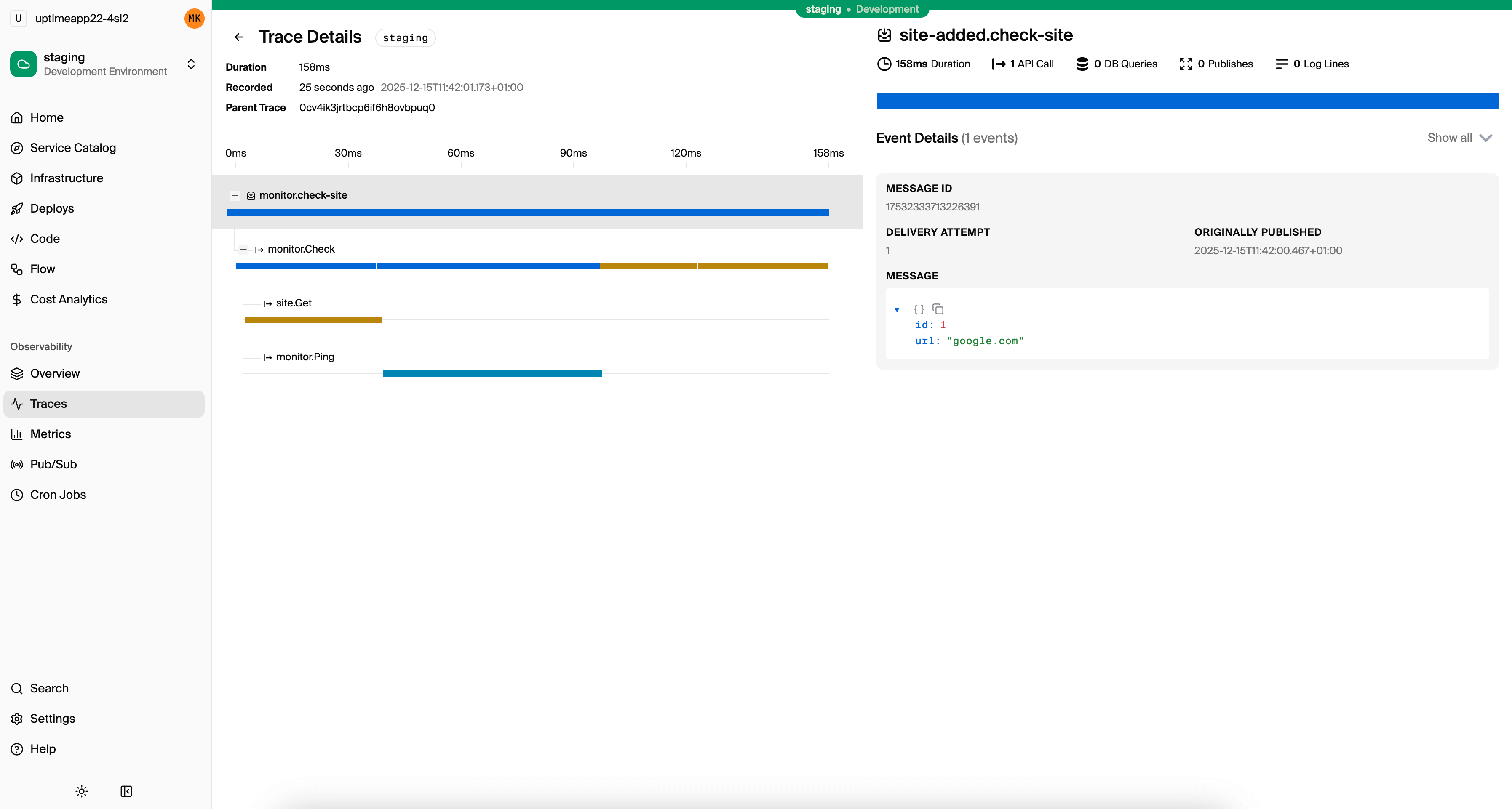
Verdict: If you already have an observability stack and a team that maintains it, Gin works fine with OpenTelemetry. If you want tracing, metrics, and structured logging from the start without days of configuration, Encore provides that out of the box. For most teams, the built-in observability alone justifies evaluating Encore.
Microservices and Service Communication
This is where the approaches diverge most significantly. Gin is an HTTP framework for a single service. Building a distributed system with it means solving service discovery, inter-service communication, and cross-service tracing yourself.
Gin
// users-service/main.go
package main

import (
    "net/http"
    "github.com/gin-gonic/gin"
)

func main() {
    r := gin.Default()

    r.GET("/users/:id", func(c *gin.Context) {
        id := c.Param("id")
        // Fetch user from database...
        c.JSON(http.StatusOK, gin.H{"id": id, "name": "Alice"})
    })

    r.Run(":3001")
}

// orders-service/main.go
package main

import (
    "encoding/json"
    "fmt"
    "net/http"
    "os"

    "github.com/gin-gonic/gin"
)

func main() {
    r := gin.Default()

    r.POST("/orders", func(c *gin.Context) {
        var req struct {
            UserID string `json:"user_id"`
        }
        if err := c.ShouldBindJSON(&req); err != nil {
            c.JSON(http.StatusBadRequest, gin.H{"error": err.Error()})
            return
        }

        // Call users service - you manage the URL and HTTP client
        resp, err := http.Get(
            fmt.Sprintf("%s/users/%s", os.Getenv("USERS_SERVICE_URL"), req.UserID),
        )
        if err != nil {
            c.JSON(http.StatusInternalServerError, gin.H{"error": "Failed to reach users service"})
            return
        }
        defer resp.Body.Close()

        var user map[string]interface{}
        json.NewDecoder(resp.Body).Decode(&user)

        // Create order with user data...
        c.JSON(http.StatusOK, gin.H{"status": "created", "user": user})
    })

    r.Run(":3002")
}
Each service is a separate binary with its own main function, port configuration, and deployment pipeline. You manage service URLs through environment variables, handle network errors and retries, manually propagate trace context, and parse responses without type safety. This is perfectly workable for two or three services, but it scales in complexity as the system grows.
Encore.go
users/users.go// users/users.go
package users

import "context"

type User struct {
    ID   string `json:"id"`
    Name string `json:"name"`
}

//encore:api public method=GET path=/users/:id
func Get(ctx context.Context, id string) (*User, error) {
    // Fetch user from database...
    return &User{ID: id, Name: "Alice"}, nil
}
orders/orders.go// orders/orders.go
package orders

import (
    "context"
    "encore.app/users"
)

type CreateOrderRequest struct {
    UserID string `json:"user_id"`
}

type Order struct {
    Status string      `json:"status"`
    User   *users.User `json:"user"`
}

//encore:api public method=POST path=/orders
func CreateOrder(ctx context.Context, req *CreateOrderRequest) (*Order, error) {
    // Type-safe call to users service - no URL, no HTTP client, no parsing
    user, err := users.Get(ctx, req.UserID)
    if err != nil {
        return nil, err
    }

    return &Order{Status: "created", User: user}, nil
}
Service-to-service calls look like regular function calls. encore.app/users is an import path that Encore resolves to the users service, giving you compile-time type checking on both the request and response. Encore handles service discovery, serialization, and trace propagation automatically. You also get a service catalog that visualizes your architecture and how services communicate.
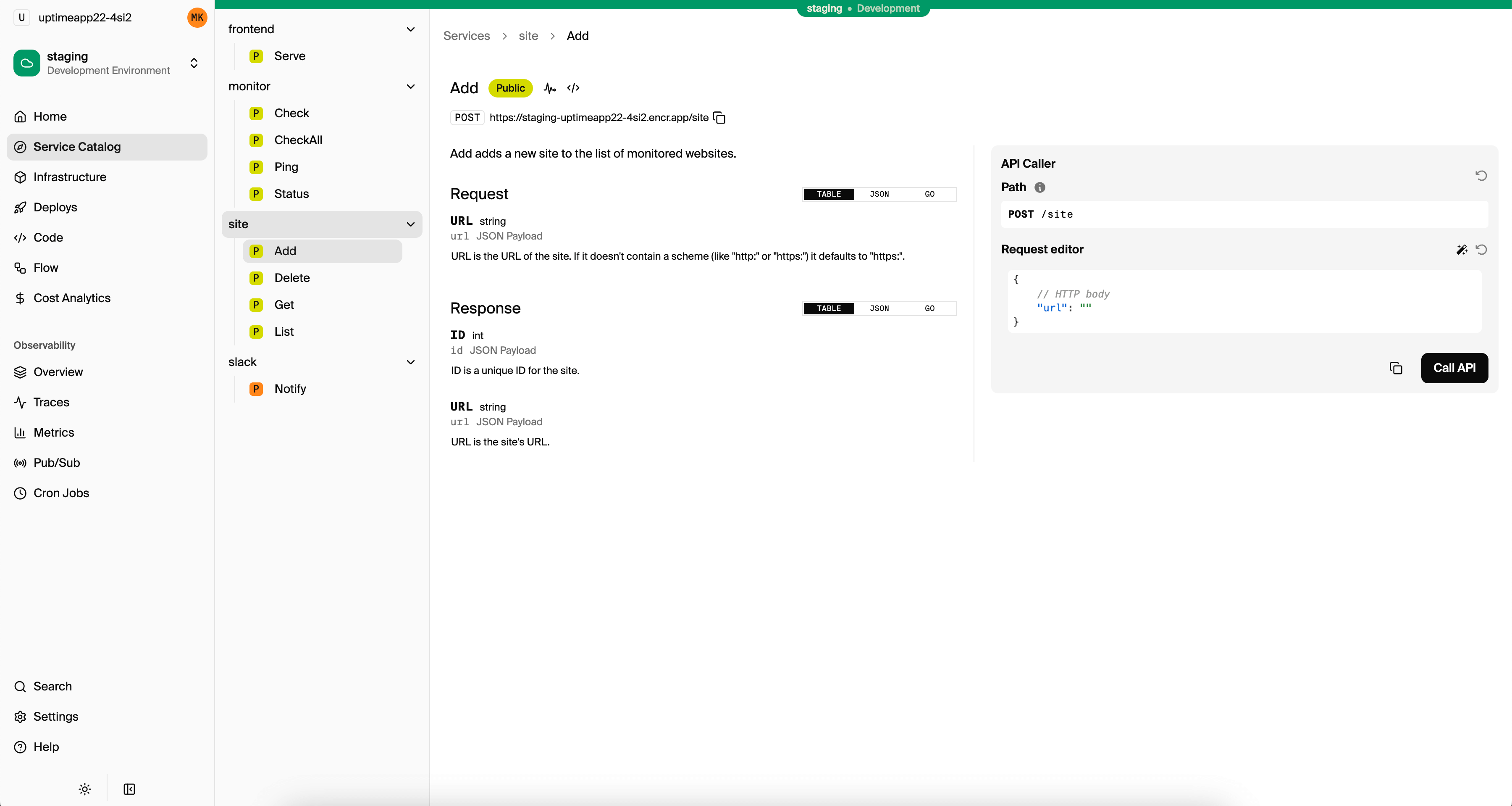
Verdict: For a single service, Gin is perfectly sufficient and the difference doesn't matter much. For distributed systems with multiple services communicating with each other, Encore removes substantial infrastructure complexity. Type-safe service calls, automatic service discovery, and correlated distributed traces across services are significant advantages that compound as the system grows.
AI Code Generation
Go has strong opinions about many things, but how you structure a backend isn't one of them. That's usually fine for developers, but AI agents are the inverse: good at filling in details once a structure exists, bad at deciding what that structure should be.
Gin
When an AI agent writes code for a Gin project, it has to make architectural decisions on every prompt: which middleware to register, how to bind and validate JSON, how to structure route groups, where to initialize the database connection pool, how to propagate context. The output works, but it varies between prompts, and the agent spends most of its effort on plumbing rather than your actual business logic.
// An agent asked to "add an order creation endpoint" might generate:
// - A new route group or modify an existing one
// - Custom binding and validation with different struct tags each time
// - A database connection setup with a new initialization pattern
// - Manual JSON response encoding with gin.H or a struct
// - Middleware composition that doesn't match the rest of the codebase
Encore.go
With Encore, the project's API patterns, infrastructure declarations, and service structure are already defined. The agent reads the existing conventions and writes code that follows them. A prompt to "add an order creation endpoint" produces a function with an //encore:api annotation and a database call using the existing sqldb declaration, not a new architecture.
orders/orders.go// The agent sees existing patterns and follows them:
//encore:api auth method=POST path=/orders
func Create(ctx context.Context, req *CreateOrderRequest) (*Order, error) {
    // Business logic only — the agent doesn't reinvent the structure
    var order Order
    err := db.QueryRow(ctx,
        "INSERT INTO orders (customer_id, total) VALUES ($1, $2) RETURNING id, customer_id, total",
        req.CustomerID, req.Total,
    ).Scan(&order.ID, &order.CustomerID, &order.Total)
    return &order, err
}
Encore also provides an MCP server and editor rules (encore llm-rules init) that give agents access to database schemas, distributed traces, and service architecture. This means agents can generate queries that match your actual tables, debug with real request data, and verify their own work. Read more in How AI Agents Want to Write Go.
Verdict: Gin requires the agent to make architectural decisions on every prompt, which produces working but inconsistent output. Encore gives agents conventions to follow and live system context through MCP, which leads to more consistent, deployable code.
How to Choose
Start at the top and follow the first question you can answer with a yes:
Do you want infrastructure provisioned from your code, without building a DevOps team internally?
EncoreInfrastructure automation in your own AWS or GCP accountEncoreInfrastructure automation in your own AWS or GCP accountAre you building several services that share databases, Pub/Sub, or cron jobs?
EncoreType-safe service calls and built-in tracingEncoreType-safe service calls and built-in tracingDo you already have deployment pipelines, observability, and databases set up, and only need the HTTP layer?
GinFits into your existing stack, with a large middleware ecosystemGinFits into your existing stack, with a large middleware ecosystemDo you want built-in tracing, metrics, and logs without setting up OpenTelemetry?
EncoreObservability across services out of the boxEncoreObservability across services out of the boxGinA minimal framework for a single-service API with full controlGetting Started
The best way to decide is to build something small with both:
- Gin Documentation
- Encore.go Quickstart
- Encore AI Integration for using Encore with AI coding agents
You can also follow the Encore.go REST API tutorial to build a complete application with a database and see how the infrastructure primitives work in practice.
Encore is open source with 12,000+ GitHub stars. Besides deploying to your own AWS or GCP account, you can build Docker images and deploy anywhere. To try it, install the CLI and create a starter app:
Run in your terminal to get started locally.
Have questions about choosing between Go frameworks? Join our Discord community where developers discuss architecture decisions daily.
Deploy to your cloud on AWS and Google Cloud
without managing infrastructure
Encore lets developers and agents define application infrastructure directly in code, then automatically provisions it from local development to production in your AWS or GCP account.
