Echo vs Encore.go in 2026
Two approaches to building Go backends, compared side by side

Echo is one of the more thoughtfully designed Go web frameworks. It returns errors from handlers instead of relying on panics, uses the standard context.Context, and has documentation that consistently gets praised by the community. If you've worked with Express in Node.js, Echo's API will feel familiar, but it stays closer to idiomatic Go than most alternatives.
Encore.go shares some of those idiomatic sensibilities, but the scope is different. Where Echo is a web framework focused on HTTP routing and middleware, Encore is a backend development platform that adds infrastructure automation on top of your application code. You declare databases, Pub/Sub topics, cron jobs, and services directly in Go, and Encore provisions them automatically in local development and production. The question isn't really which is "better" in the abstract, it's which scope matches what you're building.
Quick Comparison
The Basics: Defining an API
A simple GET endpoint that greets someone by name.
Echo

package main

import (
    "net/http"

    "github.com/labstack/echo/v4"
)

func main() {
    e := echo.New()

    e.GET("/hello/:name", func(c echo.Context) error {
        name := c.Param("name")
        return c.JSON(http.StatusOK, map[string]string{
            "message": "Hello, " + name + "!",
        })
    })

    e.Start(":8080")
}
Echo keeps things clean. You create an instance, define routes with handlers that return errors, and start the server. The echo.Context provides convenience methods like c.Param() for path parameters and c.JSON() for responses. There's no magic here, which is part of the appeal.
Encore.go

hello/hello.gopackage hello

import "context"

type Response struct {
    Message string `json:"message"`
}

//encore:api public method=GET path=/hello/:name
func Hello(ctx context.Context, name string) (*Response, error) {
    return &Response{Message: "Hello, " + name + "!"}, nil
}
Encore uses a comment annotation to declare the endpoint. The function signature defines the API contract: path parameters are extracted from the function arguments, and the return type becomes the response schema. There's no server setup or routing configuration because Encore handles that.
Verdict: Echo's approach is explicit and familiar. You see every piece of the HTTP lifecycle. Encore trades that visibility for conciseness, with the framework handling server configuration and request binding based on function signatures. For a single endpoint, Echo is arguably clearer. As the number of endpoints grows, Encore's declarative style produces less boilerplate.
Type Safety and Validation
Echo
Echo integrates with go-playground/validator for struct-level validation through binding and validation tags:
package main

import (
    "net/http"

    "github.com/labstack/echo/v4"
    "github.com/go-playground/validator/v10"
)

type CreateUserRequest struct {
    Email string `json:"email" validate:"required,email"`
    Name  string `json:"name" validate:"required,min=1"`
    Age   int    `json:"age" validate:"gte=0,lte=150"`
}

type User struct {
    ID    int    `json:"id"`
    Email string `json:"email"`
    Name  string `json:"name"`
    Age   int    `json:"age"`
}

type CustomValidator struct {
    validator *validator.Validate
}

func (cv *CustomValidator) Validate(i interface{}) error {
    return cv.validator.Struct(i)
}

func main() {
    e := echo.New()
    e.Validator = &CustomValidator{validator: validator.New()}

    e.POST("/users", func(c echo.Context) error {
        req := new(CreateUserRequest)
        if err := c.Bind(req); err != nil {
            return err
        }
        if err := c.Validate(req); err != nil {
            return echo.NewHTTPError(http.StatusBadRequest, err.Error())
        }
        user := &User{ID: 1, Email: req.Email, Name: req.Name, Age: req.Age}
        return c.JSON(http.StatusCreated, user)
    })

    e.Start(":8080")
}
Echo separates binding (parsing the request body into a struct) from validation (checking the struct meets your constraints). You register a custom validator on the Echo instance, then call c.Bind() followed by c.Validate() in each handler. The validation rules live in struct tags, which is a common Go pattern. It works well, though you do need to wire up the validator yourself and remember to call both steps in every handler.
Encore.go
user/user.gopackage user

import "context"

type CreateUserRequest struct {
    Email string `json:"email"`
    Name  string `json:"name"`
    Age   int    `json:"age"`
}

type User struct {
    ID    int    `json:"id"`
    Email string `json:"email"`
    Name  string `json:"name"`
    Age   int    `json:"age"`
}

//encore:api public method=POST path=/users
func CreateUser(ctx context.Context, req *CreateUserRequest) (*User, error) {
    return &User{ID: 1, Email: req.Email, Name: req.Name, Age: req.Age}, nil
}
Encore validates request data based on the struct types at compile time. The framework parses your Go types and generates validation code, so there's no separate validator setup or struct tags for validation rules. Request binding and validation happen automatically before your handler is called.
Verdict: Echo's validation through go-playground/validator is flexible and well-understood in the Go ecosystem. You can express complex constraints with struct tags and custom validators. Encore's approach is simpler since validation is automatic, but you have less control over custom validation rules. If you need fine-grained validation logic, Echo gives you more options. If you want zero-configuration request validation, Encore handles it out of the box.
Database Integration
Echo
Echo doesn't include database support, so you bring your own. Most teams use database/sql directly or an ORM like GORM or sqlx:
package main

import (
    "database/sql"
    "net/http"
    "os"

    "github.com/labstack/echo/v4"
    _ "github.com/lib/pq"
)

var db *sql.DB

func main() {
    var err error
    db, err = sql.Open("postgres", os.Getenv("DATABASE_URL"))
    if err != nil {
        panic(err)
    }
    defer db.Close()

    e := echo.New()

    e.GET("/users/:id", func(c echo.Context) error {
        id := c.Param("id")
        var name, email string
        err := db.QueryRowContext(c.Request().Context(),
            "SELECT name, email FROM users WHERE id = $1", id,
        ).Scan(&name, &email)
        if err != nil {
            return echo.NewHTTPError(http.StatusNotFound, "user not found")
        }
        return c.JSON(http.StatusOK, map[string]string{
            "id": id, "name": name, "email": email,
        })
    })

    e.Start(":8080")
}
You manage the connection string, connection pool, and lifecycle yourself. For local development, you typically start PostgreSQL with Docker and set the DATABASE_URL environment variable. Migrations are handled by a separate tool like golang-migrate or goose.
Encore.go
user/user.gopackage user

import (
    "context"

    "encore.dev/storage/sqldb"
)

type User struct {
    ID    int    `json:"id"`
    Name  string `json:"name"`
    Email string `json:"email"`
}

var db = sqldb.NewDatabase("users", sqldb.DatabaseConfig{
    Migrations: "./migrations",
})

//encore:api public method=GET path=/users/:id
func GetUser(ctx context.Context, id int) (*User, error) {
    var user User
    err := db.QueryRow(ctx,
        "SELECT id, name, email FROM users WHERE id = $1", id,
    ).Scan(&user.ID, &user.Name, &user.Email)
    return &user, err
}
The sqldb.NewDatabase call declares that this service needs a PostgreSQL database. When you run encore run, Encore provisions a local PostgreSQL instance, creates the database, and runs your migration files automatically. No Docker Compose file to write, no connection strings, no environment variables. The same declaration also drives provisioning in production, where Encore creates an RDS or Cloud SQL instance in your cloud account.
Verdict: The SQL code itself is similar in both cases, standard Go database patterns. The difference is everything around it. With Echo, you manage database lifecycle, connection strings, local setup, and migrations tooling. With Encore, you declare the database and the framework handles the rest. For projects with one database, the Echo approach is manageable. For projects with multiple services each owning their own database, Encore's automation removes a lot of operational overhead.
Middleware and Authentication
Echo
Echo has a clean middleware system where middleware functions return errors, just like handlers:
package main

import (
    "net/http"
    "strings"

    "github.com/labstack/echo/v4"
    "github.com/labstack/echo/v4/middleware"
)

func main() {
    e := echo.New()

    // Built-in middleware
    e.Use(middleware.Logger())
    e.Use(middleware.Recover())
    e.Use(middleware.CORS())

    // Custom authentication middleware
    authMiddleware := func(next echo.HandlerFunc) echo.HandlerFunc {
        return func(c echo.Context) error {
            token := c.Request().Header.Get("Authorization")
            token = strings.TrimPrefix(token, "Bearer ")
            if token == "" {
                return echo.NewHTTPError(http.StatusUnauthorized, "missing token")
            }

            userID, err := validateToken(token)
            if err != nil {
                return echo.NewHTTPError(http.StatusUnauthorized, "invalid token")
            }

            c.Set("userID", userID)
            return next(c)
        }
    }

    // Public route
    e.GET("/health", func(c echo.Context) error {
        return c.JSON(http.StatusOK, map[string]string{"status": "ok"})
    })

    // Protected routes
    api := e.Group("/api", authMiddleware)
    api.GET("/profile", func(c echo.Context) error {
        userID := c.Get("userID").(string)
        return c.JSON(http.StatusOK, map[string]string{"userID": userID})
    })

    e.Start(":8080")
}

func validateToken(token string) (string, error) {
    // Token validation logic
    return "user-123", nil
}
Echo's middleware pattern is consistent with its handler design: everything returns an error. The echo.Context carries data between middleware and handlers through c.Set() and c.Get(). Route groups make it straightforward to apply middleware to specific paths. It's a well-thought-out system that feels natural.
Encore.go
Encore uses a dedicated auth handler annotation and typed auth data:
auth/auth.gopackage auth

import (
    "context"
    "strings"

    "encore.dev/beta/auth"
    "encore.dev/beta/errs"
)

type AuthData struct {
    UserID string
}

//encore:authhandler
func AuthHandler(ctx context.Context, token string) (auth.UID, *AuthData, error) {
    token = strings.TrimPrefix(token, "Bearer ")
    if token == "" {
        return "", nil, &errs.Error{
            Code:    errs.Unauthenticated,
            Message: "missing token",
        }
    }

    userID, err := validateToken(token)
    if err != nil {
        return "", nil, &errs.Error{
            Code:    errs.Unauthenticated,
            Message: "invalid token",
        }
    }

    return auth.UID(userID), &AuthData{UserID: userID}, nil
}
Then any endpoint that requires authentication uses the auth access level:
profile/profile.gopackage profile

import (
    "context"

    myauth "encore.app/auth"
    "encore.dev/beta/auth"
)

//encore:api auth method=GET path=/profile
func GetProfile(ctx context.Context) (*myauth.AuthData, error) {
    data := auth.Data().(*myauth.AuthData)
    return data, nil
}
The auth handler is defined once and applies to every endpoint marked with auth. The AuthData struct is available in any service that needs it, and it's type-safe since you're working with a concrete Go struct instead of pulling untyped values from a context map.
Verdict: Echo's middleware system is flexible and well-designed. You can compose middleware freely, apply it to route groups, and build custom chains for different paths. Encore's auth handler is more structured, with a single auth definition that provides type-safe auth data across all services. Echo gives you more flexibility in how authentication is applied. Encore provides stronger guarantees that auth data is consistent and typed across your entire application. For single-service applications, Echo's approach is perfectly adequate. For multi-service architectures, Encore's centralized, typed auth handler avoids the common problem of reimplementing auth middleware in each service.
Observability
Echo
Echo provides request logging through middleware, and you can integrate OpenTelemetry for distributed tracing:
package main

import (
    "github.com/labstack/echo/v4"
    "github.com/labstack/echo/v4/middleware"
    "go.opentelemetry.io/contrib/instrumentation/github.com/labstack/echo/otelecho"
    "go.opentelemetry.io/otel"
    "go.opentelemetry.io/otel/exporters/otlp/otlptrace"
    "go.opentelemetry.io/otel/sdk/trace"
)

func main() {
    // Set up OpenTelemetry exporter
    exporter, _ := otlptrace.New(context.Background(),
        otlptrace.WithEndpoint("otel-collector:4317"),
    )
    tp := trace.NewTracerProvider(trace.WithBatcher(exporter))
    otel.SetTracerProvider(tp)

    e := echo.New()
    e.Use(middleware.Logger())
    e.Use(otelecho.Middleware("my-service"))

    e.GET("/users/:id", getUser)
    e.Start(":8080")
}
The otelecho middleware instruments incoming requests, but you still need to configure an exporter, set up a collector (like Jaeger or Grafana Tempo), and manually instrument database calls, outgoing HTTP requests, and any other operations you want to trace. It's a real project to get comprehensive observability working, even with the OpenTelemetry ecosystem.
Encore.go
user/user.gopackage user

import (
    "context"

    "encore.dev/storage/sqldb"
)

var db = sqldb.NewDatabase("users", sqldb.DatabaseConfig{
    Migrations: "./migrations",
})

//encore:api public method=GET path=/users/:id
func GetUser(ctx context.Context, id int) (*User, error) {
    var user User
    err := db.QueryRow(ctx,
        "SELECT id, name, email FROM users WHERE id = $1", id,
    ).Scan(&user.ID, &user.Name, &user.Email)
    return &user, err
}
There's nothing special in the code. Encore traces every request end-to-end automatically. Database queries, service-to-service calls, and Pub/Sub messages all appear in traces without any instrumentation code. The local development dashboard shows traces immediately when you run encore run.
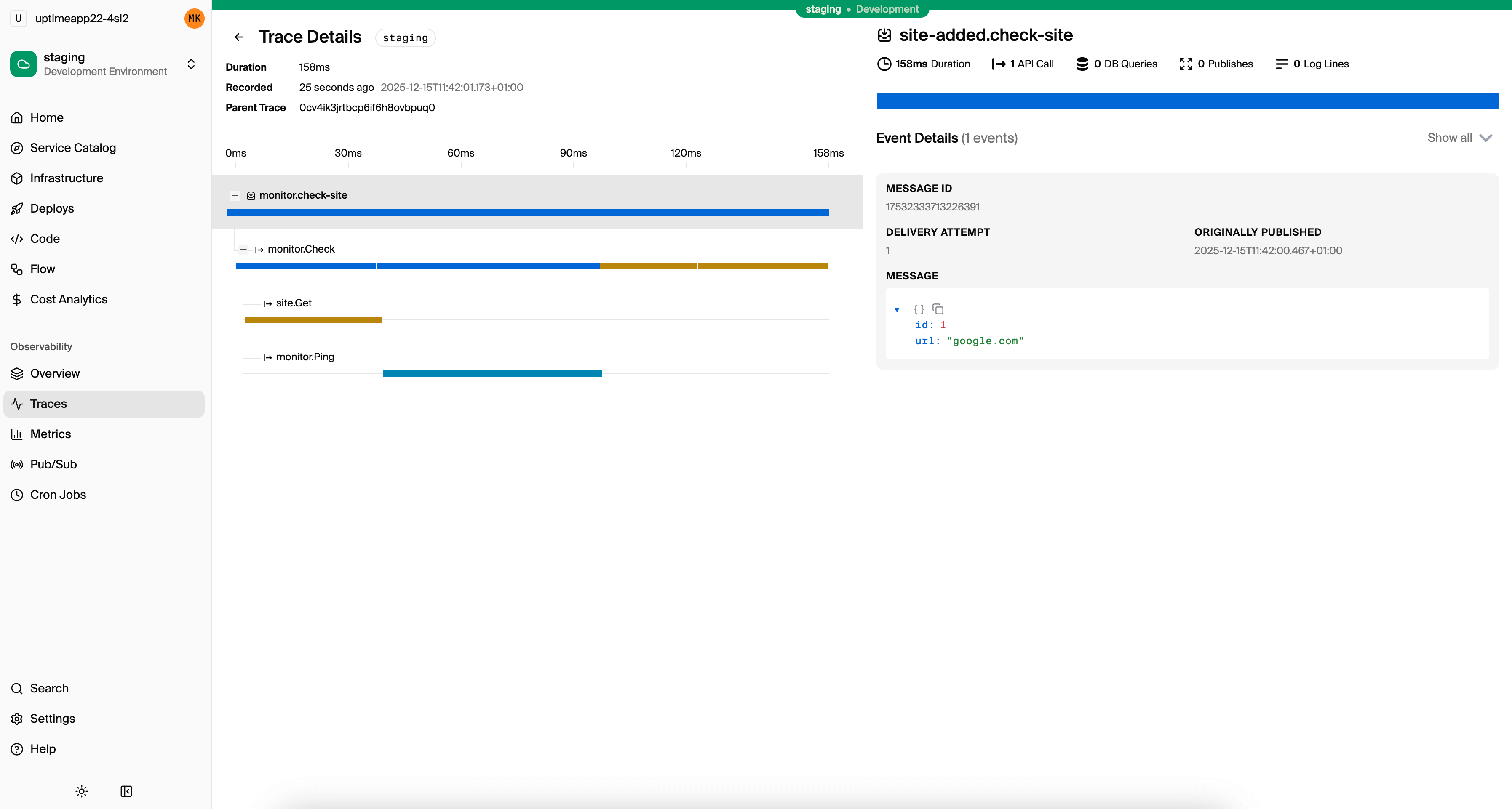
Verdict: Echo can achieve good observability, but it requires meaningful effort: choosing and configuring an OpenTelemetry exporter, running a collector, instrumenting database drivers, and wiring it all together. Encore provides distributed tracing, structured logging, and metrics out of the box with zero configuration. If observability is important to your project and you'd rather not spend days setting it up, Encore has a significant advantage.
Microservices and Service Communication
Echo
With Echo, each service is a standalone application with its own main() function and its own HTTP server:
// users-service/main.go
package main

import (
    "net/http"

    "github.com/labstack/echo/v4"
)

func main() {
    e := echo.New()

    e.GET("/users/:id", func(c echo.Context) error {
        id := c.Param("id")
        return c.JSON(http.StatusOK, map[string]string{
            "id": id, "name": "Alice",
        })
    })

    e.Start(":3001")
}

// orders-service/main.go
package main

import (
    "encoding/json"
    "fmt"
    "net/http"
    "os"

    "github.com/labstack/echo/v4"
)

func main() {
    e := echo.New()

    e.POST("/orders", func(c echo.Context) error {
        var req struct {
            UserID string `json:"userId"`
        }
        if err := c.Bind(&req); err != nil {
            return err
        }

        // Manual HTTP call to users service
        usersURL := os.Getenv("USERS_SERVICE_URL")
        resp, err := http.Get(fmt.Sprintf("%s/users/%s", usersURL, req.UserID))
        if err != nil {
            return echo.NewHTTPError(http.StatusServiceUnavailable, "users service unavailable")
        }
        defer resp.Body.Close()

        var user map[string]string
        json.NewDecoder(resp.Body).Decode(&user)

        return c.JSON(http.StatusCreated, map[string]interface{}{
            "orderId": 1,
            "user":    user,
        })
    })

    e.Start(":3002")
}
You manage service URLs through environment variables, handle HTTP errors and retries manually, and parse responses without type safety. As the number of services grows, the boilerplate for inter-service communication adds up. You also need to run each service separately during local development and configure service discovery for production.
Encore.go
users/users.go// users/users.go
package users

import "context"

type User struct {
    ID   string `json:"id"`
    Name string `json:"name"`
}

//encore:api public method=GET path=/users/:id
func Get(ctx context.Context, id string) (*User, error) {
    return &User{ID: id, Name: "Alice"}, nil
}
orders/orders.go// orders/orders.go
package orders

import (
    "context"

    "encore.app/users"
)

type CreateOrderRequest struct {
    UserID string `json:"userId"`
}

type Order struct {
    OrderID int         `json:"orderId"`
    User    *users.User `json:"user"`
}

//encore:api public method=POST path=/orders
func CreateOrder(ctx context.Context, req *CreateOrderRequest) (*Order, error) {
    user, err := users.Get(ctx, req.UserID)
    if err != nil {
        return nil, err
    }
    return &Order{OrderID: 1, User: user}, nil
}
Calling another service is a regular Go function call. The types are shared at compile time, so if the users service changes its response type, the orders service gets a compile error. Encore handles service discovery, request serialization, and tracing correlation automatically. Running encore run starts all services together, and you can see how they communicate in the service catalog.
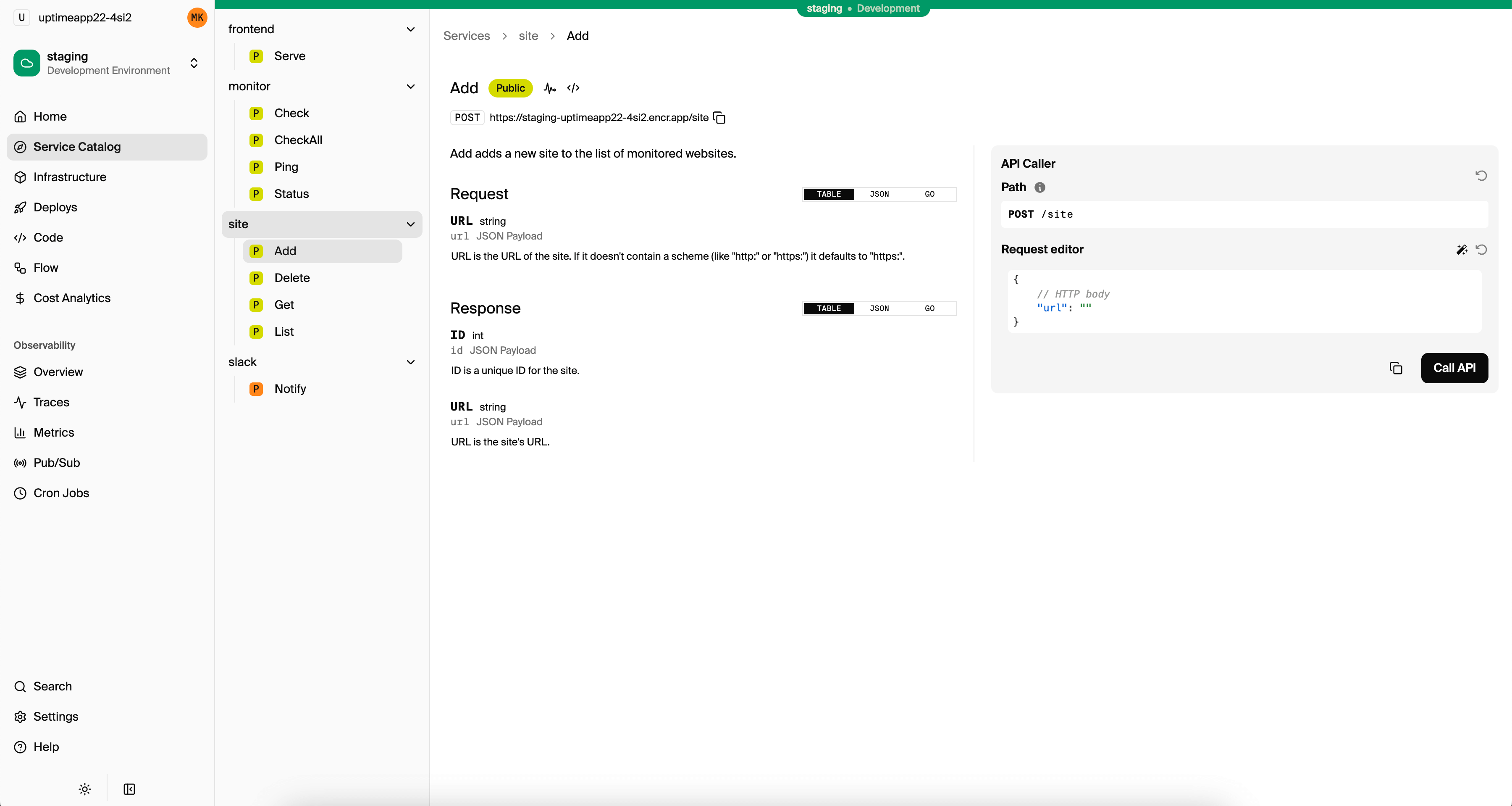
Verdict: This is where the difference between a web framework and a development platform becomes most apparent. Echo gives you HTTP routing and leaves service communication entirely to you, including URLs, serialization, error handling, retries, and service discovery. Encore makes service calls feel like local function calls with compile-time type checking. For single-service applications, this distinction doesn't matter. For multi-service architectures, Encore removes a substantial amount of infrastructure plumbing.
AI Code Generation
Go has strong opinions about many things, but how you structure a backend isn't one of them. That's usually fine for developers, but AI agents are the inverse: good at filling in details once a structure exists, bad at deciding what that structure should be.
Echo
When an AI agent writes code for an Echo project, it has to make architectural decisions on every prompt: how to set up the custom validator, whether to use c.Bind() then c.Validate() or combine them, which error handling pattern to follow, how to structure middleware chains, where to register routes. The output works, but it varies between prompts, and the agent spends most of its effort on plumbing rather than your actual business logic.
// An agent asked to "add an order creation endpoint" might generate:
// - A new route registration or modify an existing group
// - A fresh validator setup or a different validation approach each time
// - Error responses using echo.NewHTTPError, c.JSON, or a custom error handler
// - Manual request binding with a different pattern than the rest of the codebase
// - Middleware wiring that doesn't match existing conventions
Encore.go
With Encore, the project's API patterns, infrastructure declarations, and service structure are already defined. The agent reads the existing conventions and writes code that follows them. A prompt to "add an order creation endpoint" produces a function with an //encore:api annotation and a database call using the existing sqldb declaration, not a new architecture.
orders/orders.go// The agent sees existing patterns and follows them:
//encore:api auth method=POST path=/orders
func Create(ctx context.Context, req *CreateOrderRequest) (*Order, error) {
    // Business logic only — the agent doesn't reinvent the structure
    var order Order
    err := db.QueryRow(ctx,
        "INSERT INTO orders (customer_id, total) VALUES ($1, $2) RETURNING id, customer_id, total",
        req.CustomerID, req.Total,
    ).Scan(&order.ID, &order.CustomerID, &order.Total)
    return &order, err
}
Encore also provides an MCP server and editor rules (encore llm-rules init) that give agents access to database schemas, distributed traces, and service architecture. This means agents can generate queries that match your actual tables, debug with real request data, and verify their own work. Read more in How AI Agents Want to Write Go.
Verdict: Echo requires the agent to make architectural decisions on every prompt, which produces working but inconsistent output. Encore gives agents conventions to follow and live system context through MCP, which leads to more consistent, deployable code.
How to Choose
Start at the top and follow the first question you can answer with a yes:
Do you want infrastructure provisioned from your code, without building a DevOps team internally?
EncoreInfrastructure automation in your own AWS or GCP accountEncoreInfrastructure automation in your own AWS or GCP accountAre you building several services that share databases, Pub/Sub, or cron jobs?
EncoreType-safe service calls and built-in tracingEncoreType-safe service calls and built-in tracingDo you already have database provisioning, deployment pipelines, and observability, and only need the HTTP layer?
EchoA clean, idiomatic HTTP layer that slots into your stackEchoA clean, idiomatic HTTP layer that slots into your stackDo you want built-in tracing, metrics, and logs without setting up OpenTelemetry?
EncoreObservability across services out of the boxEncoreObservability across services out of the boxEchoFocused REST APIs with clean, idiomatic GoGetting Started
Try both with a small project to see which tradeoffs matter for your situation:
- Echo Guide
- Encore.go Quickstart
- Encore.go REST API Tutorial to build a complete application with a database
You might also find the Best Go Backend Frameworks comparison helpful for a broader perspective on the Go ecosystem.
Encore is open source with 12,000+ GitHub stars. Besides deploying to your own AWS or GCP account, you can build Docker images and deploy anywhere. To try it, install the CLI and create a starter app:
Run in your terminal to get started locally.
Have questions about choosing a framework? Join our Discord community where developers discuss architecture decisions daily.
Deploy to your cloud on AWS and Google Cloud
without managing infrastructure
Encore lets developers and agents define application infrastructure directly in code, then automatically provisions it from local development to production in your AWS or GCP account.
