Connect your cloud account
Whatever cloud you prefer is fine by us
The Encore platform lets you deploy your application to any of the major cloud providers, using your own cloud account. This lets you use Encore to improve your experience and productivity, while keeping the reliability of a major cloud provider.
Each environment can be configured to use a different cloud provider, and you can have as many environments as you wish. This also lets you easily deploy a hybrid or multi-cloud application, as you see fit.
The Encore platform will provision infrastructure in your cloud account, but for safety reasons the Encore platform does not automatically destroy infrastructure once it's no longer required. To do this, you need to manually approve the deletion of the infrastructure in your Encore dashboard.
This means if you disconnect your app from your cloud provider, or delete the environment within Encore, you need to explicitly approve the deletion of the infrastructure in your Encore dashboard.
Google Cloud Platform (GCP)
The Encore platform provides a GCP Service Account for each Encore application, letting you grant the Encore platform access to provision all the necessary infrastructure directly in your own GCP account.
Permissions scoping
GCP's permissions system is well-suited for scoping down the Encore platform's access. While the simplest setup grants access at the organization level, permissions can also be scoped down to a single GCP project. This is useful when you want to isolate the Encore platform's access to a specific project within your organization, for example a sandboxed prototyping environment. Contact us to discuss the best setup for your needs.
Required permissions
When connecting a specific GCP project (instead of granting access at the organization level), the simplest approach is to grant the Encore platform service account the roles/owner (Owner) role on the project. This gives the Encore platform full access to provision and manage all the infrastructure it needs.
If you'd prefer to grant more narrowly scoped permissions, only grant the roles for the features your application actually uses. The following project-level roles are grouped by the feature they enable:
IAM (always required)
roles/resourcemanager.projectIamAdmin— read/set project IAM policyroles/iam.serviceAccountAdmin— create/update/delete service accountsroles/iam.roleAdmin— create/patch/undelete theencore_bucket_*custom rolesroles/iam.serviceAccountTokenCreator— needed for Pub/Sub push-OIDC + workload identity flowsroles/iam.serviceAccountUser— needed to deploy Cloud Run services with a custom service account
Service usage (always required)
roles/serviceusage.serviceUsageAdmin— enables the required.googleapis.comAPIs
Cloud Run (required if deploying to Cloud Run)
roles/run.admin— create/replace/delete Cloud Run services and their IAM policyroles/vpcaccess.admin— manage serverless VPC connectors
GKE (required if deploying to GKE)
roles/container.admin— clusters, node pools, labels
Networking (required for ingress, custom domains, and private connectivity)
roles/compute.networkAdmin— VPC, subnets, firewalls, peering, reserved IPs, PSC forwarding rulesroles/compute.loadBalancerAdmin(or the broaderroles/compute.admin) — URL maps, target proxies, forwarding rules, backend buckets/servicesroles/servicenetworking.networksAdmin— private services access for Cloud SQL / Redisroles/certificatemanager.editor— certificates, cert maps and entries, DNS authorizations
Databases (required if using SQL databases or caches)
roles/cloudsql.admin— instances, users, SSL certsroles/redis.admin— Memorystore instances
Storage (required if using Object Storage)
roles/storage.admin— buckets, CORS, lifecycle, IAM
Storage / Registry (always required)
roles/artifactregistry.admin— repositories for container images
Messaging (required if using Pub/Sub topics)
roles/pubsub.admin— topics, subscriptions, and their IAM bindings
Secrets (always required)
roles/secretmanager.admin— create/version/delete secrets and grant accessor
Observability (always required)
roles/monitoring.editor— create/manage custom metric descriptors
Setup
To find your app's Service Account email and configure GCP deployments, head over to the Connect Cloud page by going to the the Encore platform dashboard > (Select your app) > App Settings > Integrations > Connect Cloud.
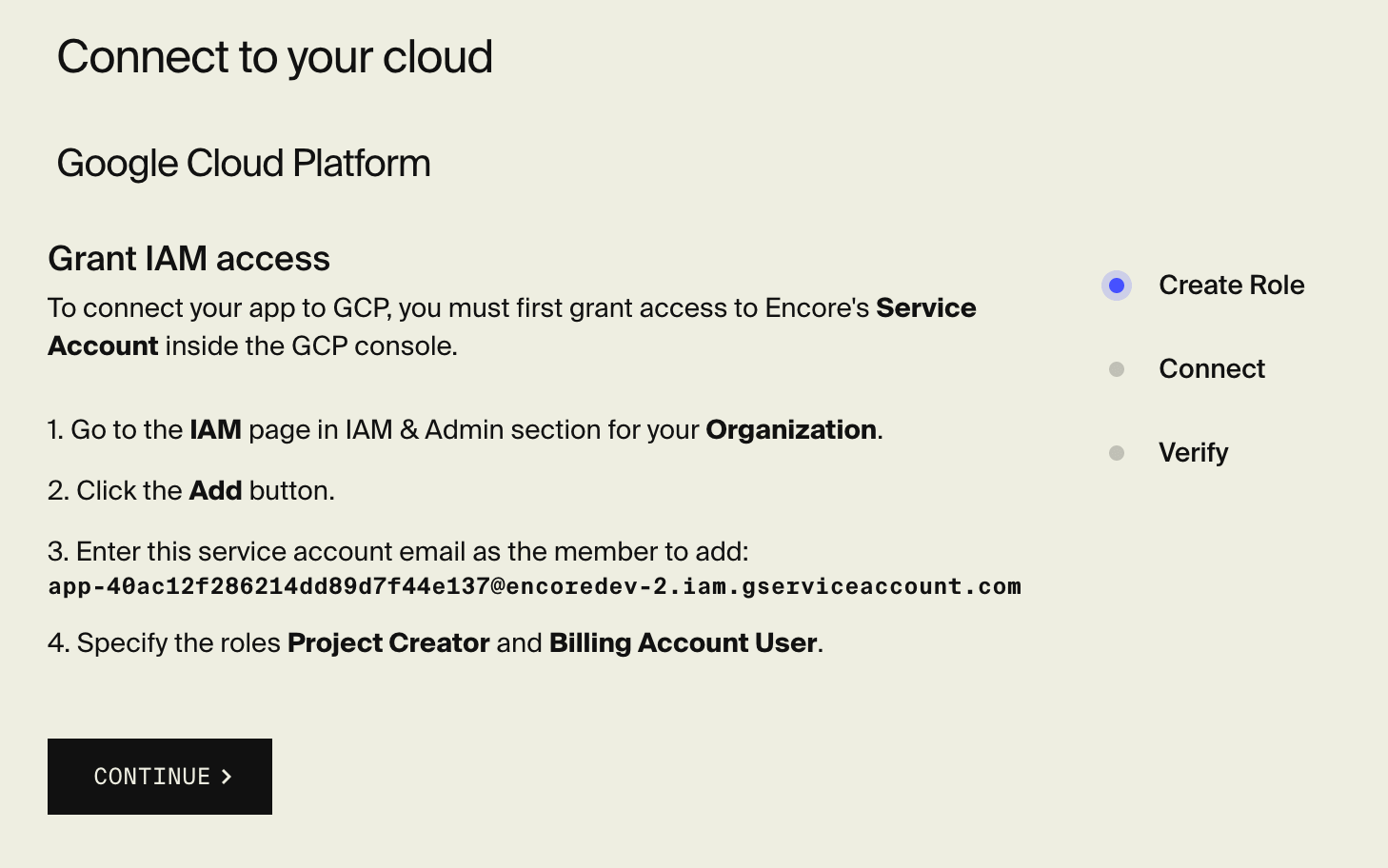
Encore Service Account vs Service Account JSON Key
When connecting your GCP account, you can choose between two authentication methods. Both grant the Encore platform the same level of access — the difference is in how that trust is established.
Encore Service Account (recommended)
The Encore platform uses its own Google-managed service account, which you grant access to your GCP Organization. No credentials are ever shared with the Encore platform, and access can be revoked at any time by removing the IAM binding.
This requires that the Encore platform service account is allowed by your Organization's Domain restricted sharing policy. If your organization enforces this policy, you'll need to edit it to allowlist the Encore platform service account (see the Troubleshooting section below).
Choose this option if:
- You can modify the
Domain restricted sharingpolicy in your GCP Organization, or it isn't enforced. - You prefer not to manage long-lived credentials.
Service Account JSON Key
You create a service account in your own GCP project, grant it the required roles, and upload its JSON key to the Encore platform. The Encore platform then authenticates as that service account when managing your infrastructure.
This avoids any changes to your Domain restricted sharing policy, but means a long-lived credential is stored by the Encore platform. The key should be rotated periodically, and revoking access requires deleting the key in GCP.
Choose this option if:
- You're unable to modify the
Domain restricted sharingpolicy. - You prefer to keep the service account fully within your own GCP Organization.
Troubleshooting
I can't access/edit the Policy for Domain restricted sharing page
To edit Organization policies, you need to have the Organization Policy Administrator role. If you don't have this role, you can ask your GCP Organization Administrator to grant you the necessary permissions.
If you're a GCP Organization Administrator, you can grant yourself the necessary permissions by following the steps below:
- Go to the IAM & Admin page in the GCP Console.
- Find your user account in the list of members.
- Click the pencil icon to edit your user account.
- Add the
Organization Policy Administratorrole to your user account. - Click Save.
I can't grant access to the Encore platform service account
If you're unable to grant access to the Encore platform service account, you may have failed to add the Encore platform to your Domain restricted sharing policy.
Make sure you've followed all the steps in the Connect Cloud page to add the Encore platform to the policy.
If you're using several GCP accounts, make sure you're logged in with the correct account and that the correct organization is selected in the GCP Console.
Encore platform returns "Could not find Organization ID"
If you see this error message, it means that the Encore platform was unable to connect to your GCP Organization. Make sure you've followed all the steps in the Connect Cloud page to grant the Encore platform access to your GCP Organization. If you're using several GCP accounts, make sure you're logged in with the correct account and that the correct organization is selected in the GCP Console.
Still having issues? Drop us an email at support@encore.dev or chat with us in the [Encore Discord](https://encore.dev/discord.
Amazon Web Services (AWS)
Permissions scoping
For a seamless experience, the default setup uses an IAM Role that gives the Encore platform the permissions needed to provision and manage infrastructure in your AWS account. The simplest way to scope this is to use a dedicated AWS sub-organization for the Encore platform, which provides clear isolation.
It's also possible to configure a more narrowly scoped IAM policy. The required permissions depend dynamically on the structure of your applications and the infrastructure resources they use. We're actively working on providing more solutions for scoping down permissions further. Contact us to discuss the best setup for your needs.
Setup
To configure your Encore app to deploy to your AWS account, head over to the Connect Cloud page by going to the the Encore platform dashboard > (Select your app) > App Settings > Integrations > Connect Cloud.
Follow the instructions to create an IAM Role, and then connect the role with the Encore platform. Learn more in the AWS docs.
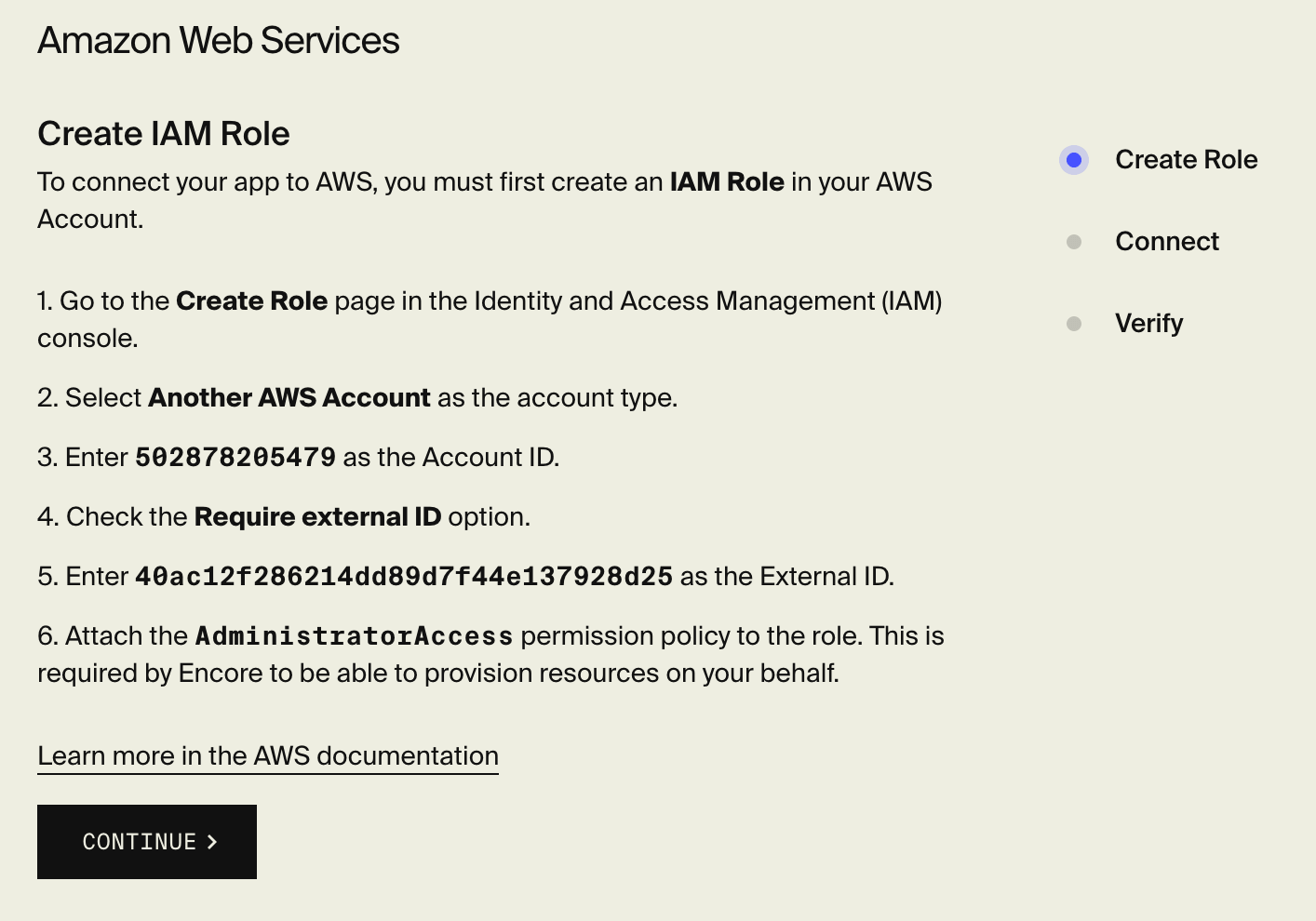
For your security, make sure to check Require external ID and specify the
external ID provided in the instructions.
After connecting your app to AWS, you will be asked to choose which region you want the Encore platform to provision resources in. Learn more about AWS regions here.