The Best Cloud Management Platforms in 2026
Compare AWS Control Tower, Encore, Azure Arc, IBM Cloudability, and HPE Morpheus.


Cloud management platforms help teams organize cloud resources, understand spending, and automate infrastructure changes. As applications grow across accounts and environments, these tools bring work that would otherwise happen through separate consoles and scripts into a shared system.
We'll also look at how Encore lets teams deploy a backend through a managed platform while running it in their own AWS or GCP account. The platform uses application code to set up the infrastructure and update it as the backend changes.
Cloud management platforms compared
AWS Control Tower
AWS Control Tower automates the setup of AWS accounts. Your cloud team defines the settings for logging and access, then uses Account Factory to create accounts with that configuration as projects need them.
From the Control Tower dashboard, administrators can see which accounts are enrolled and whether they comply with the organization's controls. Controls can prevent certain changes or flag resources that no longer meet those policies.
Encore
Encore manages the infrastructure needed to run a backend application. Developers declare services, databases, Pub/Sub topics, and other supported resources in application code. The platform reads those declarations, provisions the infrastructure in your AWS or GCP account, and deploys the application.
Your team can push code through a managed deployment workflow while retaining ownership of the cloud account and resources. Adding a database also supplies the information the platform needs to create it and configure access for the services that use it, so developers can ship the change without a separate infrastructure setup request.
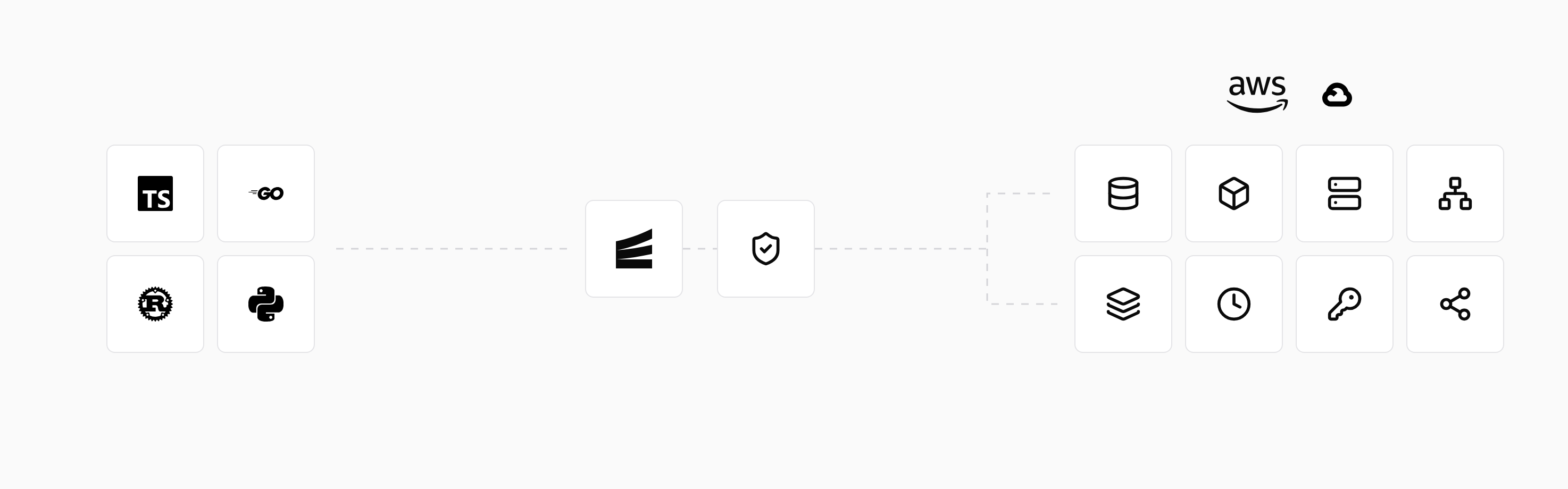
The local development workflow uses the same declarations. Running encore run starts local versions of the application's resources, including Postgres for a declared SQL database. Developers can work on the application and its infrastructure changes together before deploying them.
The managed platform provides deployments, preview environments, logs, metrics, and distributed tracing. Developers can inspect a request across services and see the operations involved when investigating a problem. The running application uses resources in your cloud account without a runtime dependency on Encore's control plane.
Azure Arc
Azure Arc extends Azure management capabilities to resources running outside Azure. It connects supported servers, Kubernetes clusters, and other infrastructure to Azure Resource Manager while the workloads continue to run in their existing locations.
An organization can use it to bring servers in a data center and resources in other clouds into Azure's inventory and management tools. Teams can organize those resources, apply supported policies, and connect services for monitoring or updates. The available actions depend on the resource type and the Azure services enabled for it.
Azure Arc is especially relevant to teams already using Azure management tools across several locations. An agent or cluster connection links each supported resource to the management system, letting the team use Azure interfaces for work on infrastructure it already operates.
IBM Cloudability
IBM Cloudability collects cloud billing and usage data so teams can understand where money is being spent. It groups costs into business views and supports budgets, forecasts, and allocation of shared spending.
When a cloud bill covers several products or teams, shared services can be difficult to assign to a single owner. Cloudability's allocation rules divide those costs across the teams or applications using them. Engineering and finance can then track the spending against their budgets.
Cloudability also uses resource usage and cost data to recommend capacity changes. Teams can check those recommendations against the application's performance requirements before making a change.
HPE Morpheus
HPE Morpheus provides provisioning and management workflows across supported cloud and virtualization environments. A platform team can publish infrastructure choices through a catalog, giving developers a way to request resources using configurations the organization has approved.
The catalog can include the automation needed to create a resource and manage it later. Requests can go through approval policies, including integrations with systems such as ServiceNow. Platform teams configure the available choices, credentials, and workflows; developers use the catalog to request the infrastructure they need.
This approach lets organizations provide a common interface over several infrastructure systems. The platform team maintains the templates and integrations behind it, so a developer's request can follow the organization's deployment process even when the underlying environments differ.
How do these platforms connect to your cloud?
Management tools need access to the accounts or resources they work with. A billing platform collects cost and usage data. A provisioning platform also needs permission to create and update infrastructure. Tools that manage existing servers may use an agent installed on each machine.
The information comes from cloud APIs, billing exports, agents, and deployment records. Tags can connect a resource to its team or application, while a deployment system can identify which services use it. Keeping those connections current helps teams locate resources and assign costs as applications change.
What affects the cost of a cloud management platform?
Platform fees can depend on usage, managed resources, cloud spending, or a subscription agreement. The software may also use other cloud services for logging, storage, or monitoring, which add charges to the cloud account. A quote needs to include the features and integrations your team plans to enable.
There is also work involved in connecting accounts, setting up policies, and maintaining templates. A self-service catalog needs someone to maintain the workflows offered to developers. An application platform derives more of that configuration from the code, while a cost management product relies on billing integrations and allocation rules.
Cloud usage is charged separately from the management platform. Provisioning automation can reduce the time engineers spend setting up resources, while billing tools can help identify idle capacity that can be removed.
Run in your terminal to get started locally.
Related guides
Frequently asked questions
Is a cloud management platform the same as a managed service provider?
A cloud management platform is software. A managed service provider supplies engineers to operate an agreed part of your environment and may use management platforms to do that work.
Do cloud management platforms replace Terraform?
Some platforms run workflows around existing Terraform definitions. Others create infrastructure through cloud APIs or their own resource model. Encore provisions supported application infrastructure from declarations in application code, without requiring separate Terraform definitions for those resources.
Deploy to your cloud on AWS and Google Cloud
without managing infrastructure
Encore lets developers and agents define application infrastructure directly in code, then automatically provisions it from local development to production in your AWS or GCP account.
