Cloud Infrastructure Management Services: What They Do
What providers manage, how much support you get, and which infrastructure tasks can be automated.


Cloud infrastructure management services take care of the cloud resources an application runs on. Depending on the service, a provider sets up the environment and keeps it running through deployments, updates, monitoring, and recovery. Teams use these services to get operational help without hiring for every part of the work.
A small team may want someone to look after production while developers build the product. An organization with its own infrastructure engineers might need overnight coverage or help maintaining older systems. For teams spending much of their time setting up new services, automation can handle the repeated provisioning and deployment work.
What do cloud infrastructure management services include?
The scope varies by provider. Some take responsibility for an existing environment, while others help build it and then maintain it. These are common parts of the service:
Providers offer different levels of support. Some handle the initial setup and ongoing maintenance, including deployments and incident response. Others focus on a specific task, such as monitoring, and leave your team to investigate the alerts.
Doesn't the cloud provider already manage the infrastructure?
AWS, GCP, and Azure operate the underlying cloud services, but the work left to your team depends on which services you use. A virtual machine leaves you managing its operating system and software. A managed database takes care of more of that work, but your team still makes decisions about access, capacity, and recovery settings.
With a managed Postgres database, the cloud provider operates the database service. Your team chooses how the application connects to it and configures its access, capacity, and recovery settings. Database schema changes also need to be applied as the application develops. AWS describes this division of work through its shared responsibility model.
A management provider can configure and maintain those resources for you. Deployment platforms automate many of the same steps using the requirements defined in application code or infrastructure configuration.
Cloud providers also sell operational services that add monitoring, maintenance, and engineering support to the resources you already use. These are purchased separately from the underlying compute, storage, and databases.
What does ongoing management look like?
Ongoing management includes the infrastructure changes needed for new releases, software updates, and growing traffic. The provider maintains the resources covered by the service, including their monitoring and backups. It can also help plan changes that need a maintenance window.
Support is usually available during agreed hours, with some providers offering round-the-clock incident response. During a failure, the provider investigates the infrastructure it manages and works with your developers on problems involving the application. Your team continues to handle the code, while the provider can make changes to the systems it operates.
Do you need a managed service or an automation platform?
A managed service provider, often called an MSP, supplies engineers to operate an agreed part of your environment. They maintain systems, investigate failures, and use automation to carry out routine changes. The service includes their availability and knowledge of your environment.
An automation platform can provision resources and deploy an application using the requirements defined in its code or configuration. For a service that needs a database, the platform can create the database, configure access, and deploy the service together. Developers can make these changes through the deployment workflow instead of asking an operations team to set up each resource.
Automation is particularly useful for teams that repeatedly set up similar services and environments. Developers can deploy those changes themselves while engineers focus on the application and the systems that need ongoing attention.
How Encore automates application infrastructure
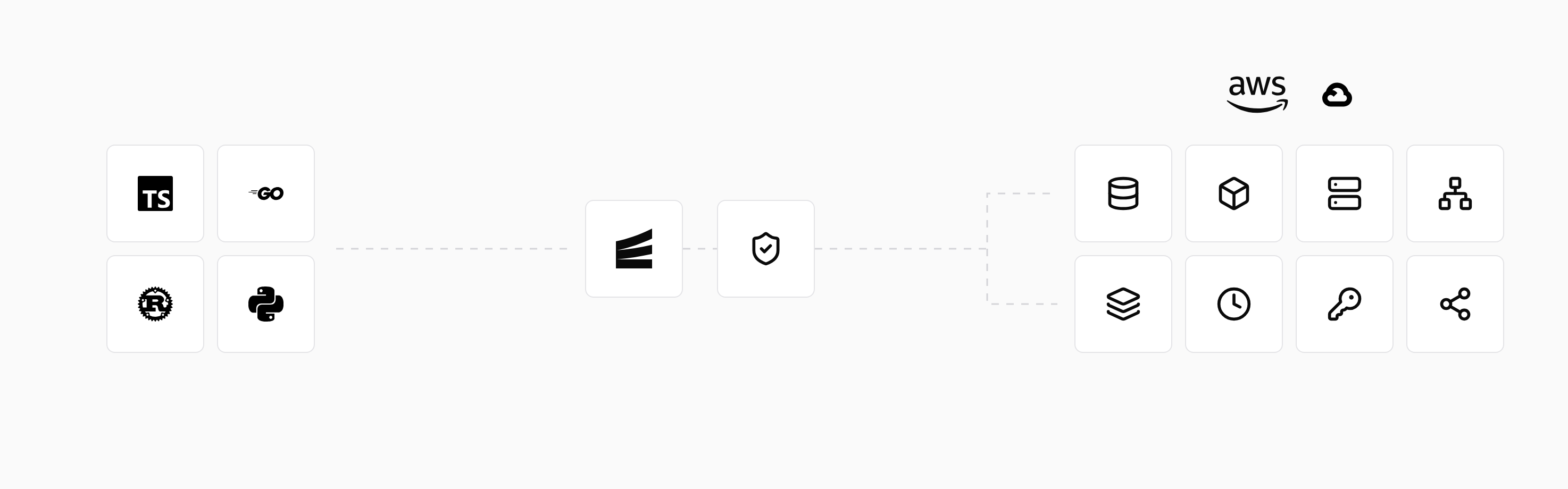
With Encore, developers declare services and infrastructure in application code, and the platform provisions the corresponding resources in their own AWS or GCP account. Your team can use a managed deployment workflow without maintaining separate infrastructure configuration for each declared resource.
For a service that uses a database and a queue, those declarations tell the platform what to create and which services need access. Encore configures the supported cloud resources and their connections as part of deployment. Adding a resource becomes an application change rather than a separate setup task for an infrastructure engineer.
The same application can run locally with encore run, which starts local versions of its declared resources. Developers can test changes before deploying them, and preview environments let a team review a pull request against its own deployed environment.
The managed platform also provides logs, metrics, and distributed tracing for deployed applications. Developers can follow a request across services and see the database queries and other operations involved when investigating a failure.
How much do cloud infrastructure management services cost?
The cloud bill and the management fee are usually separate costs. Providers may charge a monthly retainer, by the resources they manage, by engineering time, or as a percentage of cloud spending. Some also charge an initial fee to review and take over the environment.
A monthly fee might cover monitoring and routine changes, with separate charges for a migration or recovery project. Around-the-clock incident response can also cost more than business-hours support.
Quotes can be compared using the resources and support hours your application needs. The total includes the management fee, cloud usage, any required monitoring tools, and the maintenance your team continues to do.
An automation platform adds a software fee but can reduce the engineering time needed for recurring setup and configuration. The savings depend on how often your team performs that work. Cloud resource usage remains a separate cost under either approach.
What does your team still need to manage?
Application development usually stays with your team. That includes fixing code defects, reviewing releases, and deciding how to handle customer data after a failed transaction. The infrastructure provider can help investigate the environment while developers work on the application.
Your organization sets the requirements for data access and availability. The provider uses those requirements to configure the environment and plan its support coverage.
When resources run in your organization's cloud account, your team can retain access to the infrastructure and its billing. Deployment configuration and maintenance records also help a new provider or an internal team take over the work later.
Run in your terminal to get started locally.
Related guides
Frequently asked questions
Can a provider manage an existing cloud environment?
Many providers can take over an existing environment after reviewing its resources, access, and configuration. They may need to change monitoring, backups, or deployment practices before providing ongoing support.
Do infrastructure management services include cloud migration?
Some providers offer migration alongside ongoing management, but it may be a separate project. Moving an application into the cloud and maintaining it after the move involve different work.
Do I have to move my data into the management provider's account?
Not necessarily. A provider can manage resources in your organization's cloud account using access you grant it. Hosting arrangements vary, so account ownership is part of the service to clarify before signing up.
Deploy to your cloud on AWS and Google Cloud
without managing infrastructure
Encore lets developers and agents define application infrastructure directly in code, then automatically provisions it from local development to production in your AWS or GCP account.
