Best Go Web Framework for AI Coding Agents
net/http, Gin, Echo, Chi and Encore compared on what a coding agent needs from a Go backend: compiler feedback it can act on, a small API surface, and infrastructure it can run locally.

Go has a reputation as a language that coding agents handle well, mostly because of the compiler, since Go is statically typed, it refuses to compile programs with unused variables or imports, and go build finishes in seconds, so an agent learns about a broken change almost as soon as it makes it.
Go projects differ much more in the web layer, because the standard library leaves request binding, validation, middleware structure and everything below the handler to you, and an agent working in a codebase without conventions for those will invent a slightly different one in each package.
Developers report the same problem, since the most common frustration in the 2025 Go Developer Survey was making code follow Go idioms and best practices, cited by 33 percent of respondents, and 53 percent of respondents said non-functional code was their main problem with AI development tools.
What matters when an agent is writing the Go:
- Whether mistakes show up as compile errors or only as runtime behavior.
- How much framework-specific API the agent has to recall correctly.
- How request validation is declared, and whether it can be skipped by accident.
- Whether the agent can run the database and queues the code depends on before it finishes.
Go web frameworks for AI agents at a glance
Compare features across all five
Encore: typed endpoints with the infrastructure in the same Go code

Encore combines a Go backend framework with infrastructure declared in the same code, and an endpoint is a regular Go function with an //encore:api annotation, a typed params struct and a typed response. Encore parses those signatures at compile time to generate the HTTP layer, API documentation and clients, and the Postgres database and Pub/Sub topic below are package-level declarations that Encore finds the same way.
package orders

import (
	"context"
	"errors"
	"strings"

	"encore.dev/pubsub"
	"encore.dev/storage/sqldb"
)

var db = sqldb.NewDatabase("orders", sqldb.DatabaseConfig{
	Migrations: "./migrations",
})

type OrderPlaced struct {
	OrderID int64
	Email   string
}

var OrderEvents = pubsub.NewTopic[*OrderPlaced]("order-placed", pubsub.TopicConfig{
	DeliveryGuarantee: pubsub.AtLeastOnce,
})

type CreateParams struct {
	Email string
	Total int
}

// Validate runs before the handler. A non-nil error returns 400 Bad Request.
func (p *CreateParams) Validate() error {
	if !strings.Contains(p.Email, "@") {
		return errors.New("email is invalid")
	}
	if p.Total <= 0 {
		return errors.New("total must be positive")
	}
	return nil
}

type Order struct {
	ID    int64
	Email string
	Total int
}

//encore:api public method=POST path=/orders
func Create(ctx context.Context, p *CreateParams) (*Order, error) {
	o := &Order{Email: p.Email, Total: p.Total}
	err := db.QueryRow(ctx,
		`INSERT INTO orders (email, total) VALUES ($1, $2) RETURNING id`,
		p.Email, p.Total,
	).Scan(&o.ID)
	if err != nil {
		return nil, err
	}
	if _, err := OrderEvents.Publish(ctx, &OrderPlaced{OrderID: o.ID, Email: o.Email}); err != nil {
		return nil, err
	}
	return o, nil
}
Another service calls this endpoint by importing the package and calling orders.Create, which Encore compiles into a real network call. If an agent passes a field that does not exist, encore check, which checks the application for compile-time errors, fails with the Go compiler's unknown field Amount in struct literal of type orders.CreateParams, the same error Go gives for any struct, so the agent fixes an API mismatch between services the way it fixes a typo.
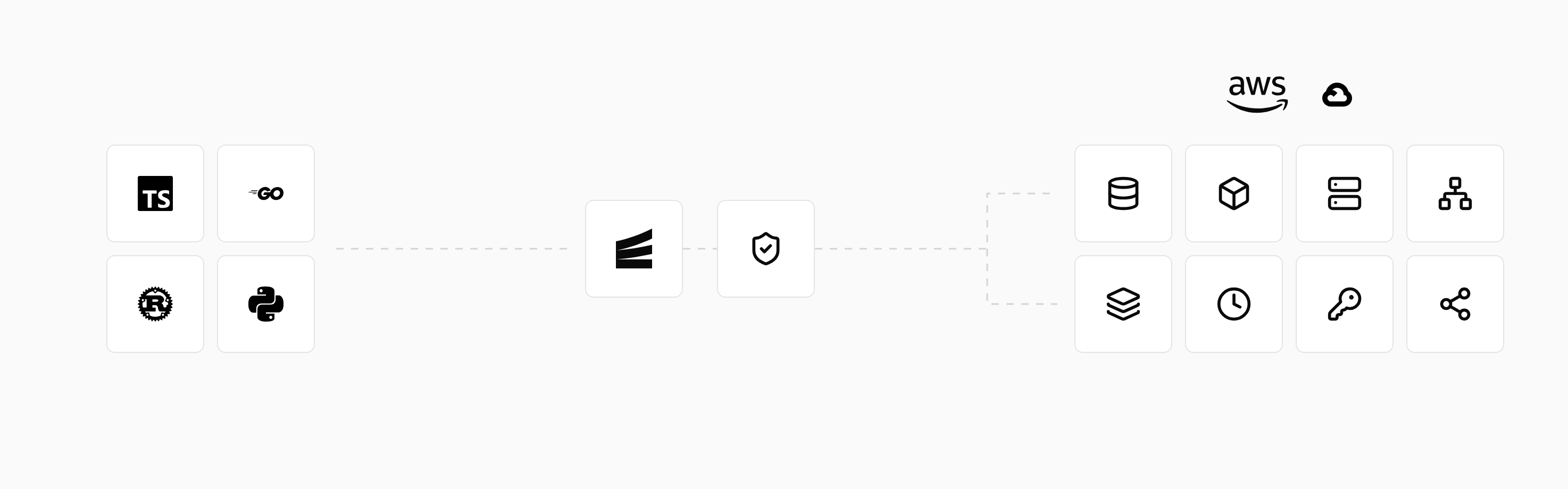
encore run starts Postgres locally, runs the migrations and starts the Pub/Sub topic, so an agent can call the endpoint and check the result before it reports back, and the local MCP server lets it query the database and read traces directly. On deploy, Encore provisions the same declarations in your own AWS or GCP account, with networking, IAM and sizing configured per environment outside the code the agent edits, so the agent declares infrastructure in code while the cloud access sits with Encore's IAM role rather than with the agent.
Key features
- API endpoints as plain Go functions, with request validation through a
Validate() errormethod. - Service-to-service calls as function calls, checked by the Go compiler.
- Postgres, Pub/Sub, cron jobs, caches, object storage and secrets declared in Go.
encore testrunsgo testagainst real databases, with per-test databases throughet.NewTestDatabase.- Deploys to your own AWS or GCP account, with tracing and logs built in.
Good to know
Encore needs its own compilation step, so go build and go test are replaced by encore run, encore check and encore test, which an agent has to be told about in its rules file, and encore llm-rules init generates that file for Cursor, Claude Code, VS Code or Zed, or as an AGENTS.md file. Existing net/http handlers can be mounted as raw endpoints, so a codebase can move over one service at a time. For a head-to-head with two of the frameworks below, see Gin vs Encore and Echo vs Encore.
Run in your terminal to get started locally.
net/http: the standard library router
 net/http
The standard library's net/http package gained method matching and path wildcards in Go 1.22, which removed the most common reason to pull in a router.
package main

import (
	"encoding/json"
	"net/http"
)

type CreateOrder struct {
	Email string `json:"email"`
	Total int    `json:"total"`
}

func main() {
	mux := http.NewServeMux()

	mux.HandleFunc("POST /orders", func(w http.ResponseWriter, r *http.Request) {
		var req CreateOrder
		if err := json.NewDecoder(r.Body).Decode(&req); err != nil {
			http.Error(w, err.Error(), http.StatusBadRequest)
			return
		}
		if req.Email == "" || req.Total < 1 {
			http.Error(w, "email and a positive total are required", http.StatusBadRequest)
			return
		}
		w.Header().Set("Content-Type", "application/json")
		w.WriteHeader(http.StatusCreated)
		json.NewEncoder(w).Encode(req)
	})

	mux.HandleFunc("GET /orders/{id}", func(w http.ResponseWriter, r *http.Request) {
		id := r.PathValue("id")
		json.NewEncoder(w).Encode(map[string]string{"id": id})
	})

	http.ListenAndServe(":8080", mux)
}
Key features
- No dependencies, and an API that has been stable for over a decade.
- Patterns like
"GET /orders/{id}"withr.PathValue. - Every Go middleware library works with
http.Handler.
Good to know
net/http has the smallest surface for an agent to get wrong and also the most code per endpoint, since decoding, validation, error formatting and status codes are written by hand each time. In a large codebase that repetition is where agents drift, and the response shape of one handler stops matching the next, which is the kind of "almost right" result that 66 percent of developers in the 2025 Stack Overflow survey named as their biggest frustration with AI tools.
Gin: binding and validation in struct tags
 Gin
Gin is the most widely used Go web framework, used by 48 percent of Go developers in JetBrains' 2025 Developer Ecosystem survey, with a fast router and ShouldBindJSON, which decodes a request and checks it against binding tags through go-playground/validator.
package main

import (
	"net/http"

	"github.com/gin-gonic/gin"
)

type CreateOrder struct {
	Email string `json:"email" binding:"required,email"`
	Total int    `json:"total" binding:"required,min=1"`
}

func main() {
	r := gin.Default()

	r.POST("/orders", func(c *gin.Context) {
		var req CreateOrder
		if err := c.ShouldBindJSON(&req); err != nil {
			c.JSON(http.StatusBadRequest, gin.H{"error": err.Error()})
			return
		}
		c.JSON(http.StatusCreated, req)
	})

	r.Run(":8080")
}
Key features
- Validation rules live on the struct, next to the fields.
- Route groups and middleware for auth and logging.
- A large body of examples, which models have seen plenty of.
Good to know
Validation tags are strings, so a typo such as binding:"requried" compiles and only fails at runtime, which takes away the compiler feedback that makes Go pleasant for agents. Handlers take *gin.Context instead of http.Handler, so standard middleware needs adapting.
Echo: handlers that return errors
 Echo
Echo handlers return an error, which Echo turns into a response through one central error handler, and Bind decodes path, query and body data into a struct.
package main

import (
	"net/http"

	"github.com/labstack/echo/v4"
)

type CreateOrder struct {
	Email string `json:"email"`
	Total int    `json:"total"`
}

func main() {
	e := echo.New()

	e.POST("/orders", func(c echo.Context) error {
		var req CreateOrder
		if err := c.Bind(&req); err != nil {
			return echo.NewHTTPError(http.StatusBadRequest, err.Error())
		}
		// Echo has no built-in validator; register one with e.Validator
		// and call c.Validate(&req) to check fields.
		return c.JSON(http.StatusCreated, req)
	})

	e.Logger.Fatal(e.Start(":8080"))
}
Key features
- Returning errors from handlers keeps error responses consistent.
- Built-in middleware for CORS, rate limiting, JWT and recovery.
- Binding from several sources into one struct.
Good to know
Echo leaves validation to a validator you register, so an agent has to find that setup and remember to call c.Validate, although the error-returning handler shape is close to idiomatic Go, which agents tend to follow well.
Chi: net/http with composable routing
 Chi
Chi is a small router built on http.Handler, adding nested routes, route groups and a set of standard middleware without changing the handler signature.
package main

import (
	"encoding/json"
	"net/http"

	"github.com/go-chi/chi/v5"
	"github.com/go-chi/chi/v5/middleware"
)

func main() {
	r := chi.NewRouter()
	r.Use(middleware.Logger)

	r.Route("/orders", func(r chi.Router) {
		r.Get("/{id}", func(w http.ResponseWriter, r *http.Request) {
			id := chi.URLParam(r, "id")
			json.NewEncoder(w).Encode(map[string]string{"id": id})
		})
	})

	http.ListenAndServe(":8080", r)
}
Key features
- Plain
http.HandlerFunchandlers, so anything written for net/http works. - Nested routers and per-group middleware.
- No external dependencies beyond the standard library.
Good to know
Chi is close enough to net/http that agents rarely misuse it, and it adds just as little on top, so decoding, validation and infrastructure are the same decisions as with the standard library. Since Go 1.22 the routing gap has narrowed, and Chi's case now rests mostly on middleware composition.
How to choose
- Encore when the service talks to Postgres or Pub/Sub, or calls other services, and you want those calls checked by the compiler and the infrastructure runnable locally.
- net/http for small services where no dependencies matter more than less boilerplate.
- Gin for JSON APIs that want struct-tag validation and a large example base.
- Echo when consistent error handling through returned errors matters most.
- Chi when you want net/http compatibility with grouped routes and middleware.
For a wider comparison that is not focused on agents, see the best Go backend frameworks and Gin vs Echo vs Fiber.
Related guides
- How to build a REST API with Go
- Chi vs Encore
- How to give AI coding agents real infrastructure to test against
- How to add a database to your Go API
- Add a database to a Go API and deploy it to AWS with an AI coding agent
- Best Go framework for microservices
- How to add Pub/Sub to a Go API
- Request Validation in Go: validator, ozzo-validation and Clean 400 Errors
Frequently asked questions
What is the best Go web framework for AI coding agents?
For a single HTTP service with no database, the standard library's net/http is a strong default, since every model has seen a lot of it and Go 1.22 added method and path patterns to its router. Chi adds composable middleware while staying net/http compatible, and Gin and Echo add binding and validation helpers. Encore suits Go backends that also need Postgres, Pub/Sub and cron jobs, because API endpoints are plain Go functions with typed requests and the infrastructure is declared in the same code, so the agent gets compile errors for API mismatches across services and can run the database and topics locally with encore run.
Why does Go work well with AI coding agents?
Go is statically typed and the compiler refuses to build programs with unused imports or variables, so an agent gets fast, specific errors after each change. The language and standard library change slowly, which means most of what a model learned about Go is still correct.
Should an agent use net/http or a framework in Go?
Use net/http when the service is small and you want the fewest dependencies. Pick a framework when you need conventions the standard library leaves to you, such as request binding with validation, grouped middleware, or, with Encore, typed service-to-service calls and infrastructure declared in code.
Deploy to your cloud on AWS and Google Cloud
without managing infrastructure
Encore lets developers and agents define application infrastructure directly in code, then automatically provisions it from local development to production in your AWS or GCP account.
