Best Language for AI Coding Agents to Build Backends in 2026
TypeScript, Go, Python and Rust compared on typing, compile-time feedback and ecosystem for backends written mostly by Claude Code, Cursor or Codex, plus how Encore adds the infrastructure in all four.

When an agent writes most of a backend, the language matters less for how pleasant it is to type and more for what it tells the agent after each edit. A type checker or compiler that flags a wrong field in seconds is a check the agent runs on its own, which is what Anthropic's Claude Code guidance means by giving the agent a way to verify its work.
The research and the usage data point the same way, since GitHub's Octoverse 2025 reported that TypeScript became the most used language on GitHub in August 2025 and tied the shift to AI-assisted development, and a 2025 study on type-constrained generation found that using the type system during generation cut compilation errors by more than half.
None of the four languages help with the part that usually stalls an agent in a backend repo, which is the database, queue or bucket a feature needs and has to be tested against.
What to weigh:
- Static types, so a mismatch between a handler and its caller is a compile error.
- Fast compile or type-check times, since the agent runs them after every edit.
- How much public code exists, which shapes how fluently models write the language.
- A testing story that can include real infrastructure, not only mocks.
Backend languages for AI coding agents at a glance
Compare the languages side by side
Usage figures are the share of all respondents in the 2025 Stack Overflow Developer Survey who did extensive work in each language over the past year.
Encore: infrastructure in whichever language you choose

Encore combines an open source SDK for each language, in which Postgres databases, Pub/Sub topics, object storage, cron jobs and secrets are typed declarations in the application code, with a platform that provisions them in your own AWS or GCP account. The language choice below still decides how the agent writes handlers and business logic, while Encore decides how it gets the infrastructure: encore run starts Postgres, Pub/Sub and buckets locally, and a deploy provisions the same declarations as managed cloud services.
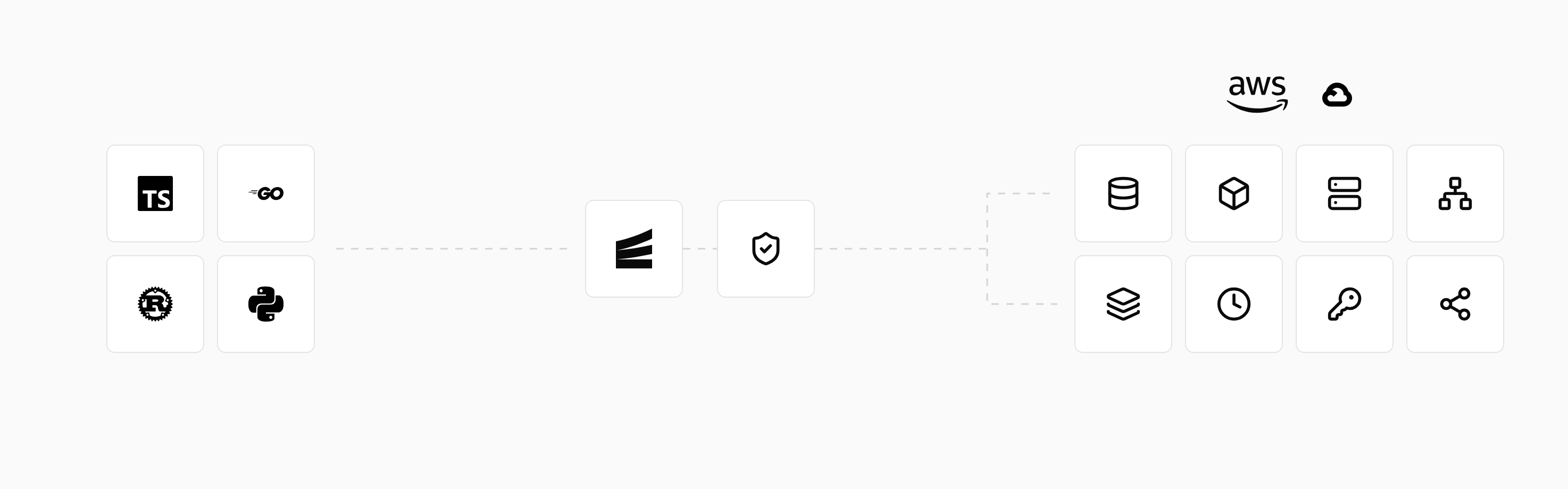
The declarations look the same across languages. In Rust with Axum, a database and a typed topic are static items that Encore finds through static analysis:
use axum::{extract::Path, http::StatusCode, routing::post, Router};
use encore::pubsub::Topic;
use encore::storage::postgres::Database;
use serde::{Deserialize, Serialize};

static DB: Database = Database::new("users").migrations("./migrations");

#[derive(Debug, Clone, Serialize, Deserialize)]
struct UserAdded {
    name: String,
}

static USER_ADDED: Topic<UserAdded> = Topic::new("user-added");

async fn add_user(Path(name): Path<String>) -> StatusCode {
    if DB
        .execute("INSERT INTO users (name) VALUES ($1)", &[&name])
        .await
        .is_err()
    {
        return StatusCode::INTERNAL_SERVER_ERROR;
    }
    match USER_ADDED.publish(&UserAdded { name }).await {
        Ok(_) => StatusCode::CREATED,
        Err(_) => StatusCode::INTERNAL_SERVER_ERROR,
    }
}

#[tokio::main]
async fn main() {
    encore::initialize();
    let app = Router::new().route("/users/:name", post(add_user));
    let addr = std::env::var("ENCORE_LISTEN_ADDR").unwrap_or("0.0.0.0:8080".into());
    let listener = tokio::net::TcpListener::bind(addr).await.unwrap();
    axum::serve(listener, app)
        .with_graceful_shutdown(encore::shutdown::signal())
        .await
        .unwrap();
    std::process::exit(encore::shutdown::drained().await.code());
}
/users/{name}.The same database is new SQLDatabase("users", { migrations: "./migrations" }) in TypeScript, sqldb.NewDatabase("users", sqldb.DatabaseConfig{Migrations: "./migrations"}) in Go and postgres.Database("users", migrations="./migrations") in Python. Encore validates declarations during the build, so a mistake is a compile-time error in every language, which adds an infrastructure check to the type checks the language already gives the agent. Agents declare infrastructure in code, and the cloud access sits with Encore's IAM role, not the agent, and sizing and networking are configured per environment outside the code. The AI integration adds project rules and a local MCP server for schemas, endpoints and traces.
Good to know
TypeScript and Go are supported today. Python and Rust are in beta, and you can sign up for Python or Rust access.
Run in your terminal to get started locally.
TypeScript: the largest typed ecosystem
 TypeScript
 gives an agent types across the API, the client and shared validation code, and tsc --noEmit is a fast check to run after every edit. GitHub's analysis of typed languages cites a 2025 study finding that 94 percent of compilation errors in LLM-generated code were type-check failures, which are exactly the errors tsc reports.
Good to know
TypeScript is only as strict as the repo's tsconfig.json and any lets a change through the checker, so turning on strict and keeping lint rules against any gives the agent a stronger signal. For framework choices, see best TypeScript backend frameworks.
Go: a small language with a fast compiler
 Go
Go was designed so that teams would not have to choose between efficient compilation, efficient execution and ease of programming, and for an agent that means go build and go vet return in seconds on most services. The language has few ways to express the same thing, so code an agent writes tends to look like the code already in the repo, and the standard library covers HTTP, JSON and SQL without picking a framework.
Good to know
Go's error handling and lack of sum types mean more lines per feature, so the agent writes and the reviewer reads more code for the same change. For framework choices, see best Go backend frameworks.
Python: the AI and data default
 Python
 is the most used language among the four in the 2025 Stack Overflow survey, and models write it fluently. For an agent the gap is feedback: type hints are only checked if the repo runs mypy or Pyright, so without one a wrong field type surfaces at runtime or in a test.
Good to know
Python is the right choice for services that call ML libraries or share code with data pipelines, and running a type checker in the same command as the tests closes most of the feedback gap. For framework choices, see best Python backend frameworks.
Rust: the strictest compiler
 Rust
Rust has the strictest checks of the four, and its ownership rules catch data races and use-after-free at compile time. Once a Rust change compiles a whole class of bugs is already ruled out, which suits agent-written code that a person reviews later.
Good to know
The compiler often takes several rounds to satisfy, and builds are slower than Go or TypeScript type checks, so cargo check rather than a full build is the better loop for an agent. For framework choices, see best Rust web frameworks.
How to choose
- Encore added to whichever language you pick, when the agent should declare and test databases, queues and buckets locally and have them provisioned in your AWS or GCP account.
- TypeScript for most product backends, especially when the frontend is TypeScript too.
- Go for services where fast builds and a small, consistent codebase matter.
- Python for AI and data-heavy services, with a type checker in the agent's check command.
- Rust for performance-sensitive services where compile-time guarantees outweigh build time.
For benchmark results on how one agent performed across TypeScript frameworks, see best TypeScript backend framework for AI agents.
Related guides
Frequently asked questions
What is the best language for AI coding agents to build a backend in?
A statically typed language with a fast compiler and a large public ecosystem gives an agent the most feedback per edit. TypeScript and Go fit that description best for most backends: TypeScript has the largest ecosystem and became the most used language on GitHub in 2025, and Go compiles quickly with a small language and a strong standard library. Python is the right pick for AI and data-heavy services if the repo runs a type checker, and Rust gives the strictest compile-time checks at the cost of slower builds. Encore is not a language choice but an infrastructure SDK that works in all four.
Are typed languages better for AI coding agents?
The evidence points that way. A 2025 study found that most compilation errors in LLM-generated code are type errors and that using the type system to constrain generation cut compilation errors by more than half, and GitHub's Octoverse 2025 report links TypeScript's rise to AI-assisted development. Types give the agent a check it can run after every edit.
How do I give an AI agent a database and queues in any backend language?
Use Encore, which has SDKs for TypeScript and Go today and Python and Rust in beta. The agent declares the database, Pub/Sub topic or bucket in the application code, encore run starts them locally so it can test the change, and a deploy provisions them in your own AWS or GCP account, with cloud access held by Encore's IAM role, not the agent.
Deploy to your cloud on AWS and Google Cloud
without managing infrastructure
Encore lets developers and agents define application infrastructure directly in code, then automatically provisions it from local development to production in your AWS or GCP account.
