Best Rust Web Frameworks in 2026
Axum, Actix Web, Rocket and Loco compared for teams building Rust backends, plus how Encore adds databases, Pub/Sub and cloud infrastructure to whichever framework you pick, such as Axum.

Rust web development has largely settled on Axum for new APIs, with Actix Web and Rocket as the established alternatives and Loco offering a Rails-style project on top of Axum. All of them run on Tokio and handle routing, extraction and serialization well, but once the service needs a Postgres database, a message broker and a bucket, the framework leaves those to you and the team ends up writing Docker Compose files for local development and Terraform for production next to the Rust code.
What to weigh when choosing:
- How the framework fits the Tokio and Tower ecosystem, which decides which middleware crates you can reuse.
- Whether you want plain async functions with extractors or macros that generate routes.
- How much is built in, from a bare router to a full project layout with ORM, jobs and mailers.
- Where the database, queues and cloud resources come from, which none of the frameworks decide.
Rust web frameworks at a glance
Compare features across all five options
Encore: the infrastructure SDK you add to your framework

Encore combines the Axum service you already have with infrastructure declared as static values in the same crate, as an SDK you add with the encore-dev crate and an encore::initialize() call rather than a framework you switch to, so Axum keeps handling routing and extraction while Postgres databases, Pub/Sub topics and subscriptions, object storage buckets, Redis, cron jobs and secrets are declarations that Encore finds through static analysis and provisions. encore run starts the databases, topics and buckets locally and applies migrations, while cron jobs run only where the app is deployed, and a deploy provisions the same declarations in your own AWS or GCP account, such as RDS and SNS/SQS on AWS or Cloud SQL and Pub/Sub on GCP.
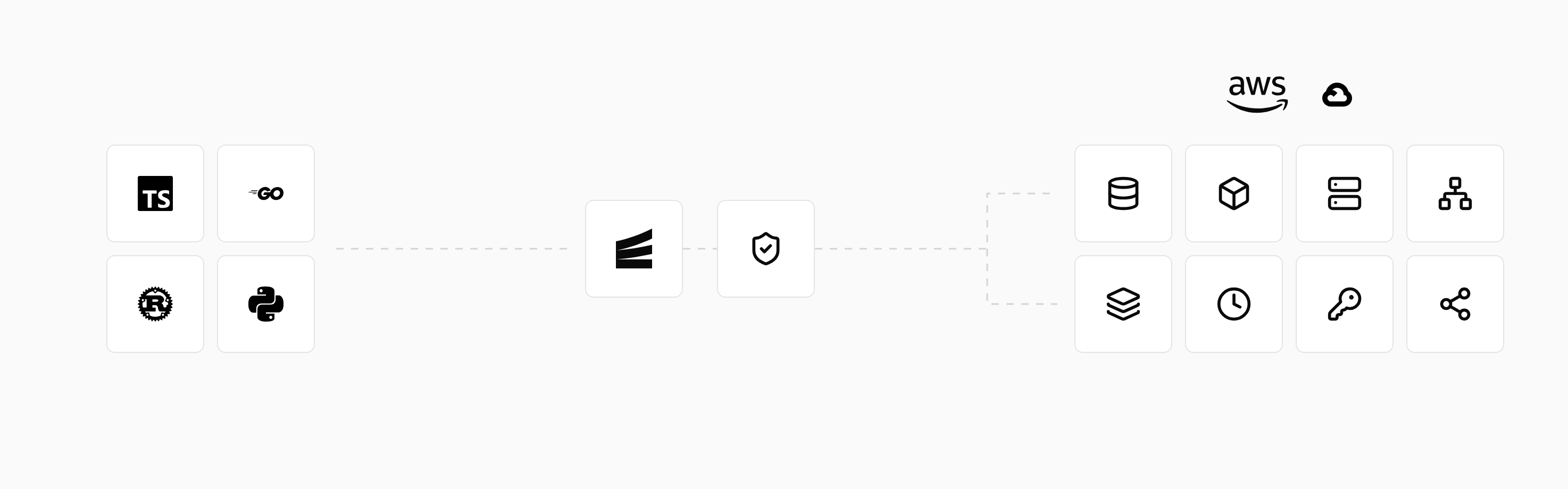
An Axum handler that inserts a row and publishes an event uses the declarations directly, without a pool in State or a broker client to construct at startup:
use axum::{http::StatusCode, routing::post, Json, Router};
use encore::pubsub::Topic;
use encore::storage::postgres::Database;
use serde::{Deserialize, Serialize};

// Encore finds these declarations and provisions them
// locally, in preview environments, and in your cloud.
static DB: Database = Database::new("users").migrations("./migrations");
static SIGNUPS: Topic<Signup> = Topic::new("signups");

#[derive(Serialize, Deserialize)]
struct Signup {
    email: String,
}

async fn create_user(Json(req): Json<Signup>) -> Result<StatusCode, StatusCode> {
    DB.execute("INSERT INTO users (email) VALUES ($1)", &[&req.email])
        .await
        .map_err(internal)?;
    SIGNUPS.publish(&req).await.map_err(internal)?;
    Ok(StatusCode::CREATED)
}

fn internal(_: encore::Error) -> StatusCode {
    StatusCode::INTERNAL_SERVER_ERROR
}

#[tokio::main]
async fn main() {
    encore::initialize();
    let app = Router::new().route("/users", post(create_user));
    let addr = std::env::var("ENCORE_LISTEN_ADDR").unwrap_or("0.0.0.0:8080".into());
    let listener = tokio::net::TcpListener::bind(addr).await.unwrap();
    axum::serve(listener, app)
        .with_graceful_shutdown(encore::shutdown::signal())
        .await
        .unwrap();
}
A subscription to that topic is another static, registered with #[encore::pubsub::register] so it starts with the app:
use encore::pubsub::{Message, Subscription};

#[encore::pubsub::register]
static WELCOME: Subscription<Signup> =
    Subscription::new(&SIGNUPS, "send-welcome", send_welcome).max_concurrency(4);

async fn send_welcome(msg: Message<Signup>) -> Result<(), encore::Error> {
    send_email(&msg.data.email).await
}
Scheduled work is declared the same way, and the route that serves the job is built from the job's own path so the two cannot drift apart:
use encore::cron;

// Encore calls POST /internal/welcome-emails every 2 hours.
static WELCOME_EMAILS: cron::Job = cron::Job::new(
    "welcome-email",
    "/internal/welcome-emails",
    cron::Schedule::Every("2h"),
)
.title("Send welcome emails");

let app = Router::new()
    .route(WELCOME_EMAILS.path(), post(send_welcome_emails));
Key features
- Postgres, Pub/Sub, object storage, Redis, cron jobs, secrets and metrics are
staticdeclarations next to the code that uses them. - An AI coding agent that needs a bucket or a cron job adds one more
staticin the same change, and the next deploy provisions it like the rest of the service. encore runstarts the infrastructure locally, and underencore testeach test gets its own migrated database.- Subscriptions take retry, backoff, ack deadline and concurrency options in the declaration, and ordered topics deliver messages per key in order.
- A deploy provisions the same declarations in your own AWS or GCP account, with no runtime dependency on Encore for production traffic.
Good to know
Encore handles infrastructure, leaves HTTP to the framework and works with whichever one you pick, so the framework comparison below still applies. Cron jobs run where the app is deployed rather than under encore run. Rust support is in beta, and you can sign up for access.
Axum: the Tokio team's framework
 Axum
Axum is maintained by the Tokio project and builds on Hyper and Tower, so handlers are plain async functions whose arguments are extractors and any Tower middleware works as a layer.
use axum::{http::StatusCode, routing::post, Json, Router};
use serde::Deserialize;

#[derive(Deserialize)]
struct Signup {
    email: String,
}

async fn create_user(Json(req): Json<Signup>) -> (StatusCode, String) {
    (StatusCode::CREATED, req.email)
}

#[tokio::main]
async fn main() {
    let app = Router::new().route("/users", post(create_user));
    let listener = tokio::net::TcpListener::bind("0.0.0.0:3000").await.unwrap();
    axum::serve(listener, app).await.unwrap();
}
Key features
- Handlers are async functions, with extractors for paths, queries, JSON bodies and shared
State. - Middleware comes from Tower and tower-http, covering tracing, CORS, compression and timeouts.
- No macros are needed for routing, which keeps compiler errors readable once you know the extractor rules.
Good to know
Axum is a router and leaves the database, auth, background jobs and project structure to you, and handler trait errors can be cryptic when an extractor is in the wrong position, and the #[debug_handler] macro from axum-macros helps there. Route path syntax changed in 0.8 from /:id to /{id}.
Actix Web: mature and fast
 Actix Web
 is one of the oldest production Rust frameworks and pairs attribute macros for routes with typed extractors.
use actix_web::{post, web, App, HttpResponse, HttpServer, Responder};
use serde::Deserialize;

#[derive(Deserialize)]
struct Signup {
    email: String,
}

#[post("/users")]
async fn create_user(req: web::Json<Signup>) -> impl Responder {
    HttpResponse::Created().body(req.email.clone())
}

#[actix_web::main]
async fn main() -> std::io::Result<()> {
    HttpServer::new(|| App::new().service(create_user))
        .bind(("0.0.0.0", 8080))?
        .run()
        .await
}
Key features
- Extractors cover JSON, forms, paths, queries and shared
web::Datastate. - WebSockets, multipart, sessions and static files are available through first-party crates.
- It has a long production history and consistently strong benchmark results.
Good to know
Actix Web runs each worker on its own single-threaded Tokio runtime, so some Tokio-based crates and Send bounds behave differently than in Axum, and its middleware model is its own rather than Tower, which means fewer shared crates with the Axum ecosystem.
Rocket: ergonomics first
 Rocket
 uses attribute macros and request guards so that a route declaration carries its method, path and data format, and since 0.5 it runs on stable Rust with async handlers.
#[macro_use]
extern crate rocket;

use rocket::http::Status;
use rocket::serde::{json::Json, Deserialize};

#[derive(Deserialize)]
#[serde(crate = "rocket::serde")]
struct Signup {
    email: String,
}

#[post("/users", data = "<req>")]
fn create_user(req: Json<Signup>) -> (Status, String) {
    (Status::Created, req.email.clone())
}

#[launch]
fn rocket() -> _ {
    rocket::build().mount("/", routes![create_user])
}
Key features
- Request guards validate input and authentication through types.
- Configuration, templating and database pools through
rocket_db_poolsare built in or first-party. - Fairings provide hooks for request and response processing.
Good to know
Rocket releases less often than Axum or Actix Web, and its macro-heavy style can make it harder to step outside the patterns it expects, so teams starting large projects usually compare its current release activity with the alternatives.
Loco: a Rails-like layer on Axum
 Loco
Loco generates a full project around Axum with SeaORM models, migrations, background workers, mailers and authentication, and its CLI scaffolds controllers and models in the style of Rails.
Key features
- Generators create models, controllers, migrations and scaffolds.
- Background workers, scheduled tasks and mailers are part of the framework.
- It is built on Axum, so Axum extractors and Tower middleware still apply.
Good to know
Loco makes many decisions for you, which speeds up the first weeks and constrains you later if your needs differ from its conventions, and the database, Redis and worker processes still have to be run locally and provisioned for production.
How to choose
- Encore added to whichever framework you pick, such as Axum, when you want Postgres, Pub/Sub, buckets and cron jobs declared in Rust, with the database, topics and buckets running locally and everything provisioned in your AWS or GCP account.
- Axum for most new APIs, especially when you want Tower middleware.
- Actix Web for a mature framework with a large built-in feature set.
- Rocket when concise, macro-driven routes matter most.
- Loco when you want a full project structure with an ORM and workers from the start.
Whichever framework you pick, the database, broker and buckets still have to exist locally, in preview environments and in production. Rust support in Encore is in beta, and you can sign up for access if you want to declare that infrastructure in the framework you already use.
Related guides
Frequently asked questions
What is the best Rust web framework in 2026?
Axum is the common default for new APIs because it is built on Tokio, Tower and Hyper. Actix Web is a mature, fast alternative with its own ecosystem, Rocket favors ergonomics and built-in features, and Loco gives you a Rails-like full-stack structure on top of Axum. Encore is not a competing framework but an infrastructure SDK you add to whichever framework you pick, such as Axum, and it provisions the infrastructure the code declares.
Is Axum better than Actix Web?
Neither is faster in a way that matters for most APIs. Axum integrates directly with the Tokio and Tower ecosystem and uses plain async functions with extractors, while Actix Web has its own runtime layer on top of Tokio, a larger built-in feature set and a long production track record.
Is Rocket still maintained?
Rocket 0.5 is stable on Rust stable and supports async, although releases come less often than for Axum or Actix Web, so check the current release activity before starting a large project on it.
How do I add Postgres and Pub/Sub to an Axum app?
Add the encore-dev crate to the Axum service you already have, call encore::initialize() before serving, and declare Database::new and Topic::new as static values, with Subscription::new for subscribers marked #[encore::pubsub::register] so that encore::initialize() starts them. Axum keeps the routing, encore run starts the database and topic locally, and a deploy provisions them in your own AWS or GCP account.
Deploy to your cloud on AWS and Google Cloud
without managing infrastructure
Encore lets developers and agents define application infrastructure directly in code, then automatically provisions it from local development to production in your AWS or GCP account.
