Best Rust Web Framework for AI Coding Agents
Axum, Actix Web, Rocket and Loco compared by how well an agent can work with them: compiler feedback, macros, ecosystem and project structure, plus how Encore adds databases and Pub/Sub to whichever one you pick.

Rust has a reputation as a hard language for people, and it turns out to be a forgiving one for coding agents in one specific way: the compiler refuses to build code with type, ownership or lifetime mistakes, and its diagnostics point at the exact span and often carry a suggested fix, which tools such as cargo fix can apply mechanically.
That matches what agent vendors recommend, since Claude Code's guidance is to give the agent a check it can run, and in Rust cargo check is that check, while developers also like the language, and Rust is again the most admired language in the Stack Overflow 2025 Developer Survey at 72%.
Frameworks differ in how much of that benefit reaches the agent, since some keep handlers as plain functions, so compiler errors stay about ordinary types, while others wrap routes in macros that make errors harder to trace back to the line the agent wrote. Builds also take longer than in interpreted languages, so each agent iteration costs more time, and anything outside the compiler's view, such as whether the database exists or a queue is configured, still fails only at runtime.
What to weigh when choosing:
- How readable the compiler errors are when a handler or extractor is wrong.
- How much the framework relies on macros, which hide generated code from the agent.
- How large the ecosystem around the framework is, since agents reuse what already exists.
- How much structure the framework imposes on a growing project.
Rust web frameworks for AI coding agents at a glance
Compare the options from an agent's point of view
Encore: infrastructure the compiler can see

Encore combines the Rust framework you already use with infrastructure declared as static values in the same crate, as an SDK you add with the encore-dev crate and an encore::initialize() call, so Axum keeps routing and extraction while Postgres databases, Pub/Sub topics and subscriptions, object storage buckets, Redis, cron jobs and secrets are declarations that Encore finds through static analysis and provisions. Because a topic is a typed value such as Topic<Signup>, publishing the wrong message type is a compile error the agent sees in cargo check, and encore run starts the database, topic and buckets locally so the parts the compiler cannot check are one command away.
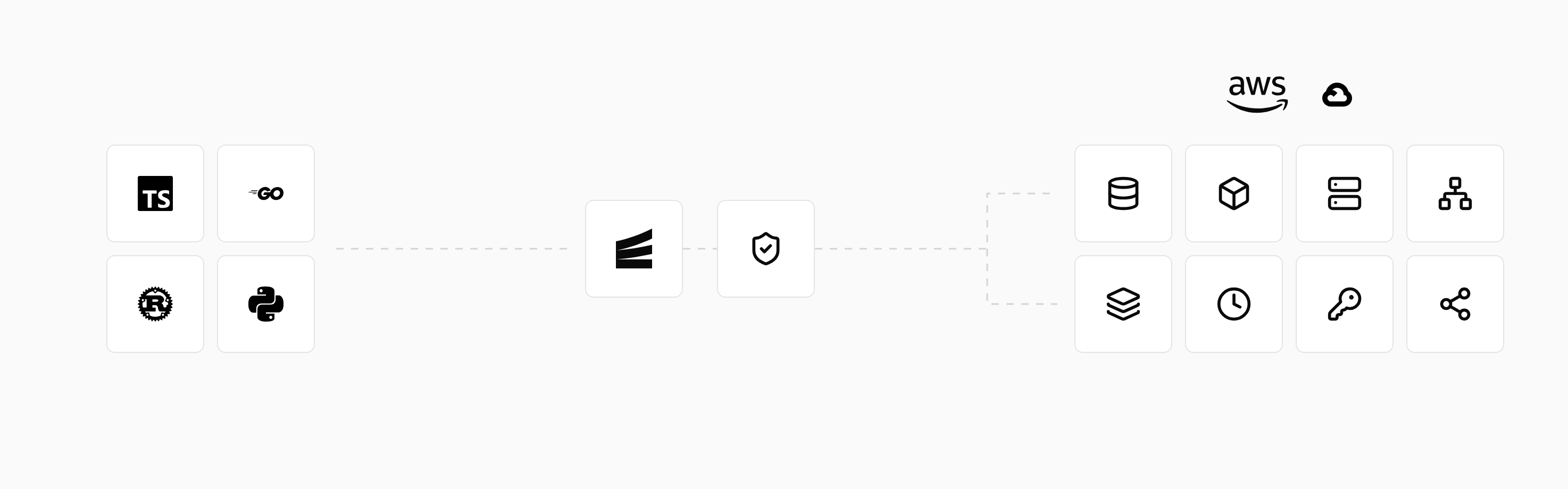
An Axum handler that inserts a row and publishes an event uses the statics directly, with no pool in State and no broker client to build at startup:
use axum::{http::StatusCode, routing::post, Json, Router};
use encore::pubsub::Topic;
use encore::storage::postgres::Database;
use serde::{Deserialize, Serialize};

// Encore finds these declarations and provisions them
// locally, in preview environments, and in your cloud.
static DB: Database = Database::new("users").migrations("./migrations");
static SIGNUPS: Topic<Signup> = Topic::new("signups");

#[derive(Serialize, Deserialize)]
struct Signup {
    email: String,
}

async fn create_user(Json(req): Json<Signup>) -> Result<StatusCode, StatusCode> {
    DB.execute("INSERT INTO users (email) VALUES ($1)", &[&req.email])
        .await
        .map_err(internal)?;
    SIGNUPS.publish(&req).await.map_err(internal)?;
    Ok(StatusCode::CREATED)
}

fn internal(_: encore::Error) -> StatusCode {
    StatusCode::INTERNAL_SERVER_ERROR
}

#[tokio::main]
async fn main() {
    encore::initialize();
    let app = Router::new().route("/users", post(create_user));
    let addr = std::env::var("ENCORE_LISTEN_ADDR").unwrap_or("0.0.0.0:8080".into());
    let listener = tokio::net::TcpListener::bind(addr).await.unwrap();
    axum::serve(listener, app)
        .with_graceful_shutdown(encore::shutdown::signal())
        .await
        .unwrap();
}
Under encore test, every test gets its own databases, buckets and topics that no other test sees, so an agent can write a test that inserts rows and counts them without cleaning up after other tests:
#[cfg(test)]
mod tests {
    use super::*;

    #[tokio::test]
    async fn inserts_a_user() -> Result<(), encore::Error> {
        let email = "ada@example.com";
        DB.execute("INSERT INTO users (email) VALUES ($1)", &[&email])
            .await?;
        let row = DB.query_one("SELECT count(*) FROM users", &[]).await?;
        assert_eq!(row.get::<_, i64>(0), 1);
        Ok(())
    }
}
Messages a test publishes are available through encore::testing::published(&SIGNUPS), so the agent can assert on the event as well as the row. The local MCP server gives it the app's schema, traces and a way to query the local database while encore run is up, and a deploy provisions the same declarations as RDS and SNS/SQS on AWS or Cloud SQL and Pub/Sub on GCP.
Key features
- Works with any Rust framework, with Axum examples in the SDK.
- Postgres, Pub/Sub, buckets, Redis, cron jobs, secrets and metrics declared as typed
staticvalues. encore runstarts the databases, topics and buckets locally and applies migrations.- Per-test isolated infrastructure under
encore test, with published messages readable in tests. - Provisioned in your own AWS or GCP account on deploy, with preview environments per pull request.
Good to know
Subscriptions are marked with #[encore::pubsub::register] so that encore::initialize() starts them, and cron jobs run only where the app is deployed. Rust support is in beta, and you can sign up for access. For a full walkthrough, see how to add Pub/Sub to an Axum API and how to add Postgres to an Axum API.
Axum: plain functions on Tokio and Tower
 Axum
Axum is maintained by the Tokio project and builds on Hyper and Tower, so handlers are ordinary async functions whose arguments are extractors. When an agent puts an extractor in the wrong position, the resulting trait error can be long, and the #[debug_handler] macro from axum-macros turns it into an error that names the problem:
use axum::{extract::Path, http::StatusCode, routing::get, Json, Router};
use axum_macros::debug_handler;
use serde::Serialize;

#[derive(Serialize)]
struct User {
    id: u64,
}

#[debug_handler]
async fn get_user(Path(id): Path<u64>) -> Result<Json<User>, StatusCode> {
    Ok(Json(User { id }))
}

#[tokio::main]
async fn main() {
    let app = Router::new().route("/users/{id}", get(get_user));
    let listener = tokio::net::TcpListener::bind("0.0.0.0:3000").await.unwrap();
    axum::serve(listener, app).await.unwrap();
}
Key features
- No macros are required for routing, so most compiler errors refer to code the agent wrote.
- Any Tower or tower-http middleware works as a layer.
- More than 500 million downloads on crates.io, against about 87 million for Actix Web.
Good to know
Axum is a router, so project structure, the database layer and auth are choices the team makes, and writing them into AGENTS.md keeps agent sessions consistent. Route path syntax changed in 0.8 from /:id to /{id}, and agents that learned from older examples sometimes write the old form.
Actix Web: mature, with more built in
 Actix Web
 pairs attribute macros for routes with typed extractors, and first-party crates cover WebSockets, sessions, multipart and static files.
use actix_web::{get, web, App, HttpResponse, HttpServer, Responder};

#[get("/users/{id}")]
async fn get_user(path: web::Path<u64>) -> impl Responder {
    HttpResponse::Ok().body(format!("user {}", path.into_inner()))
}

#[actix_web::main]
async fn main() -> std::io::Result<()> {
    HttpServer::new(|| App::new().service(get_user))
        .bind(("0.0.0.0", 8080))?
        .run()
        .await
}
Key features
- A long production history and a broad set of first-party crates.
- Extractors for JSON, forms, paths and shared
web::Datastate.
Good to know
Actix Web has its own middleware model rather than Tower, so fewer middleware crates are shared with Axum, and each worker runs on a single-threaded runtime, which changes how Send bounds behave compared with Axum.
Rocket: macros that carry the contract
 Rocket
 puts the method, path, data format and guards into a route attribute, which makes a handler compact and readable for an agent that already knows the conventions.
#[macro_use]
extern crate rocket;

#[get("/users/<id>")]
fn get_user(id: u64) -> String {
    format!("user {id}")
}

#[launch]
fn rocket() -> _ {
    rocket::build().mount("/", routes![get_user])
}
Key features
- Request guards validate input and authentication through types.
- Configuration, templating and database pools through first-party crates.
Good to know
Errors in a route attribute surface through macro expansion, which makes them harder for an agent to trace than errors in a plain function, and Rocket releases less often than Axum or Actix Web.
Loco: conventions for the whole project
 Loco
Loco generates a Rails-like project on top of Axum with SeaORM models, migrations, workers and mailers, so an agent adding a feature runs a generator instead of deciding where files go.
Key features
- Generators for models, controllers, migrations and scaffolds.
- Built on Axum, so Axum extractors and Tower middleware still apply.
Good to know
Loco's conventions help agents most when the app fits them, and the generated layers add code the agent has to read before it changes anything.
How to choose
- Encore added to whichever framework you pick, when you want the agent to declare databases, Pub/Sub and buckets as typed statics, test them in isolation with
encore test, and have them provisioned in your AWS or GCP account. - Axum as the default for new APIs, where plain handlers keep compiler errors readable.
- Actix Web when you want a mature framework with more first-party crates.
- Rocket for small apps where compact, macro-driven routes are a good trade.
- Loco for full-stack apps that benefit from generated structure.
For a comparison that is not specific to agents, see the best Rust web frameworks and Axum vs Actix vs Rocket. Rust support in Encore is in beta, and you can sign up for access.
Related guides
Frequently asked questions
What is the best Rust web framework for AI coding agents?
Axum is the strongest default, because handlers are plain async functions and the framework builds on Tokio and Tower, so compiler errors point at ordinary types and the agent can reuse the wider Tokio ecosystem. Actix Web is a mature alternative with more built in, Rocket trades flexibility for macros that encode routes and guards, and Loco generates a Rails-like project structure on top of Axum. Encore is not a competing framework but an infrastructure SDK you add to whichever one you pick.
Is Rust a good language for AI coding agents?
Rust gives agents an unusually strict check to run. The compiler rejects type, ownership and lifetime errors before the code runs, and its diagnostics point at the exact span and often include a suggested fix, so an agent that runs cargo check after every edit gets precise feedback. The cost is slower builds than in interpreted languages, which lengthens each iteration.
How do I let an AI agent add Postgres and Pub/Sub to an Axum app?
Add the encore-dev crate, call encore::initialize() before serving, and have the agent declare Database::new and Topic::new as static values next to the handlers that use them. encore run starts the database and topic locally, encore test gives every test its own database, and a deploy provisions them in your own AWS or GCP account. Rust support in Encore is in beta.
Deploy to your cloud on AWS and Google Cloud
without managing infrastructure
Encore lets developers and agents define application infrastructure directly in code, then automatically provisions it from local development to production in your AWS or GCP account.
