The Best Backend Frameworks for AI Agents to Build On in 2026
Encore, FastAPI, Django, NestJS, Hono and Gin, judged by how quickly each one tells a coding agent that its change is wrong: at compile time, on a local run, or in production.

An agent that writes a backend handler moves on as soon as it believes the change works. What decides the quality of its work is how quickly the framework proves it wrong. Some fail at compile time, some at the first request, and some only once the code meets the real database or queue in production.
The frameworks below are judged on that feedback loop: types first, then a local run with the real dependencies, then visibility into what a request actually did.
What an agent needs from a backend framework:
- Request and response shapes that fail at build time when they are wrong.
- A local run that includes the database and queues, not only the HTTP layer.
- Predictable project layout, so the agent finds where things go.
- Traces or logs that show which calls a request made.
Backend frameworks for AI agents at a glance
Compare the feedback each framework gives an agent
Encore: types, local infrastructure and traces in one command

Encore is an open source infrastructure SDK for TypeScript and Go that declares infrastructure in the application code. APIs are typed functions, and Postgres databases, Pub/Sub topics, cron jobs and buckets are declarations next to them. encore run starts the app and its infrastructure locally, and a deploy provisions the same declarations in your own AWS or GCP account.
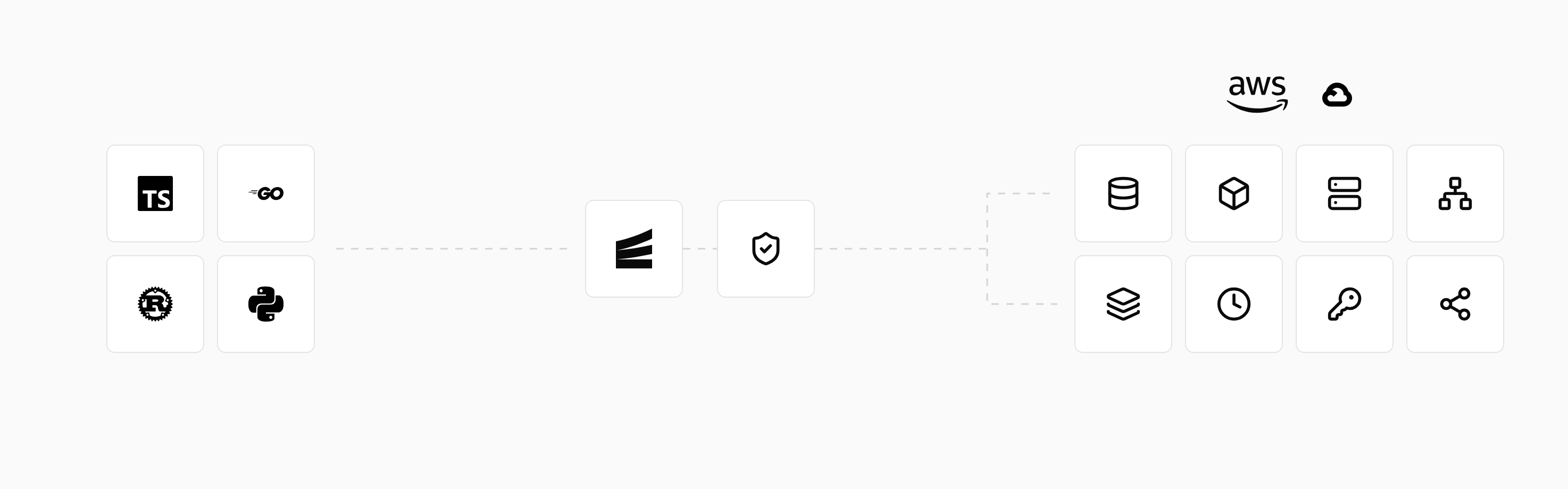
A handler that publishes an event, and a subscriber that handles it once, look like this:
import { api } from "encore.dev/api";
import { Topic, Subscription } from "encore.dev/pubsub";

interface OrderPlaced {
  orderId: string;
}

export const orderPlaced = new Topic<OrderPlaced>("order-placed", {
  deliveryGuarantee: "at-least-once",
});

export const placeOrder = api(
  { expose: true, method: "POST", path: "/orders" },
  async (req: OrderPlaced): Promise<OrderPlaced> => {
    await orderPlaced.publish(req);
    return req;
  },
);

const handled = new Set<string>(); // Use a table with a unique key in production.

const _ = new Subscription(orderPlaced, "send-receipt", {
  handler: async (event) => {
    if (handled.has(event.orderId)) return; // At-least-once delivery.
    handled.add(event.orderId);
  },
});
Each layer of feedback is there for the agent. Publishing the wrong shape is a compile error. encore run delivers the message locally, and through the local MCP server the agent calls placeOrder and reads the trace that shows the publish and the subscriber run. Testing docs cover the same flow under encore test, and Encore's agent skills teach Claude Code, Cursor or Codex the conventions. When the change merges, it deploys to your own AWS account or GCP project, where the topic becomes SNS and SQS or Pub/Sub, and Encore provisions an IAM role for the service.
Key features
- Typed APIs with request validation.
- Local Postgres, Pub/Sub and object storage with
encore run. - Distributed tracing locally and in deployed environments.
- Postgres, Pub/Sub, cron jobs and buckets provisioned in your AWS or GCP account from the same code.

encore run. The same bucket declaration is used in preview environments and production.Good to know
Encore uses its own API and infrastructure declarations, so an agent follows Encore patterns rather than Express or Gin ones, and an existing app is ported rather than dropped in. Cron jobs do not run locally, and the agent calls the endpoint directly to test them.
Run in your terminal to get started locally.
FastAPI: typed Python with the stack left to you
FastAPI builds Python APIs from type hints, with Pydantic validating requests and responses and generating OpenAPI docs. Setup is uv add "fastapi[standard]" and fastapi dev, which finds the app in main.py and starts Uvicorn with auto-reload. Agents write clean FastAPI because the patterns are small and repeated across many public projects.
The feedback stops at the HTTP layer. A wrong payload fails at request time with a clear validation error, but the database, the queue and the worker come from separate libraries and Docker Compose, and each agent session needs that stack running before it can test more than one handler.
Django: conventions the agent already knows, errors at request time

Django is the batteries-included Python framework, with an ORM, migrations, admin and auth in one package. A project starts with django-admin startproject and runs with python manage.py runserver, and its conventions mean the agent knows where models, views and URLs live. Migrations generated from model changes give the reviewer a file for every schema change.
Type checking is optional and partial, and many mistakes appear only when a request hits the view. Background jobs need a separate queue library.
NestJS: structure the agent follows, more files per feature

NestJS structures TypeScript backends with modules, controllers, providers and dependency injection. npm i -g @nestjs/cli and nest new scaffold a project, and the CLI generators put new modules where the agent expects them. The compiler catches type errors before a run.
The decorator-heavy style produces more files per feature, which costs an agent more tokens to read and write, and databases and queues are separate packages.
Hono: compact routes, a router rather than a backend

Hono is a small TypeScript framework on Web Standards that runs on Cloudflare Workers, Bun, Deno and Node.js. npm create hono@latest scaffolds a project for the runtime you pick, and agents produce working handlers quickly. Data and queue choices are left to the team, and local testing depends on the runtime and the services you add.
For an agent, that makes Hono fast for the first handler and slower for the tenth, once the change touches storage, background work or a second service and the agent has to wire each piece up itself.
Gin: Go compiler feedback, everything else assembled
 Gin
Gin is a widely used Go HTTP framework with fast routing, middleware and binding to structs, fetched on the next build once you import github.com/gin-gonic/gin. Go's compiler gives agents quick, precise errors. Configuration, infrastructure and tracing are assembled from other packages, and the agent needs those conventions written down in project instructions.
Why the feedback loop matters
The SWE-bench paper scored agents on whether their patches pass a repository's tests, the same signal a framework's tests and types give in daily use. TypeScript's handbook describes static checking as catching errors before code runs, and traces built on OpenTelemetry concepts show an agent which calls a request made.
How to choose
- Encore when agents build TypeScript or Go backends and you want them to test databases and queues locally and deploy to your own AWS or GCP account.
- FastAPI for typed Python APIs with docs generated from the code.
- Django for Python apps that want an admin and ORM from day one.
- NestJS for larger TypeScript teams that want a fixed structure.
- Hono for small APIs on edge runtimes.
- Gin for Go teams that want a plain HTTP layer.
Related guides
Frequently asked questions
What backend framework should an AI agent use?
One where the agent can check its own work: typed request and response models, a local run with the real database and queues, and a way to see what a request did. Encore gives all three for TypeScript and Go. FastAPI and Django suit Python teams, NestJS and Hono suit TypeScript, and Gin suits Go, with infrastructure and tracing added separately.
Do AI agents write better code in typed languages?
Types give the agent an error message before runtime, which it can read and fix in the same session. TypeScript, Go and Python with Pydantic models all provide that loop, and a local run then shows whether the behaviour is right.
How does an agent test a Pub/Sub flow locally with Encore?
It declares a Topic and a Subscription from encore.dev/pubsub, runs encore run, calls the publishing endpoint and reads the trace through the local MCP server. Messages are delivered locally, so the agent sees the subscriber run before it opens a pull request.
Deploy to your cloud on AWS and Google Cloud
without managing infrastructure
Encore lets developers and agents define application infrastructure directly in code, then automatically provisions it from local development to production in your AWS or GCP account.