Terraform in 2026: IBM, OpenTofu and What Changes for Your Team
Where Terraform stands after the license change, the IBM acquisition and the end of CDK for Terraform, how OpenTofu compares, and where infrastructure from code fits.

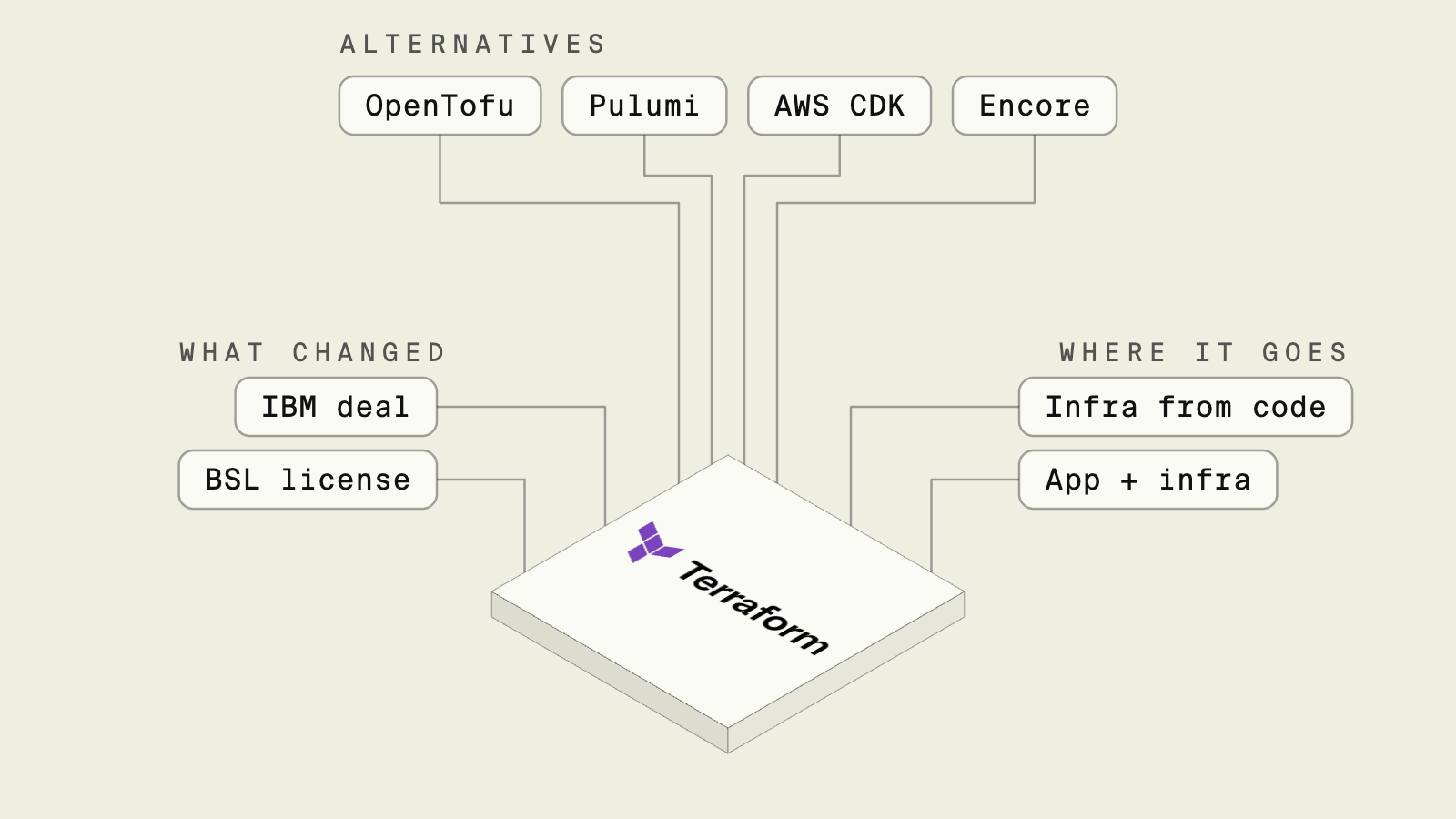
Terraform in 2026 is an IBM product under the Business Source License, OpenTofu is the MPL fork in the CNCF, and CDK for Terraform is gone. HCL is still the default for multi-cloud estates and platform teams.
For the databases, queues and cron jobs one application uses, Encore provisions them from the code in your own AWS or GCP account, with no HCL to write.
What changed for Terraform between 2023 and 2026?
Both projects still ship regularly, with Terraform and OpenTofu releases in November 2026 (versions in the table below), so neither is a dead end for an existing estate.
What does the license change mean for your team?
The Terraform license file covers Terraform 1.6.0 and later and names IBM as the licensor. Its additional use grant allows production use, as long as you do not offer Terraform to third parties on a hosted or embedded basis in competition with IBM's paid versions.
For a company running Terraform on its own infrastructure, that grant covers the normal case. The change matters to vendors that host Terraform runs for others, and to teams whose legal or procurement process only accepts OSI-approved licenses. Those are the teams that moved to OpenTofu first.
Should you pick Terraform or OpenTofu in 2026?
Pick Terraform when you use HCP Terraform or Terraform Enterprise, or when the newest Terraform features such as Terraform Policy matter to you. Pick OpenTofu when the license or vendor neutrality is the deciding factor. The day-to-day loop is the same in both: write HCL, run a plan, review it and apply it against a state file. OpenTofu vs Terraform covers the feature differences in detail.
What happened to CDK for Terraform?
CDK for Terraform let teams write Terraform configuration in TypeScript, Python, Go, Java or C#. HashiCorp deprecated it on December 10, 2025, archived the repository and stopped compatibility updates, so it will drift further from new Terraform and provider releases.
Teams on CDKTF have three realistic options:
- Export to HCL with
cdktf synth --hcland continue in plain Terraform or OpenTofu, which is what HashiCorp recommends. - Move to another code-first IaC tool, such as AWS CDK for AWS-only estates or Pulumi for many providers.
- Move application resources into application code, where the database or queue is declared next to the code that uses it, and keep HCL for the rest.
Why does Terraform still feel heavy for application teams?
Terraform was built for infrastructure owned by an ops or platform team: networks, accounts, shared databases. For that work, a separate codebase, an explicit plan and a state file are the controls you want.
An application team adding one queue to one service pays the same costs. The resource lives in another repository and another language, a pull request waits for someone who knows the modules, and the state file has to stay in sync with what the code expects. Coding agents feel this too: an agent that adds a feature can write the handler, but the queue it needs sits in an HCL module it cannot run locally or test before review.
Where does infrastructure from code fit in 2026?

Encore brings infrastructure from code: the application declares the databases, Pub/Sub topics, cron jobs, buckets and secrets it uses, and Encore provisions them in your own AWS or GCP account. There is no HCL module and no state file for those resources. encore run starts the databases, topics, buckets and secrets locally. Cron jobs are managed by the Encore platform in cloud environments and do not run locally or in previews.
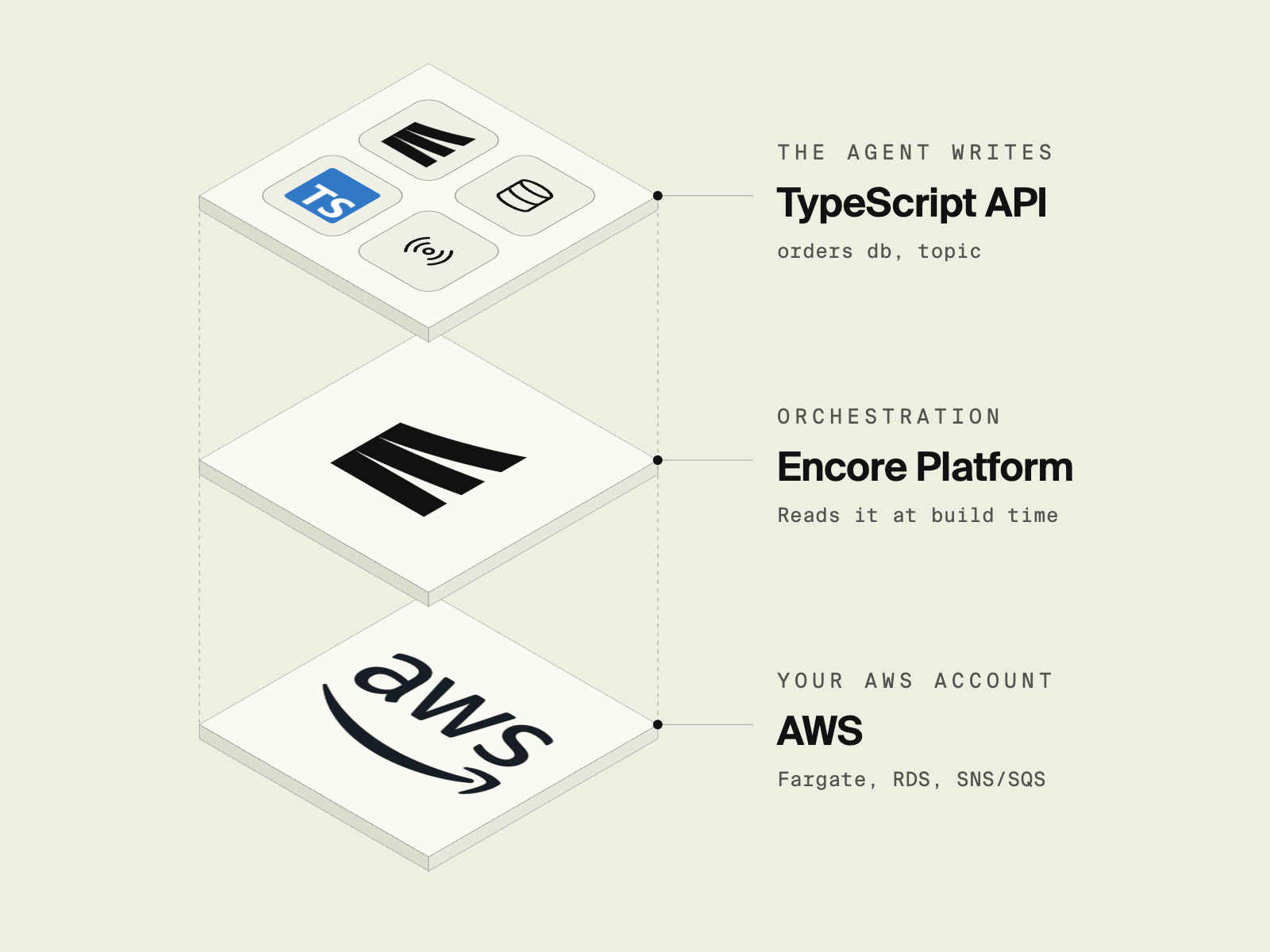
Here is a service with a database, a topic for downstream work and a nightly job, the three resources that most often turn into a Terraform pull request:
// invoices/invoices.ts (encore.dev 1.58.9)
import { api } from "encore.dev/api";
import { SQLDatabase } from "encore.dev/storage/sqldb";
import { Topic } from "encore.dev/pubsub";
import { CronJob } from "encore.dev/cron";

// RDS on AWS, Cloud SQL on GCP, a local Postgres with `encore run`.
const db = new SQLDatabase("invoices", { migrations: "./migrations" });

export interface InvoiceIssued {
  invoiceId: number;
}

// SNS and SQS on AWS, Google Cloud Pub/Sub on GCP.
export const invoiceIssued = new Topic<InvoiceIssued>("invoice-issued", {
  deliveryGuarantee: "at-least-once",
});

export const issue = api(
  { expose: true, method: "POST", path: "/invoices" },
  async (p: { customerId: number; amountCents: number }): Promise<{ id: number }> => {
    const row = await db.queryRow<{ id: number }>`
      INSERT INTO invoices (customer_id, amount_cents)
      VALUES (${p.customerId}, ${p.amountCents})
      RETURNING id`;
    await invoiceIssued.publish({ invoiceId: row!.id });
    return { id: row!.id };
  },
);

export const markOverdue = api({}, async (): Promise<void> => {
  await db.exec`
    UPDATE invoices SET status = 'overdue'
    WHERE status = 'open' AND due_at < now()`;
});

// Triggered by the Encore platform in cloud environments.
const _ = new CronJob("mark-overdue", {
  title: "Mark unpaid invoices overdue",
  schedule: "0 1 * * *",
  endpoint: markOverdue,
});
On deploy, Encore provisions RDS and SNS with SQS in your AWS account, or Cloud SQL and Pub/Sub on GCP. Encore provisions an IAM role for the service, or a service account on GCP. Cron jobs are managed by the Encore platform and do not run locally or in preview environments, so you call markOverdue directly to test it. Instance sizes and backups stay adjustable per environment in infrastructure configuration.
This is also why it suits coding agents: an agent adding a feature declares the table or topic in the same change, runs it locally right away, and opens one pull request with no Terraform to touch.
It does not replace Terraform everywhere: the VPC baseline, DNS zones and resources shared across many services stay in HCL, and the Encore Terraform provider lets that Terraform read Encore-managed resources. Migrating from Terraform covers moving application resources over one service at a time.
Run in your terminal to get started locally.
What should you do with Terraform in 2026?
- Keep Terraform if you run HCP Terraform or Terraform Enterprise, span several clouds and have a platform team that owns the modules.
- Move to OpenTofu if the Business Source License is a problem for your company and you want the same HCL workflow under MPL 2.0.
- Leave CDK for Terraform now, by exporting to HCL or moving to a maintained tool, before provider updates break it.
- Use Encore for application infrastructure when a backend's databases, queues, buckets and cron jobs on AWS or GCP are what keeps sending developers to the Terraform repository.
Verdict. Terraform is not going away in 2026, and for shared, multi-cloud infrastructure it and OpenTofu remain the tools to beat. The changes since 2023 are about license and ownership, not capability. For the resources a single backend uses, the bigger shift is declaring them in the application code, where Encore provisions them in your own cloud account and the separate IaC codebase disappears. Do you still need Terraform? walks through the decision by team type.
Related resources
Frequently asked questions
Is Terraform still open source in 2026?
No. Terraform 1.6.0 and later are released under the Business Source License 1.1, a source-available license, after HashiCorp moved away from MPL 2.0 in August 2023. Production use is allowed unless you offer Terraform to third parties in competition with IBM. OpenTofu is the MPL 2.0 fork.
Did IBM buy Terraform?
Yes. IBM completed its acquisition of HashiCorp on February 27, 2025, and Terraform now ships from IBM's automation software portfolio. The Terraform license file names IBM as the licensor.
Is OpenTofu compatible with Terraform?
Yes. Most configurations work unchanged, since OpenTofu aims to stay compatible with Terraform configurations and has a migration guide for switching a working estate. Features added to either tool since the fork differ, so check newer syntax before you switch.
What happened to CDK for Terraform?
HashiCorp deprecated CDK for Terraform on December 10, 2025 and archived the repository. It no longer gets fixes or compatibility updates. HashiCorp suggests exporting projects to HCL with cdktf synth --hcl, and teams that want infrastructure in a general-purpose language look at AWS CDK, Pulumi or infrastructure from code.
Deploy to your cloud on AWS and Google Cloud
without managing infrastructure
Encore lets developers and agents define application infrastructure directly in code, then automatically provisions it from local development to production in your AWS or GCP account.
