DigitalOcean vs AWS in 2026: Which Cloud Fits Your Backend?
DigitalOcean offers a short list of products that are quick to learn. AWS offers far more services and more control, with more to configure, and this guide compares them for a typical backend with a database, storage and background work.

DigitalOcean and AWS sit at opposite ends of the cloud market. DigitalOcean offers a focused set of products, including Droplets, App Platform, Managed Databases and Spaces, with a console a small team can learn in an afternoon, while AWS offers hundreds of services with fine-grained IAM and more configuration for each.
For a typical backend, the comparison comes down to compute, the database, object storage and the ops work around them. This guide covers each, plus a way to run on AWS from application code.
DigitalOcean vs AWS at a glance
Each option is covered below, starting with Encore.
Running your backend on AWS from application code with Encore

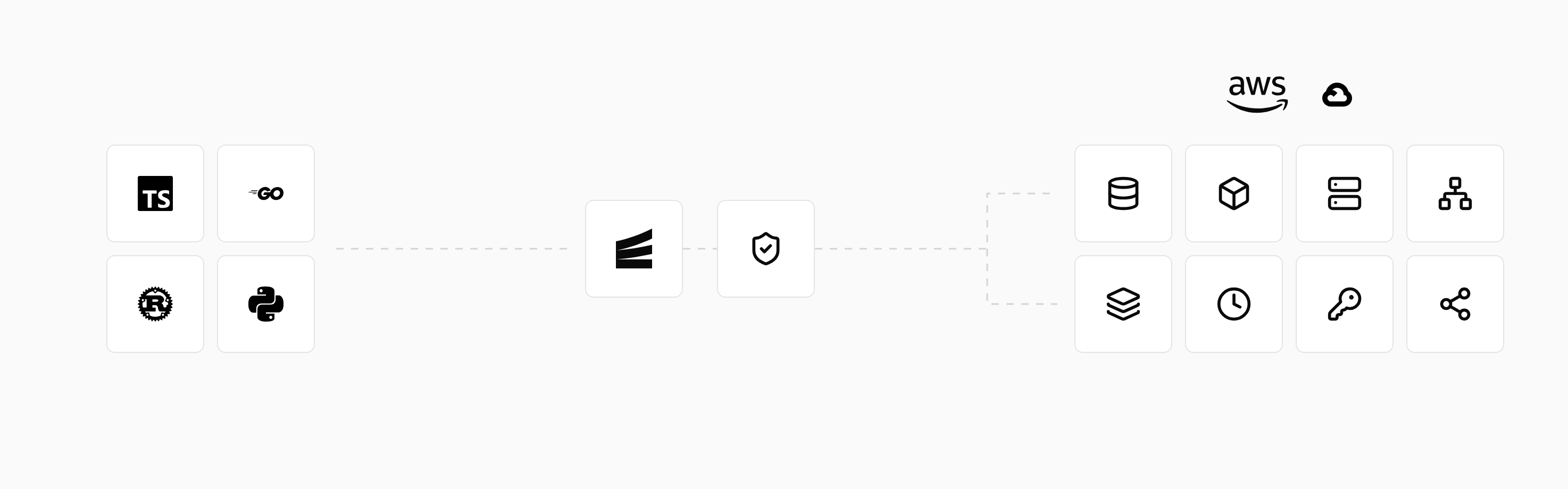
Encore is infrastructure from code for TypeScript and Go, with a platform that provisions and deploys into your own AWS or GCP account. Services declare the databases, buckets, Pub/Sub topics and cron jobs they use in code, and Encore provisions RDS, S3, SNS and SQS, and Fargate or EKS in your AWS account, and Encore provisions an IAM role for the service, as an alternative to writing Terraform.
A Go service that records uploads in Postgres and hands the browser a signed URL for S3 looks like this:
// media/media.go
package media

import (
	"context"
	"fmt"
	"time"

	"encore.dev/storage/objects"
	"encore.dev/storage/sqldb"
)

// S3 on AWS, Cloud Storage on GCP, a local emulator with encore run.
var Uploads = objects.NewBucket("uploads", objects.BucketConfig{})

var db = sqldb.NewDatabase("media", sqldb.DatabaseConfig{
	Migrations: "./migrations",
})

type UploadURLParams struct {
	Filename string `json:"filename"`
}

type UploadURLResponse struct {
	ID  int64  `json:"id"`
	URL string `json:"url"`
}

// CreateUploadURL records the upload and returns a signed URL the browser can PUT to.
//
//encore:api public method=POST path=/uploads
func CreateUploadURL(ctx context.Context, p *UploadURLParams) (*UploadURLResponse, error) {
	key := fmt.Sprintf("%d-%s", time.Now().UnixNano(), p.Filename)

	var id int64
	err := db.QueryRow(ctx,
		`INSERT INTO uploads (object_key) VALUES ($1) RETURNING id`, key,
	).Scan(&id)
	if err != nil {
		return nil, err
	}

	signed, err := Uploads.SignedUploadURL(ctx, key, objects.WithTTL(15*time.Minute))
	if err != nil {
		return nil, err
	}
	return &UploadURLResponse{ID: id, URL: signed.URL}, nil
}
The migration in media/migrations creates the uploads table the queries use:
-- media/migrations/1_create_uploads.up.sql
CREATE TABLE uploads (
    id BIGSERIAL PRIMARY KEY,
    object_key TEXT NOT NULL
);
Run in your terminal to get started locally.
encore run starts Postgres locally along with an object storage emulator, so the signed URL works on a laptop before anything is deployed. In the cloud the same declarations become an RDS database and an S3 bucket in your account.
Coding agents benefit from the same model: an agent that adds the bucket writes one declaration and never handles AWS access keys, while Encore provisions an IAM role for the service.
Best fit: teams that want their backend on AWS with the setup effort closer to DigitalOcean's.
DigitalOcean

DigitalOcean's App Platform deploys from Git or a container image, builds with buildpacks or a Dockerfile, and since May 2026 can autoscale on requests per second and P95 duration as well as CPU. Droplets cover workloads that need a plain VM, and DOKS runs managed Kubernetes.
Managed Databases offers PostgreSQL, MySQL, Valkey, MongoDB, Kafka and OpenSearch, with daily backups, point-in-time recovery and standby nodes for failover. From November 30, 2026, Standard Edition PostgreSQL and MySQL plans stop offering more than 4 GiB of RAM or standby and read-only nodes for new clusters, which pushes larger databases to Advanced Edition. Spaces provides S3-compatible object storage with a built-in CDN.
The trade-off is breadth: there is no equivalent of SQS, DynamoDB, Step Functions or the long list of AWS compliance programs, and there is no per-resource policy language comparable to IAM.
Best fit: small teams that want a few well-documented products and predictable setup.
AWS
 AWS
AWS offers compute from EC2 to Lambda, with ECS and EKS for containers, and ECS Express Mode now creates a Fargate service with a load balancer and autoscaling from one request. RDS and Aurora cover Postgres, S3 is the reference for object storage, and SQS, SNS and EventBridge handle messaging.
The cost of that breadth is configuration: every resource needs networking, IAM policies and usually Terraform or CDK to keep environments consistent. AWS App Runner, the closest equivalent to App Platform, stopped accepting new customers on April 30, 2026.
Best fit: teams that need specific AWS services, regions or compliance programs and have the capacity to configure them.
Moving from DigitalOcean to AWS
Postgres usually accounts for most of the move and migrates with pg_dump and pg_restore, or with logical replication for a low-downtime cutover, and Spaces objects copy to S3 with any S3-compatible client because both speak the same API. Application code that uses an S3 SDK against Spaces usually only needs a new endpoint and credentials.
With Encore, once you connect your AWS account, the database and bucket in the example above are created on the first deploy, and the remaining work is importing the data. The Go hosting guide and Render alternatives cover the compute side in more detail.
Verdict
Choose DigitalOcean when the product list covers what the backend needs and the team values a small surface area. Choose AWS when you need its services, regions or compliance coverage. Choose Encore on AWS when you want AWS for those reasons and want the backend's infrastructure defined in application code.
Related guides
Frequently asked questions
Is DigitalOcean better than AWS?
DigitalOcean is simpler, with fewer products, a smaller console and an App Platform that deploys from Git. AWS has far more services, regions and compliance programs, and fine-grained IAM, at the cost of more configuration. The better choice depends on whether the team needs that breadth.
Should I move from DigitalOcean to AWS?
Teams usually move when they need AWS-only services, enterprise customers require workloads in AWS, or they outgrow a managed plan. The move is mostly databases and storage: Postgres migrates with pg_dump or replication, and Spaces objects copy to S3 with any S3-compatible tool.
How do I deploy a Go API with a database and file uploads to AWS?
With Encore, declare the database with sqldb.NewDatabase and the bucket with objects.NewBucket in the service package, and return a signed upload URL from an //encore:api endpoint with SignedUploadURL. encore run gives you local Postgres and an object storage emulator, and deploying to an environment connected to your AWS account provisions RDS and S3.
Deploy to your cloud on AWS and Google Cloud
without managing infrastructure
Encore lets developers and agents define application infrastructure directly in code, then automatically provisions it from local development to production in your AWS or GCP account.
