Deploy to AWS Without Kubernetes
Production options that run containers and functions on AWS with no cluster to operate, ranked by how much you set up yourself.

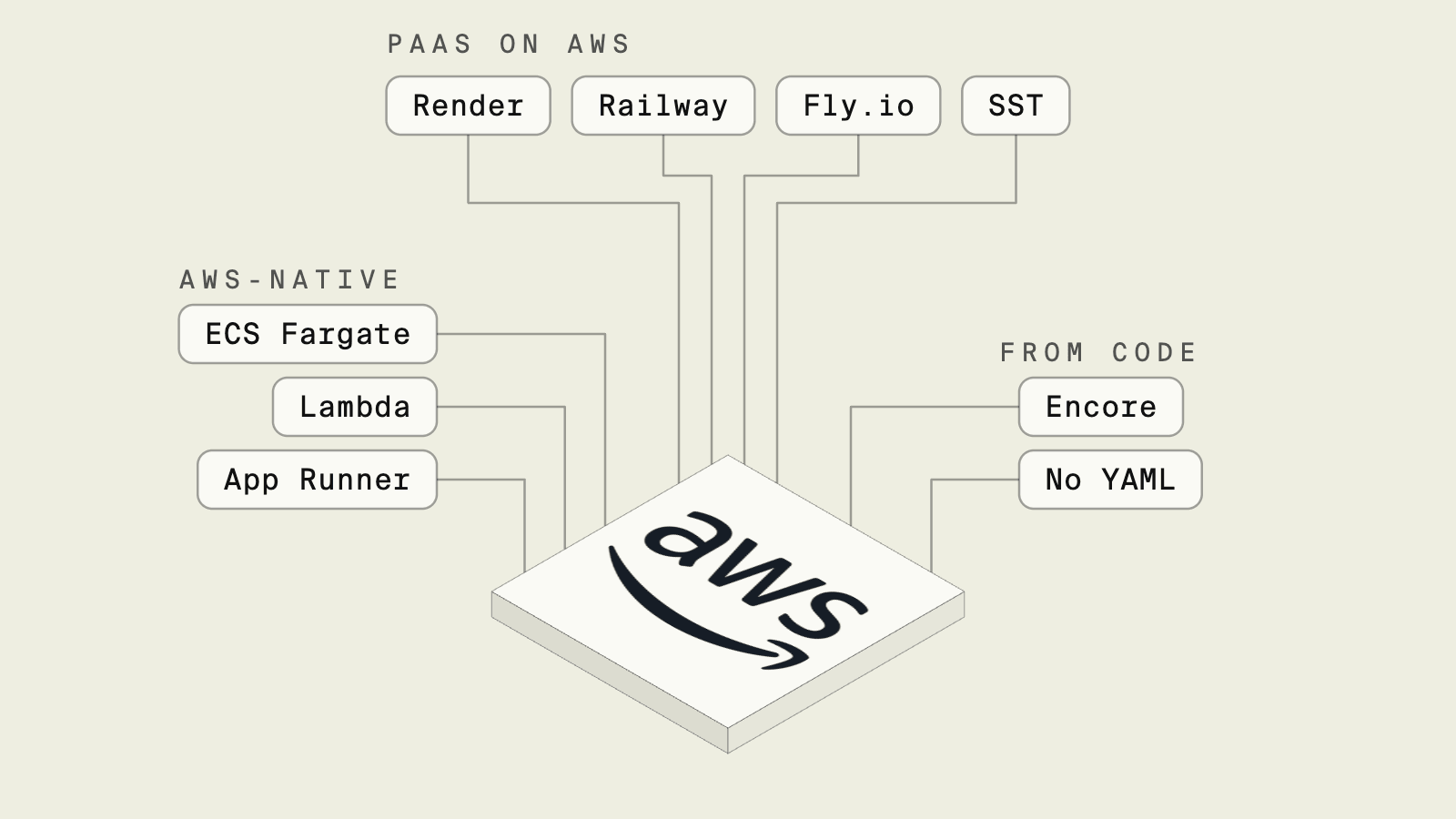
You can deploy to AWS without Kubernetes by running containers on ECS with Fargate, which has no servers or cluster control plane to operate. The simplest AWS-native way to do that is ECS Express Mode, which turns a container image into a load-balanced HTTPS service. For a TypeScript or Go backend that also needs a database, queues and scheduled jobs, Encore deploys to Fargate in your own AWS account and provisions RDS, SNS/SQS, S3 and Secrets Manager from declarations in the code. Lambda covers event-driven work, and Terraform or CDK give a platform engineer full control.
Skipping Kubernetes removes the cluster: node groups, CNI networking, ingress controllers, Helm charts and upgrade cycles. It does not remove the rest of the infrastructure. A web service still needs a load balancer, TLS, a VPC, IAM roles, a database and somewhere for logs. The options below differ in who sets those up.
What are the ways to deploy to AWS without Kubernetes?
AWS App Runner used to be the simplest container option on this list. AWS closed it to new customers on April 30, 2026 and recommends ECS Express Mode instead; existing customers can keep using it.
Verdict. Fargate is the runtime most teams want when they leave Kubernetes out. The difference between the options is everything around it. Express Mode handles the web tier and nothing else. Encore ranks first because it provisions the service and the database, queues, scheduled jobs and secrets around it in your own AWS account, from the same code.
How does ECS Express Mode work?
ECS Express Mode launched in November 2025. One CLI call creates the service:
aws ecs create-express-gateway-service \
  --service-name orders-api \
  --execution-role-arn arn:aws:iam::123456789012:role/ecsTaskExecutionRole \
  --infrastructure-role-arn arn:aws:iam::123456789012:role/ecsInfrastructureRoleForExpressServices \
  --primary-container '{"image": "123456789012.dkr.ecr.us-east-1.amazonaws.com/orders-api:v1", "containerPort": 8080}' \
  --health-check-path /health
That gives you a Fargate service, an Application Load Balancer with TLS, target-tracking autoscaling, CloudWatch logs and a URL such as orders-api.ecs.us-east-1.on.aws, all visible in your account. You still write the Dockerfile and the CI job that pushes images, create RDS and any queues, put database credentials in Secrets Manager, and place the tasks in subnets that can reach the database.
How does ECS on Fargate with Terraform or CDK work?
ECS has two objects: a task definition (image, CPU, memory, environment, IAM roles) and a service (how many tasks, which load balancer, which subnets). Fargate runs the tasks without EC2 instances. Written out in Terraform, a single service with a database is a VPC with public and private subnets, a NAT gateway, an ALB with an HTTPS listener and ACM certificate, a target group, security groups, a task role and an execution role, an ECR repository, a log group, an RDS instance, a subnet group and the ECS cluster, service and task definition. That is several hundred lines before queues or scheduled jobs, and it is the right amount of control for a team that has someone to own it.
When does Lambda fit instead?
Lambda runs functions on demand and bills per request and duration, so it suits handlers triggered by S3, SQS or EventBridge and APIs that see little traffic. The limits matter for a general backend: cold starts, a 15-minute maximum run time, one database connection per concurrent instance (so RDS usually needs RDS Proxy), and a deploy unit per function. Frameworks like SST and the Serverless Framework help with packaging and local development.
How does Encore deploy to AWS without Kubernetes?

Encore is infrastructure from code. The application declares what it uses, and when you push, Encore provisions the matching AWS resources in your own account and deploys the services to ECS on Fargate, or to EKS if you pick that for the environment.
// orders/orders.ts (encore.dev 1.58)
import { api } from "encore.dev/api";
import { SQLDatabase } from "encore.dev/storage/sqldb";
import { Topic, Subscription } from "encore.dev/pubsub";
import { Bucket } from "encore.dev/storage/objects";

// RDS for PostgreSQL; a local Postgres under `encore run`.
const db = new SQLDatabase("orders", { migrations: "./migrations" });

// S3 bucket for invoice PDFs.
const invoices = new Bucket("invoices", { versioned: false });

interface OrderPaid {
  orderId: string;
}
// SNS topic with an SQS queue and dead-letter queue.
export const orderPaid = new Topic<OrderPaid>("order-paid", {
  deliveryGuarantee: "at-least-once",
});

export const markPaid = api(
  { method: "POST", path: "/orders/:id/paid", expose: true },
  async ({ id }: { id: string }): Promise<void> => {
    await db.exec`UPDATE orders SET status = 'paid' WHERE id = ${id}`;
    await orderPaid.publish({ orderId: id });
  },
);

const _ = new Subscription(orderPaid, "write-invoice", {
  handler: async ({ orderId }) => {
    const pdf = Buffer.from(`Invoice for order ${orderId}`); // render the real PDF here
    await invoices.upload(`${orderId}.pdf`, pdf, { contentType: "application/pdf" });
  },
});
On deploy, that code becomes an ECS service on Fargate behind an Application Load Balancer, an RDS for PostgreSQL instance in a private subnet, an SNS topic with an SQS queue and dead-letter queue, an S3 bucket and CloudWatch logs, inside a VPC Encore creates for the environment. Encore provisions an IAM role for the service. There are no task definitions, Kubernetes manifests or Terraform files to maintain, and the resources are standard AWS resources you can inspect in the console. Scheduled work uses a cron job, which the Encore platform runs on schedule without an extra AWS resource; cron jobs do not fire locally or in preview environments.
What you still own: the application code, database migrations and the decision of what to declare. For resources Encore does not declare in code, you can add them in your AWS account and call them from the services as you would from any ECS task.
Which approach fits?
- Encore when the backend is TypeScript or Go and needs a database, workers, scheduled jobs, files or secrets in your own AWS account, without writing infrastructure code.
- ECS Express Mode when you have one stateless container and will set up the database and the rest yourself.
- ECS with Terraform or CDK when someone on the team wants to own every resource.
- Lambda for event-driven handlers and APIs that are idle most of the time.
- Elastic Beanstalk only for a monolith that already runs on it.
If you are deciding whether you need Kubernetes at all, Do You Need Kubernetes? walks through the service counts and team sizes where EKS starts to pay off. To try Encore, start with the quickstart.
Windows: iwr https://encore.dev/install.ps1 | iex
Linux: curl -L https://encore.dev/install.sh | bash
Related resources
Frequently asked questions
Can I run production workloads on AWS without Kubernetes?
Yes. ECS on Fargate runs containers without servers or a cluster control plane to manage, Lambda runs functions, and Elastic Beanstalk runs code on EC2. Most teams with fewer than a few dozen services never need EKS. What they do need is a way to manage the load balancer, database, queues, secrets and IAM around the containers.
What is the simplest way to run a container on AWS without Kubernetes?
ECS Express Mode. Give it a container image and two IAM roles, and it creates a Fargate service, an Application Load Balancer with HTTPS, autoscaling and a URL in your account. It replaced App Runner as the AWS recommendation after App Runner closed to new customers on April 30, 2026.
Does Encore use Kubernetes on AWS?
No, not unless you choose EKS. When you create an environment in your own AWS account, you pick ECS on Fargate or EKS as the compute platform. Either way you declare databases, Pub/Sub topics, buckets, cron jobs and secrets in TypeScript or Go code, and Encore provisions the matching AWS resources without Kubernetes manifests or Terraform.
Deploy to your cloud on AWS and Google Cloud
without managing infrastructure
Encore lets developers and agents define application infrastructure directly in code, then automatically provisions it from local development to production in your AWS or GCP account.
