Supabase vs Firebase: Which Backend Platform Fits Your App in 2026
How Supabase and Firebase differ on data model, queries, auth, functions, pricing and lock-in, and when a backend in your own cloud account is the better fit.


Supabase and Firebase solve the same problem: give a frontend or mobile team a database, auth, file storage and functions without running a backend. They get there from opposite directions. Supabase wraps PostgreSQL and exposes it through generated APIs. Firebase is built around Firestore, a document database designed to be queried straight from client SDKs.
That starting point shapes everything else, from how you write queries and permissions to how the bill grows. This guide compares the two head to head, and covers when Encore fits: once the app needs backend logic that neither platform's functions handle well, running in your own AWS or GCP account.
Supabase vs Firebase at a glance
Each option is covered below, starting with Encore.
Running the backend in your own cloud with Encore
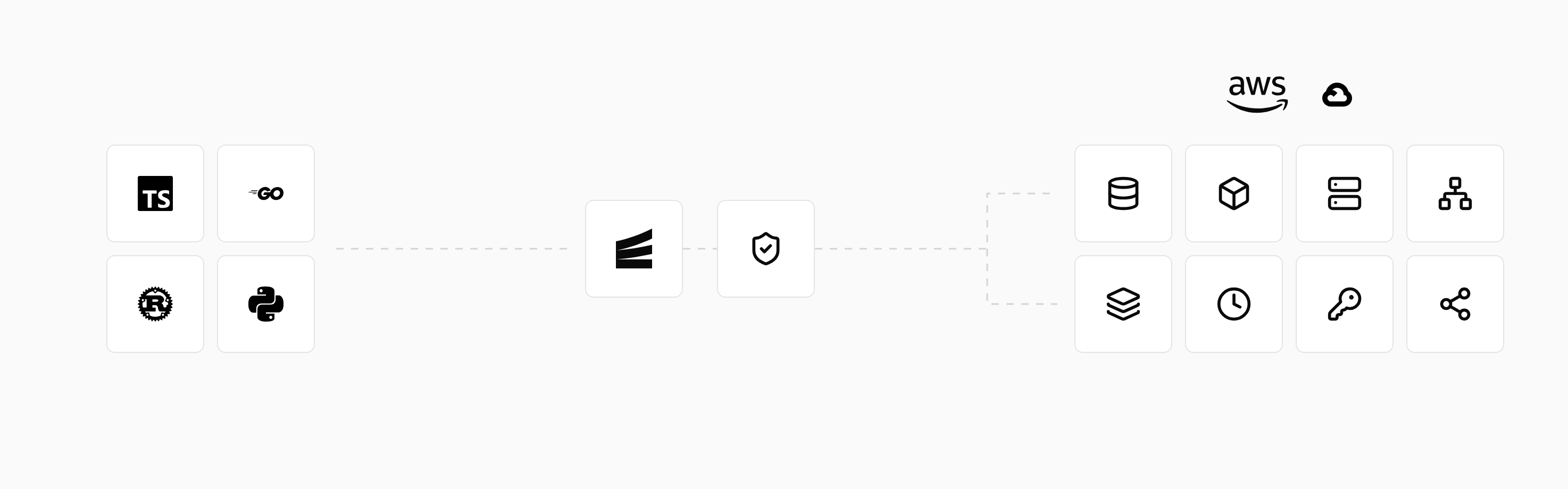
Encore combines an open source infrastructure SDK for TypeScript and Go with a platform that provisions and deploys into your own AWS or GCP account. Instead of exposing the database to clients, you write API endpoints and declare the infrastructure they use: Postgres databases, Pub/Sub topics, cron jobs, buckets and secrets. Encore provisions RDS or Cloud SQL, SNS and SQS or Google Pub/Sub, S3 or Cloud Storage, and an IAM role for each service.
Access control lives in the endpoint, next to the query it protects:
// notes/notes.ts
import { api } from "encore.dev/api";
import { getAuthData } from "~encore/auth";
import { SQLDatabase } from "encore.dev/storage/sqldb";

const db = new SQLDatabase("notes", { migrations: "./migrations" });

interface Note {
  id: number;
  body: string;
}

// auth: true means the request must pass the app's auth handler first.
export const mine = api(
  { expose: true, auth: true, method: "GET", path: "/notes" },
  async (): Promise<{ notes: Note[] }> => {
    const { userID } = getAuthData()!;
    const notes: Note[] = [];
    for await (const row of db.query<Note>`
      SELECT id, body FROM notes WHERE owner_id = ${userID} ORDER BY id DESC`) {
      notes.push(row);
    }
    return { notes };
  },
);
The migration in notes/migrations creates the notes table the queries use:
-- notes/migrations/1_create_notes.up.sql
CREATE TABLE notes (
    id BIGSERIAL PRIMARY KEY,
    owner_id TEXT NOT NULL,
    body TEXT NOT NULL
);
Run in your terminal to get started locally.
The auth handler decides who the user is. It can verify tokens from Firebase Auth, Supabase Auth, Clerk or your own sessions, so moving the backend does not have to mean moving users. encore run starts Postgres locally and applies the migrations, and the same code deploys to RDS on AWS or Cloud SQL on GCP.
You write endpoints instead of calling the database from the client, and in return business rules sit in typed code that a reviewer, or a coding agent, can read in one place, instead of being split between client queries and policy files.
Supabase: Postgres with generated APIs
Supabase gives each project a PostgreSQL database with auto-generated REST and GraphQL APIs, Auth, Storage, Realtime subscriptions and Edge Functions written in TypeScript on Deno. Permissions are Row Level Security policies in SQL, so the database itself decides which rows a signed-in user can read or write.
Being Postgres, Supabase gives you joins, transactions, extensions such as pgvector, and a migration path to any other Postgres host. Supabase is open source and can be self-hosted. Per Supabase pricing, free projects are paused after a week of inactivity, which matters for side projects and demos.
Firebase: Firestore and client SDKs
Firebase centers on Cloud Firestore, a document database with realtime listeners and offline support in its mobile and web SDKs. Access is controlled with Security Rules, and server logic runs in Cloud Functions. For relational data, Firebase SQL Connect adds a GraphQL schema over Cloud SQL for PostgreSQL with generated, type-safe client SDKs.
Firebase fits mobile apps that need offline sync and push notifications out of the box. The costs are the document model, which makes reporting and many-to-many data awkward, and pricing per document read and write on the Blaze plan, per Firebase pricing, which can grow quickly for read-heavy screens.
Good to know
Leaving Supabase is mostly a Postgres dump plus rewriting Auth, Storage and Edge Function usage. Leaving Firestore means remodeling documents into tables and replacing every client-side query and Security Rule.
How to choose
Pick Encore when the app has outgrown client-side queries and needs backend services, background jobs and queues, running in your own AWS or GCP account with infrastructure defined in TypeScript or Go.
Pick Supabase when you want Postgres, SQL and Row Level Security with a hosted dashboard and the option to self-host. Pick Firebase for mobile-first apps that depend on offline sync, realtime listeners and the rest of the Firebase SDK.
Related guides
Frequently asked questions
What is the main difference between Supabase and Firebase?
Supabase is built on PostgreSQL, so data is relational, queried with SQL and protected with Row Level Security policies. Firebase centers on Cloud Firestore, a NoSQL document database queried from client SDKs and protected with Security Rules. Firebase also offers SQL Connect, a GraphQL layer over Cloud SQL for PostgreSQL.
Is Supabase cheaper than Firebase?
Cost depends on the workload: Supabase bills per project plus usage-based extras, and free projects pause after a week of inactivity. Firebase's Blaze plan is pay as you go, billed per document read, write and delete in Firestore, which is cheap for small apps and can grow quickly for read-heavy ones.
What if I outgrow both Supabase and Firebase?
A common next step is a backend in your own cloud account. With Encore, you write the backend in TypeScript or Go with Postgres, Pub/Sub, cron and secrets declared in code, and Encore provisions RDS or Cloud SQL, queues and IAM in your own AWS or GCP account. You can keep Firebase Auth, Supabase Auth or another provider by verifying its tokens in an auth handler.
Deploy to your cloud on AWS and Google Cloud
without managing infrastructure
Encore lets developers and agents define application infrastructure directly in code, then automatically provisions it from local development to production in your AWS or GCP account.
