Railway vs Google Cloud Run for Backend Apps
How Railway and Google Cloud Run compare for running a backend API: deploy workflow, databases, cron and background work, scaling and cold starts, and pricing in November 2026, with a Go service that deploys to Cloud Run in your own GCP project with git push.

Railway and Google Cloud Run both run containers without a server to manage, but they sit at different levels. Railway is a platform with a project canvas, template databases and git deploys. Cloud Run is a GCP compute service that you combine with Cloud SQL, Pub/Sub and IAM yourself.
This guide compares the two for backend APIs on deploy workflow, databases, background work, scaling and price as of November 18, 2026. It ends with Encore, which keeps a Railway-like git push and deploys to Cloud Run in your own GCP project.
Railway vs Cloud Run at a glance
Railway prices come from Railway's plans docs, with Hobby at $5 and Pro at $20 a month, each including that amount of usage. Cloud Run prices are the us-central1 request-based rates from Cloud Run pricing, with 180,000 vCPU-seconds, 360,000 GiB-seconds and 2 million requests free each month. Both were checked on November 18, 2026.
Deploy workflow
On Railway you connect a GitHub repository, and each push builds and deploys the service, with PR environments for review. On Cloud Run the unit is a container image: gcloud run deploy --source . builds one with Cloud Build, and a production setup adds a CI pipeline, Artifact Registry and a service account per service. Railway is faster to a first deploy, and Cloud Run gives you every GCP control around it.
Databases and state
Railway's Postgres is a template service backed by a volume, billed like any other service plus $0.15 per GB-month of storage. On GCP the equivalent is Cloud SQL for PostgreSQL, with managed backups, high availability and read replicas, connected from Cloud Run through the Cloud SQL connector or a private IP. Cloud SQL costs more at small sizes and removes backups and failover from your list.
Background work and cron
A Railway worker is a service that runs a loop, and a cron service runs a command on a schedule with runs at least 5 minutes apart, per Railway's cron docs. On Cloud Run, background work arrives as Pub/Sub push requests with an ack deadline of up to 10 minutes, long batch work runs as Cloud Run jobs, and Cloud Scheduler triggers both on a schedule.
Scaling and cold starts
Cloud Run scales on concurrent requests and to zero when idle, so the first request after a quiet period waits for a container to start unless minimum instances are set. Railway services stay up unless you turn on serverless sleep, which sleeps a service after 5 to 10 minutes without outbound traffic. Long requests also differ: Cloud Run's request timeout defaults to 5 minutes with a 60-minute maximum.
Price for a small API
A service using half a vCPU and 512 MB around the clock is about $15 a month on Railway: $10 for CPU and $5 for memory, covered in part by the plan's included usage. On Cloud Run with request-based billing, the same service costs only for the seconds requests are in flight, so an API that is busy 10% of the time stays near or inside the free tier. A service that is busy all day costs more on Cloud Run unless you switch it to instance-based billing at $0.000018 per vCPU-second.
How does Encore compare to Railway and Cloud Run?

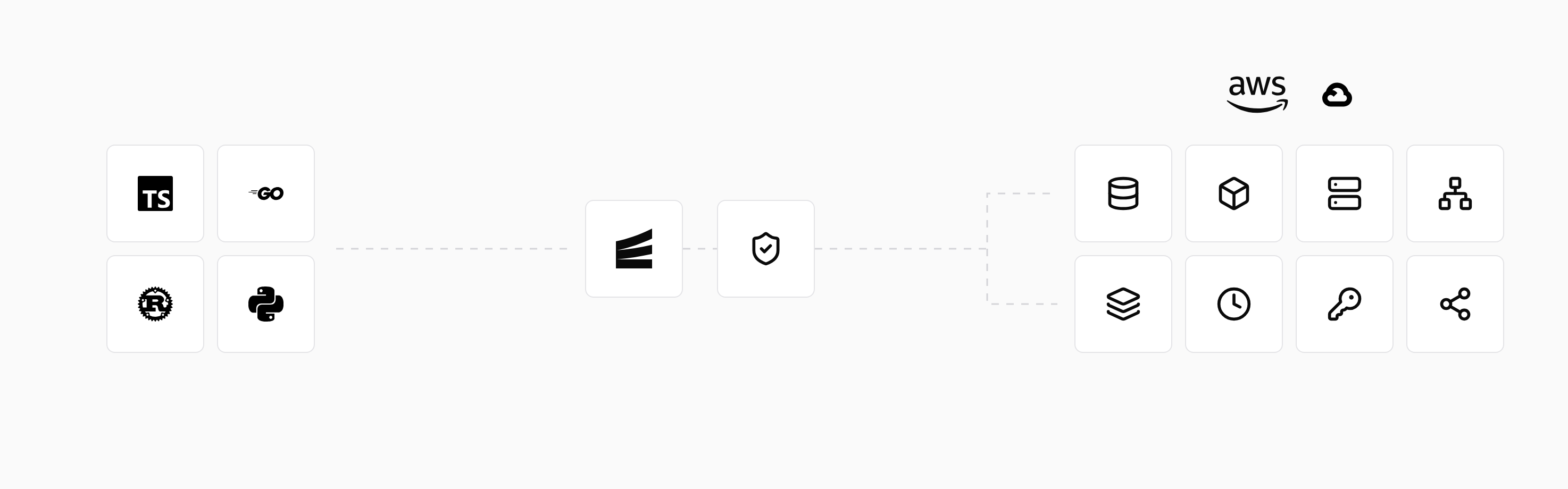
Encore is a backend framework with built-in infrastructure for Go and TypeScript. It keeps Railway's git-push workflow and deploys to Cloud Run in your own GCP project, with the database, topics and cron jobs declared in code. Per the GCP infrastructure docs, Encore provisions Cloud SQL and Pub/Sub with dead-letter topics. Encore provisions an IAM role for the service, or a service account on GCP, so the setup Cloud Run normally needs comes from the application code.
Run in your terminal to get started locally.
package links

import (
	"context"

	"encore.dev/cron"
	"encore.dev/pubsub"
	"encore.dev/storage/sqldb"
)

// Railway: a Postgres service from a template.
// Encore on GCP: a Cloud SQL instance in your project.
var db = sqldb.NewDatabase("links", sqldb.DatabaseConfig{Migrations: "./migrations"})

type Clicked struct {
	Slug string
}

// A Pub/Sub topic in your GCP project, with a dead-letter topic.
var clicks = pubsub.NewTopic[*Clicked]("link-clicked", pubsub.TopicConfig{
	DeliveryGuarantee: pubsub.AtLeastOnce,
})

type Link struct {
	Target string `json:"target"`
}

//encore:api public method=GET path=/l/:slug
func Resolve(ctx context.Context, slug string) (*Link, error) {
	l := &Link{}
	if err := db.QueryRow(ctx, `SELECT target FROM links WHERE slug = $1`, slug).Scan(&l.Target); err != nil {
		return nil, err
	}
	// Count the click off the request path.
	_, _ = clicks.Publish(ctx, &Clicked{Slug: slug})
	return l, nil
}

var _ = pubsub.NewSubscription(clicks, "count-click", pubsub.SubscriptionConfig[*Clicked]{
	// At-least-once delivery can count a click twice, which is fine for a counter.
	Handler: func(ctx context.Context, c *Clicked) error {
		_, err := db.Exec(ctx, `UPDATE links SET clicks = clicks + 1 WHERE slug = $1`, c.Slug)
		return err
	},
})

//encore:api private
func Prune(ctx context.Context) error {
	_, err := db.Exec(ctx,
		`DELETE FROM links WHERE clicks = 0 AND created_at < now() - interval '90 days'`)
	return err
}

// Railway: a cron service. Encore: scheduled by the Encore platform.
var _ = cron.NewJob("prune-links", cron.JobConfig{
	Title:    "Delete unused links",
	Schedule: "0 3 * * *",
	Endpoint: Prune,
})
encore run starts the service with a local Postgres and Pub/Sub, and the cron job is scheduled by the Encore platform once deployed, as the cron jobs docs describe. The databases and Pub/Sub docs cover the rest, and connecting your own cloud covers linking the GCP project, and an existing instance can be brought in with import Cloud SQL.
A coding agent that adds a topic or a scheduled job writes a few lines of Go, and the next push provisions it in the GCP project with the right service account permissions, with no Cloud Scheduler or IAM changes by hand.
Best fit: Go or TypeScript backends that want Railway's git-push deploys with the services running on Cloud Run and Cloud SQL in their own GCP project.
How to choose
Pick Railway for the quickest path from repository to running app, with databases and workers on one canvas and usage-based billing. Pick Cloud Run when the backend belongs in GCP next to other services, and you have the time to wire Cloud SQL, Pub/Sub, Scheduler and IAM together. Pick Encore when you want Cloud Run in your own project without that wiring.
Related guides
Frequently asked questions
Is Railway cheaper than Google Cloud Run?
Yes, for steady traffic, and no for spiky traffic. Railway bills the CPU and memory a service uses, at $20 per vCPU-month and $10 per GB-month in November 2026, so a busy always-on service is predictable. Cloud Run's request-based billing charges only while requests are in flight and has a monthly free tier, so a low-traffic API can cost close to nothing.
Can Cloud Run replace Railway for a backend with a database?
Yes. Cloud Run can replace Railway with more setup: Cloud Run runs the containers, Cloud SQL provides Postgres, Pub/Sub handles background messages and Cloud Scheduler triggers cron, but each is a separate GCP product to configure, connect and grant IAM permissions to, while Railway puts them in one project canvas.
Does Cloud Run have cold starts like Railway's serverless mode?
Yes. Both can have them: Cloud Run scales to zero by default and starts an instance on the next request unless you set a minimum instance count. Railway's serverless setting sleeps a service after 5 to 10 minutes with no outbound traffic, and the first request to a sleeping service may get a 502 while it wakes.
How do I get a Railway-style workflow on Cloud Run?
Encore deploys Go and TypeScript backends to Cloud Run in your own GCP project on git push. The database, Pub/Sub topics and cron jobs are declared in code, and Encore provisions Cloud SQL and Pub/Sub. Encore provisions an IAM role for the service, or a service account on GCP, and the cron schedule is run by the Encore platform.
Deploy to your cloud on AWS and Google Cloud
without managing infrastructure
Encore lets developers and agents define application infrastructure directly in code, then automatically provisions it from local development to production in your AWS or GCP account.
