Railway Alternatives in 2026
The best Railway alternatives in 2026 for teams that want simpler backend development and more control over production.

Railway makes it easy to deploy a backend and connect its services, databases, and scheduled jobs. As the system grows, the team manages more deployment settings, credentials, and dependencies alongside the application code, and new features may need resources in the AWS or GCP account the company already uses. Developers and agents need to test those changes across the backend, and teams need control over production configuration without turning every new resource into a separate infrastructure task.
For teams looking for Railway alternatives, the problems tend to include:
- Every new service adds deployment settings, credentials, and connections that someone has to configure and maintain.
- Connecting the backend to private services in the company's AWS or GCP account adds networking and access configuration outside Railway.
- Growing compute, storage, and network usage makes the bill harder to forecast and costs harder to attribute to individual features.
- Keeping local development environments up to date with deployed services and infrastructure becomes complex and time consuming.
- Agents add services and resources quickly, but reviewing their connections, permissions, and behavior across the backend takes more work.
Railway alternatives at a glance
Compare deployment and infrastructure features
Encore: managed backend infrastructure in your own cloud

Encore combines the simplicity of a managed backend platform with infrastructure in your own AWS or GCP account, defined through type-safe primitives in application code. Developers and agents can use services, APIs, databases, Pub/Sub, buckets, caches, cron jobs, and secrets, while the platform automatically sets up and manages all the infrastructure in your AWS or GCP account. The SDK is open source and can be used to deploy your app anywhere that can run Docker images.
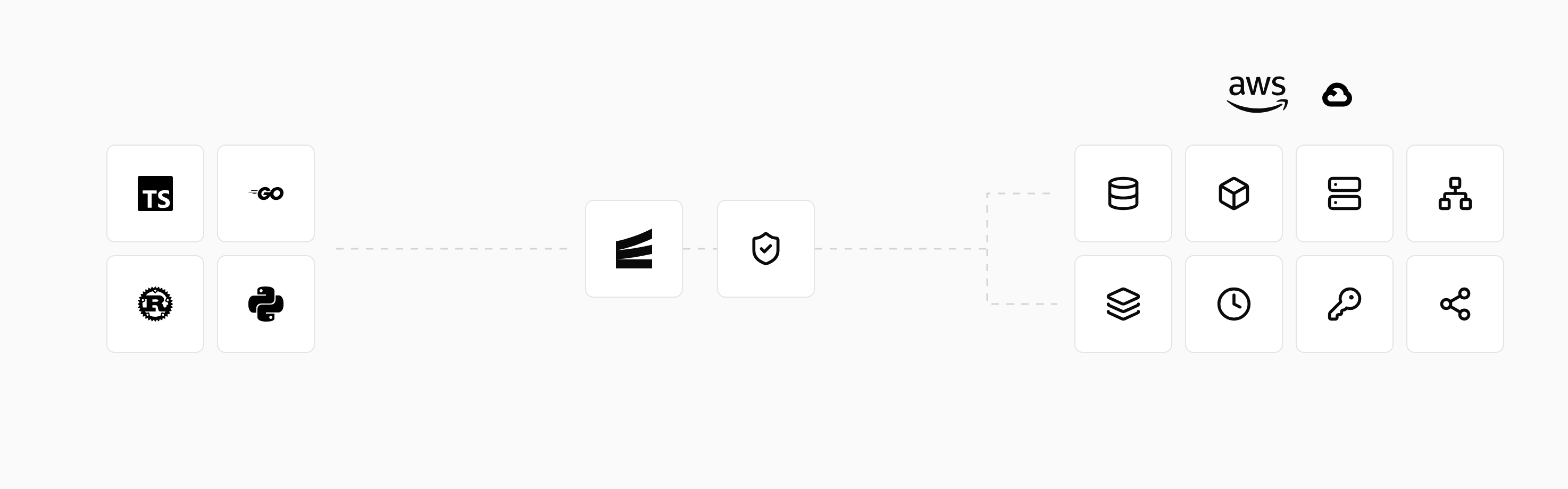
Unlike most other tools in this comparison, Encore can run your whole app locally with local infrastructure, so you and your agent can iterate quickly without needing a deploy to test new features.
As needs become more nuanced, engineers can manage configuration such as sizing, scaling, networking, and regions in Encore's dashboard or in your own cloud console.
Key features
- APIs, services, databases, Pub/Sub, object storage, caches, and cron jobs are declared in application code.
- Local development starts supported infrastructure automatically, and preview environments reproduce the application's service and resource graph.
- Automatic deployment to your own cloud on AWS or Google Cloud.
- Generated API clients and service maps keep application behavior and infrastructure dependencies visible together.
- Built-in metrics, tracing, and logs.

encore run. The same bucket declaration is used in preview environments and production.Good to know
Encore is for engineering teams that want application resources defined alongside their backend code, with production in their own AWS or GCP account. Railway's Enterprise BYOC can address hosting location while preserving its existing workflow; Encore also changes how services and resource dependencies are defined and tested.
Start with one API or event-driven workload while the rest of the application stays on Railway. Existing Postgres can remain an external dependency if you establish suitable connectivity, or its schema and data can move with standard Postgres tools. Migrated operations use Encore APIs and resource declarations; database templates, environment variables, and deployment settings need to be mapped to the target environment.
See the Railway migration guide for workload mapping and adoption steps.
Run in your terminal to get started locally.
Render: managed hosting for services and workers

Render hosts web services, private services, background workers, cron jobs, and managed Postgres. Services in the same region can communicate over a private network, and Blueprints describe the deployment in a version-controlled YAML file.
Key features
- Web services, private services, background workers, cron jobs, and workflows run from Git repositories or container images.
- Managed Postgres, Key Value, persistent disks, and private networking cover common stateful backend needs.
render.yamlBlueprints describe related services and databases, and can generate pull-request preview environments.
Render's MCP server, dashboard, API, and CLI can inspect services and logs. A Blueprint can reproduce a group of services and databases in preview environments, while application-level dependencies and permissions remain in the code and deployment configuration your team maintains.
Good to know
Render fits teams that want hosted services and workers with little infrastructure setup, while keeping their existing framework. Production stays on Render's managed infrastructure; moving to AWS or GCP means recreating the deployment, resource connections, and operational configuration there.
Fly.io: containers deployed close to your users

Fly.io runs container images on Machines in regions you select. Fly Launch handles common deployment tasks, while Machine configuration gives teams control over processes, compute, and lifecycle behavior. It suits workloads where placing compute near users matters.
Key features
- Machines expose direct control over container processes, CPU, memory, lifecycle, and placement across Fly regions.
fly.toml, Dockerfiles, andflyctlkeep most deployment configuration versioned with the application.- Private networking, volumes, and managed Postgres support applications that need regional compute and stateful services.
The Dockerfile and fly.toml can be deployed through flyctl, and the Fly MCP server can operate apps. Testing a change includes the application, Machine configuration, network paths, and storage behavior. Volumes are local to a server, with replication handled by the application or another storage system.
Good to know
Fly.io fits teams that need regional placement and direct control over container workloads on Fly's infrastructure. Check the operational requirements of each workload: Fly's managed Postgres and an application using local volumes have different backup, replication, and failover responsibilities.
Coolify: a deployment platform on servers you control
 Coolify
Coolify provides a deployment dashboard for applications, databases, and services on your own servers. It supports repository builds, container images, and Docker Compose, so an existing backend can keep its framework and deployment packaging.
Key features
- Applications deploy from Git repositories, build packs, Dockerfiles, existing images, or Docker Compose.
- PostgreSQL, MySQL, Redis-compatible stores, MongoDB, and other databases run as containers on connected servers.
- Pull-request previews can use separate domains and environment variables, while the API and CLI support deployment automation.
Application, Dockerfile, or Compose changes can trigger deployments through Coolify's API or repository integration. Preview deployments run pull requests separately from production. Your team configures the resources and credentials each preview uses, including how it connects to databases and other stateful services.
Good to know
Coolify fits teams that want a PaaS-like dashboard on their own VPS or cloud servers and have the capacity to operate it. Server security, platform updates, backups, recovery, and capacity planning remain part of the team's work. Self-hosting changes who controls the deployment without requiring the backend to adopt a new application model.
How to choose
Start at the top and follow the first question you can answer with a yes:
Are you outgrowing Railway and want to deploy to your own cloud on AWS or Google Cloud without DevOps?
EncoreInfrastructure from code, provisioned in your own AWS or GCP accountEncoreInfrastructure from code, provisioned in your own AWS or GCP accountAre you building several services that share databases, Pub/Sub, or cron jobs?
EncoreType-safe service calls and built-in tracingEncoreType-safe service calls and built-in tracingIs cloud ownership the main requirement, and does the existing Railway workflow otherwise fit?
 Enterprise BYOCRailway's bring-your-own-cloud offeringEnterprise BYOCRailway's bring-your-own-cloud offering
Do you want a managed service-and-worker workflow?
RenderWeb services, workers, and managed databasesRenderWeb services, workers, and managed databasesDo you need containers placed in specific regions, close to your users?
Fly.ioRegionally placed MachinesFly.ioRegionally placed MachinesIs your team prepared to operate its own servers and deployment platform?
CoolifyA deployment control plane on servers you runCoolifyA deployment control plane on servers you runIn more detail:
Choose Render for a managed service-and-worker workflow, Fly.io for regional container placement, or Coolify for deployment on servers your team operates. If the existing Railway workflow fits and cloud ownership is the main requirement, evaluate its Enterprise BYOC offering. Encore fits teams that want production in their own AWS or GCP account and want developers and agents to define and test backend resources in application code.
Related comparison and migration guides
Frequently asked questions
What is the best alternative to Railway?
Encore for application-defined infrastructure in your own AWS or GCP account, Render for managed services and workers, Fly.io for regional container deployment, or Coolify for self-hosted deployment tooling. The right choice depends on whether you want to change hosting, operations, or backend development.
Can Railway deploy into my own cloud account?
Railway advertises Enterprise BYOC for deployment in an existing VPC. Evaluate its availability and requirements with Railway before assuming a migration is necessary for cloud ownership.
Does moving from Railway to Encore require a rewrite?
Migrated backend operations adopt Encore APIs and resource declarations. You can retain the frontend and move one component at a time; existing Postgres schema and data are portable, while deployment settings and resource connections need to be adapted.
Do Encore environments use identical infrastructure locally and in production?
No. The same application definitions describe services and resource dependencies across local development, previews, and production. Local implementations and cloud capacity differ by environment. Preview environments run on Encore Cloud by default; own-account previews are available on Enterprise.
Is Encore a drop-in host for an existing container?
No. Backend operations use Encore APIs and supported resource declarations. You can adopt it incrementally, but migrating is a development-model change rather than moving an unchanged container image.
Does using my own cloud account make costs fixed?
No. AWS or GCP charges depend on the resources, capacity, and usage your team configures, alongside Encore fees. Cloud ownership gives you native billing visibility and configuration control, not a guarantee of lower or fixed costs.
Deploy to your cloud on AWS and Google Cloud
without managing infrastructure
Encore lets developers and agents define application infrastructure directly in code, then automatically provisions it from local development to production in your AWS or GCP account.