Convex Alternatives in 2026
The best Convex alternatives in 2026 for teams that need SQL and more choice over how and where their backend runs.

Convex puts backend operations in TypeScript and keeps subscribed clients updated as data changes. As applications built on Convex grow, teams may need SQL for reporting or backend services with different runtime and scaling requirements. Those needs can lead them toward their own AWS or GCP account, where they want more infrastructure control without making development and testing harder.
Reasons to consider Convex alternatives:
- Relational queries, reporting, and existing Postgres tools need SQL access rather than Convex-specific document queries.
- Workers or compute-heavy operations need to run beyond the platform's execution or concurrency limits.
- Services need separate deployment and scaling settings under your team's control.
- The backend needs to run in your own AWS or GCP account, with access to private services and existing networking and IAM.
- More subscriptions, function executions, and database traffic make usage costs harder to plan.
- Moving away means adapting the document model, functions, and reactive client subscriptions, even when much of the business logic is TypeScript.
Convex alternatives at a glance
Encore: backend code with infrastructure under your control

Encore combines the simplicity of a managed backend platform with infrastructure in your own AWS or GCP account, defined through type-safe primitives in application code. Developers and agents can use services, APIs, databases, Pub/Sub, buckets, caches, cron jobs, and secrets, while the platform automatically sets up and manages all the infrastructure in your AWS or GCP account. The SDK is open source and can be used to deploy your app anywhere that can run Docker images.
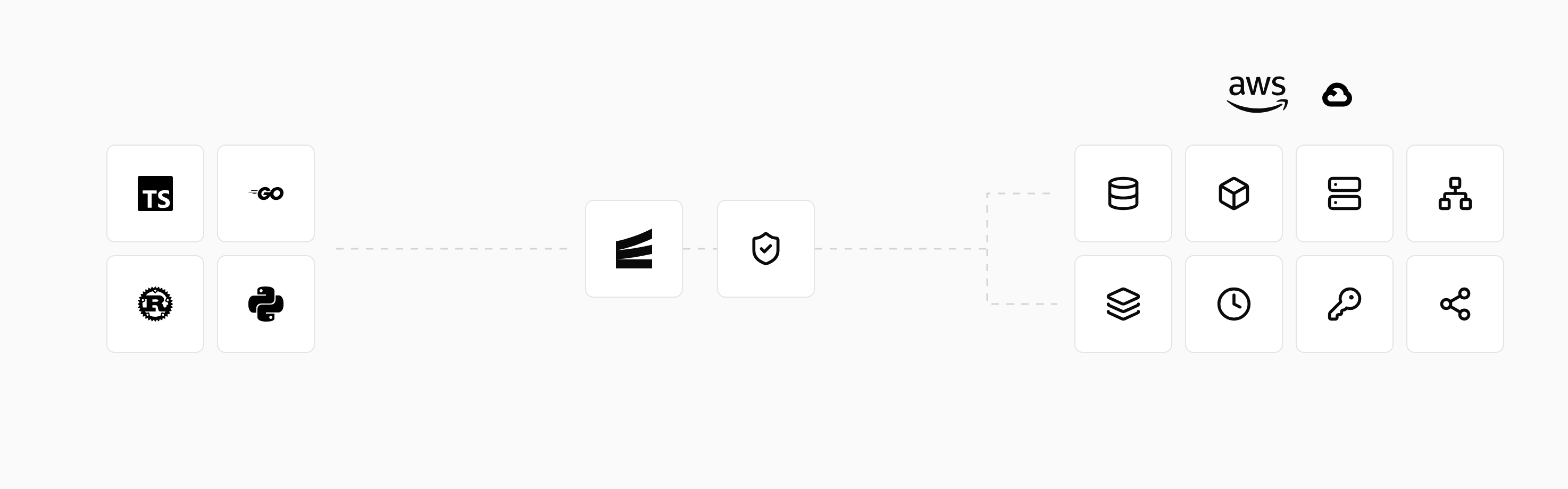
Encore can run your whole app locally with local infrastructure, so you and your agent can iterate quickly without needing a deploy to test new features. Backend operations use explicit APIs and SQL queries, with Pub/Sub for events between services. Postgres data can be accessed with standard SQL tools, while Convex queries, mutations, and reactive subscriptions depend on its document API and runtime, even in a self-hosted deployment.
Postgres-backed services run in your AWS or GCP account. As needs become more nuanced, engineers can manage configuration such as sizing, scaling, networking, and regions in Encore's dashboard or in your own cloud console.
Working with agents
Traditional codebases are hard for agents to read: configuration is scattered across YAML, infrastructure is defined separately, and service relationships are unclear. Encore applications are self-describing, so an agent can read the architecture through Encore's MCP server and agent rules instead of guessing at it. Generated code follows your existing patterns, type safety catches mistakes before deploy, and the agent can test changes instantly against real infrastructure running locally. See AI development with Encore for more.

encore run. The same bucket declaration is used in preview environments and production.Best for
Encore is for engineering teams moving beyond Convex that want their backend in their own AWS or GCP account, with developers and agents building features while Encore sets up and manages the infrastructure.
You can start with one API or background workload while Convex keeps handling the reactive parts of the product. An Encore service can call Convex functions through its client APIs, with authentication and authorization configured for that integration. If you use an external identity provider, the new backend can validate tokens from that same provider.
Moving the database means exporting Convex documents, designing a Postgres schema, and adapting queries and mutations to SQL-backed operations. Convex's automatic query subscriptions need application-defined streaming, polling, or a retained Convex feature; Encore's Pub/Sub connects backend services rather than providing a browser query subscription API.
Start with the quickstart, or install the CLI to create a starter app:
Run in your terminal to get started locally.
Supabase: Postgres with a backend service bundle

Supabase combines Postgres, authentication, storage, realtime, and Edge Functions. Tables, foreign keys, joins, and SQL transactions give teams a relational data model, while client SDKs provide access to the bundled services.
Working with agents
An agent can write schema migrations, RLS policies, client calls, and Edge Functions, then check them with Supabase's local development tools. The operation still spans application code and database policies, so testing needs to cover the access path used by the client as well as any elevated backend credentials.
Best for
Supabase fits teams that want Postgres while keeping a managed backend bundle. Convex documents and functions need to be adapted to SQL queries, APIs, and RLS policies. Realtime database changes, Broadcast, and Presence provide different subscription behavior from Convex reactive queries. Self-hosting provides an ownership option with provisioning, security, backups, and scaling handled by your team. The managed offering has spend controls, with usage and capacity still determining the bill.
Firebase: managed services for mobile and web apps

Firebase combines authentication, databases, storage, functions, and hosting with mobile tools such as Crashlytics and Remote Config. Its Firestore database supports realtime listeners and offline client access, making it a good fit for apps that need to stay useful without a connection.
// With an initialized Firestore client:
const documents = query(
  collection(db, "documents"),
  where("ownerId", "==", userId),
);
onSnapshot(documents, (snapshot) => {
  renderDocuments(snapshot.docs.map((doc) => doc.data()));
});
Working with agents
An agent can generate client calls, functions, and Security Rules and test them with the Local Emulator Suite. Permissions live across rules for client access and IAM for server access, so checking a feature means following both paths. Functions can also call Google Cloud services beyond the Firebase bundle, with their permissions and configuration managed separately.
Best for
Firebase fits teams that want stronger mobile tooling or Firestore's sync model and are comfortable with Google's ecosystem and usage billing. Moving from Convex means adapting document queries, mutations, and subscriptions to Firestore's APIs and Security Rules. Its Postgres-backed SQL service preserves a relational model, with schemas and operations defined through its own connector tooling.
Appwrite: a backend bundle you can self-host

Appwrite provides authentication, databases, file storage, functions, and realtime APIs through client and server SDKs. You can use Appwrite Cloud or run the platform on infrastructure you control.
Working with agents
An agent can run backend function code in Docker with Appwrite's local development tools. Execution permissions, event triggers, and timeouts need to be checked against the deployed project or a self-hosted instance; the local function runner does not enforce them.
Best for
Appwrite fits teams that want a BaaS bundle they can operate themselves, with self-hosting putting updates, backups, monitoring, and scaling under their control. That control comes with real operational work: self-hosting Appwrite effectively means running a whole platform of services, which takes significant experience managing infrastructure. Moving from Convex means adapting functions, document queries, and reactive subscriptions to Appwrite's APIs and permission model. Its Realtime API delivers service events rather than automatically maintaining the results of Convex queries.
PocketBase: a small backend on one server
 PocketBase
PocketBase packages a SQLite database, authentication, file storage, an admin UI, and realtime subscriptions into a single executable you run on your own server.
Working with agents
An agent can start a local instance, exercise the APIs, and work with collection rules and migrations without a hosted development account.
Best for
PocketBase fits small apps that can run on one server and teams willing to manage it. Moving from Convex means adapting the data model to SQLite-backed collections, and the single-server architecture becomes a constraint if you need independently scaled services. Its documentation advises against production-critical use while compatibility changes can require manual migrations.
How to choose
Start at the top and follow the first question you can answer with a yes:
Are you outgrowing Convex and want to deploy to your own cloud on AWS or Google Cloud without DevOps?
EncoreInfrastructure from code, provisioned in your own AWS or GCP accountEncoreInfrastructure from code, provisioned in your own AWS or GCP accountAre you building several services that share databases, Pub/Sub, or cron jobs?
EncoreType-safe service calls and built-in tracingEncoreType-safe service calls and built-in tracingDoes automatic query reactivity still fit, with hosting the main concern?
 Self-hosted ConvexSelf-host it to keep the existing applicationSelf-hosted ConvexSelf-host it to keep the existing application
Do you want Postgres with a backend service bundle?
SupabasePostgres with Auth, Storage, Realtime, and Edge FunctionsSupabasePostgres with Auth, Storage, Realtime, and Edge FunctionsDo you need mobile tooling, offline sync, and Google's ecosystem?
FirebaseFirestore sync and mobile SDKsFirebaseFirestore sync and mobile SDKsDo you want a BaaS platform like Convex but with more database options, like MySQL?
AppwriteA backend bundle, managed or self-hostedAppwriteA backend bundle, managed or self-hostedIs it a small app that fits on one server, with a team willing to run it?
PocketBaseSQLite, auth, and storage in a single executablePocketBaseSQLite, auth, and storage in a single executableIn more detail:
The right choice comes down to what you need to change:
- Encore for SQL-backed services and infrastructure in your own AWS or GCP account, with an integrated workflow for developers and agents.
- Supabase for Postgres with a backend service bundle.
- Firebase for mobile tooling, offline sync, and Google's ecosystem.
- Appwrite for a self-hostable backend bundle.
- PocketBase for a small backend that fits on one server.
If automatic query reactivity still fits the product and hosting is the main concern, self-hosting Convex can preserve more of the existing application, though running, upgrading, and scaling the backend and its database on servers you operate takes significant experience managing infrastructure. Convex also offers US and EU hosting regions, so a different region may address a data location requirement without changing platforms.
An Encore service can take on workloads that need SQL, separate scaling, or private cloud access while Convex continues handling reactive features. Keep the required transaction and subscription behavior explicit as operations move between the two systems.
Frequently asked questions
What is the best alternative to Convex?
Encore fits teams needing a service-based backend in their own AWS or GCP account, Supabase offers Postgres with a backend bundle, Firebase suits mobile apps and offline sync, Appwrite provides a self-hostable bundle, and PocketBase fits small self-hosted apps.
Does Encore replace Convex's automatic reactivity?
Not directly. Encore provides typed APIs, streaming APIs, and backend Pub/Sub, but it does not automatically subscribe clients to database query results. Keep Convex for those features or implement the required client update behavior separately.
Can I use SQL with a Convex alternative?
Yes. Encore and Supabase support Postgres. Moving Convex documents into SQL requires a relational schema, data transformation, and adapted queries and mutations.
Can I self-host Convex instead of migrating?
Yes. Convex has a backend you can self-host while keeping its function and document model. Your team takes responsibility for operating that deployment; self-hosting does not turn the application API into SQL.
Can I use Encore alongside Convex?
Yes. Move selected APIs or background workloads to Encore while Convex keeps providing reactive features. Configure authentication for calls between the systems and account for writes that need to remain consistent across their separate databases.
Is Convex a good fit for AI coding agents?
Yes. TypeScript functions, validators, generated types, and local or cloud development deployments give agents a practical way to build and test. An alternative becomes relevant when the team needs a different data model, service architecture, or production deployment boundary.
Deploy to your cloud on AWS and Google Cloud
without managing infrastructure
Encore lets developers and agents define application infrastructure directly in code, then automatically provisions it from local development to production in your AWS or GCP account.