CircleCI Alternatives in 2026: CI/CD Options Compared
CircleCI is a dedicated hosted CI service with orbs, caching and self-hosted runners. When teams look past it, GitHub Actions, GitLab CI, Buildkite and Jenkins are the usual picks. How they compare, and how application infrastructure still sits outside CI.


CircleCI is a dedicated hosted CI service: pipelines in .circleci/config.yml, orbs for reusable jobs, test splitting across parallel containers, and self-hosted runners for private networks. It works with GitHub, GitLab and Bitbucket, and teams pick it because CI is its own product rather than a tab inside the git host.
Teams look past CircleCI when credit bills climb, when the git host already ships a CI they are willing to standardize on, or when builds must run on hardware and networks they control end to end. This guide ranks the mainstream alternatives as CI products, then shows where application infrastructure still lives after you pick one.
CircleCI alternatives at a glance
Encore is not in this ranking. It is infrastructure from code: you declare application infrastructure in TypeScript or Go, and the platform provisions and deploys it into your own AWS or GCP account. It does not replace CircleCI, GitHub Actions, GitLab CI, Buildkite or Jenkins as the system that runs your test jobs.
1. GitHub Actions
 GitHub Actions
 keeps workflows in the repository, with hosted or self-hosted runners and a large marketplace of actions. Environments, required reviewers and OIDC to cloud roles cover many deploy gates without a separate CI vendor.
Choose Actions when the code is already on GitHub and consolidating onto the host CI matters more than keeping a dedicated CI product. For a broader comparison of leaving Actions itself, see GitHub Actions alternatives.
Best fit: teams whose repositories live on GitHub and want CI in the same UI.
2. GitLab CI/CD
 GitLab
 CI/CD defines pipelines in .gitlab-ci.yml with stages, jobs, environments and approvals. Runners are GitLab-hosted or self-managed. The same product can host the repository, registry and security scans, and GitLab itself can be self-managed for compliance.
Choose GitLab CI when the code already lives on GitLab, or when consolidating SCM and CI matters more than staying on a dedicated CI SaaS. For a full walkthrough, see GitLab CI/CD in 2026.
Best fit: teams on GitLab, including those that self-manage it.
3. Buildkite
 Buildkite
 splits CI into a hosted control plane and the Buildkite agent, which runs builds on your machines or on Buildkite-hosted infrastructure. Pipelines are YAML and can be generated dynamically at build time, which suits large monorepos and compliance-heavy environments.
It is the closest hosted-control replacement for "agents on our hardware" without operating a Jenkins controller yourself.
Best fit: teams with large, specialized or regulated builds that must stay on their own compute.
4. Jenkins
 Jenkins
 remains the default fully self-hosted automation server: a controller, agents and a large plugin ecosystem, and you keep the runners, plugins and upgrade cadence yourself.
Choose Jenkins when air-gapped networks, custom executors or existing plugin investments dominate. Skip it when the goal of leaving CircleCI is less maintenance. For a wider list, see Jenkins alternatives.
Best fit: organizations that already staff Jenkins and need maximum self-hosted flexibility.
How to choose
Stay on CircleCI when a dedicated hosted CI service with strong caching and orbs still fits the bill. Move to GitHub Actions when the repository is on GitHub and you want fewer vendors. Pick GitLab CI when the git host is GitLab. Pick Buildkite for agents on your own fleet with a hosted control plane, and Jenkins for full self-hosting.
None of these tools invents your RDS instance, Pub/Sub topics, object storage buckets or IAM roles: they run jobs, and the deploy stage is where backends grow a second codebase of Terraform root modules for load balancers, task definitions, databases, queues, secrets and roles. For how build, test and deploy stages fit together, see CI/CD pipeline in 2026.
Keep your CI, put application infra in Encore

CI stays the gate, and Encore is infrastructure from code for the deploy of declared resources into your own AWS or GCP account. CircleCI, GitHub Actions, GitLab CI, Buildkite or Jenkins run encore check, unit tests and whatever else you gate on. Encore handles the deploy stage for the databases, queues, object storage, cron jobs and secrets your code declares.
On a git push the platform runs a build and test phase, then provisions infrastructure and deploys. Link the app to GitHub, set each environment's Branch Push to the branch you release from, and connect the cloud account once. Encore provisions an IAM role for the service, so deploy credentials for application infra do not need to live as long-lived keys in the CI server.
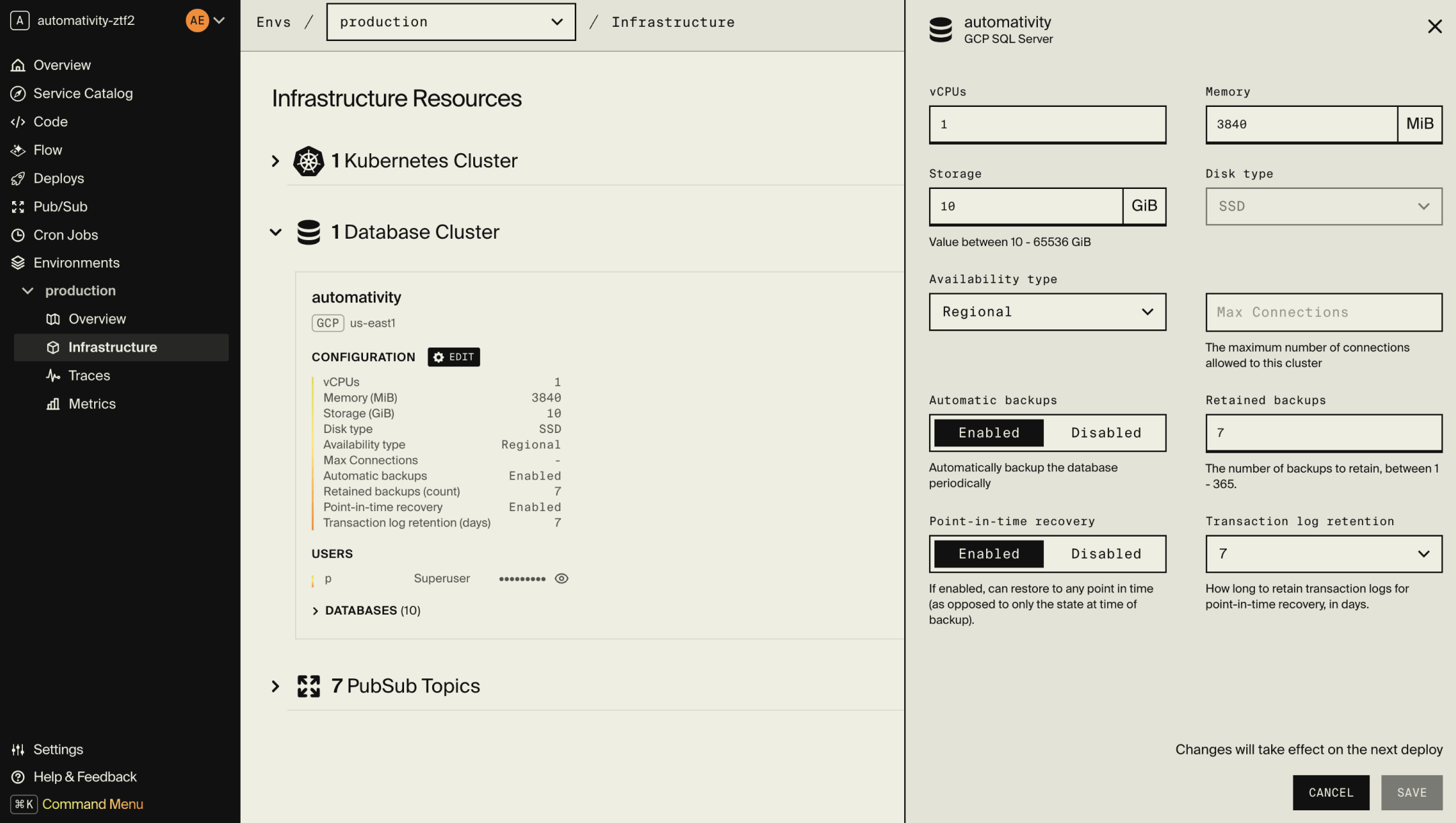
Checks in CircleCI, deploy on Encore
Keep CircleCI for pull request checks with a minimal job that installs the CLI and runs the same checks developers run locally:
# .circleci/config.yml
version: 2.1

jobs:
  verify:
    docker:
      - image: cimg/base:current
    steps:
      - checkout
      - run:
          name: Install Encore CLI
          command: curl -L https://encore.dev/install.sh | bash
      - run:
          name: Check the app
          command: ~/.encore/bin/encore check
      - run:
          name: Run tests
          command: ~/.encore/bin/encore test

workflows:
  backend:
    jobs:
      - verify
With Branch Push pointed at main, the same merge that passes CI starts the Encore rollout. Teams that stay on CircleCI for tests and use Encore for deploy keep one clear boundary: CI proves the change, Encore provisions and ships the application infrastructure.
Set up the app
Run in your terminal to get started locally.
A queue for fulfillment work is declared in application code, like this in TypeScript:
// orders/events.ts
import { Topic, Subscription } from "encore.dev/pubsub";
import { api } from "encore.dev/api";

export interface OrderPlaced {
  orderId: string;
}

export const orderPlaced = new Topic<OrderPlaced>("order-placed", {
  deliveryGuarantee: "at-least-once",
});

export const place = api(
  { expose: true, method: "POST", path: "/orders" },
  async ({ orderId }: { orderId: string }): Promise<void> => {
    await orderPlaced.publish({ orderId });
  },
);

const _ = new Subscription(orderPlaced, "fulfill", {
  handler: async (event) => {
    // Fulfill event.orderId.
  },
});
encore run delivers that topic locally. On AWS the subscription becomes SNS and SQS with a dead-letter queue; on GCP it becomes GCP Pub/Sub with a dead-letter topic. An AI coding agent adding a consumer writes the Subscription in the same pull request that CircleCI already tests, and the deploy provisions the queue.
Best fit: teams happy with CircleCI (or another CI above) for build and test, who want the deploy stage to provision application infrastructure from TypeScript or Go into their own cloud.
Related guides
Frequently asked questions
What is the best alternative to CircleCI?
GitHub Actions if your repositories are on GitHub and you want CI next to the code. GitLab CI/CD if the code is on GitLab or you want SCM and CI in one product. Buildkite if builds must run on your machines behind a hosted control plane. Jenkins if you need a fully self-hosted controller and plugin ecosystem.
Why do teams leave CircleCI?
Common reasons are credit or concurrency cost at scale, wanting CI native to GitHub or GitLab, needing every job on private hardware with a different control plane, or consolidating tools after an acquisition. Some teams also find CircleCI fine for build and test, and that the pain sits in the deploy stage rather than in the CI product.
Is GitHub Actions a good CircleCI alternative?
Yes when the repository already lives on GitHub, workflow YAML is manageable, and minute cost is acceptable. It is a weaker swap if you specifically want a dedicated CI product separate from the git host UI, or if builds must stay on a large private agent fleet that Buildkite or Jenkins already serve well.
Does Encore replace CircleCI?
No. Encore is not a CI product. Keep CircleCI, GitHub Actions, GitLab CI, Buildkite or Jenkins for encore check, unit tests and whatever else you gate on. Encore provisions databases, queues, object storage, cron and secrets from code and deploys into your AWS or GCP account when you push to the environment branch.
Deploy to your cloud on AWS and Google Cloud
without managing infrastructure
Encore lets developers and agents define application infrastructure directly in code, then automatically provisions it from local development to production in your AWS or GCP account.
