Aptible Alternatives in 2026
Six alternatives to Aptible for teams that want a git-push platform for regulated backends, compared on where the workloads run, pricing in November 2026 and how much of the compliance boundary sits in your own AWS or GCP account.

Aptible is a compliance-focused PaaS with git-push deploys, managed Postgres and dedicated stacks that apply HIPAA and SOC 2 controls, per its pricing page. Teams look elsewhere when the $499 a month stack plus per-GB pricing outgrows the app, or when they want the data in an AWS or GCP account they own.
This guide compares six alternatives on where the workloads run, what they cost as of November 18, 2026, and how much of the compliance boundary moves into your own account. None of the tools below make an app compliant on their own, so the comparison stays on infrastructure and ownership.
Aptible alternatives at a glance
Aptible is the baseline here: Development has no base fee, Production is $499 a month with one dedicated stack, general purpose containers are $0.08 per GB RAM per hour, and endpoints are $0.06 per hour, from Aptible's pricing. Aptible's stacks docs describe running inside your own AWS account as an Enterprise feature.
1. Encore

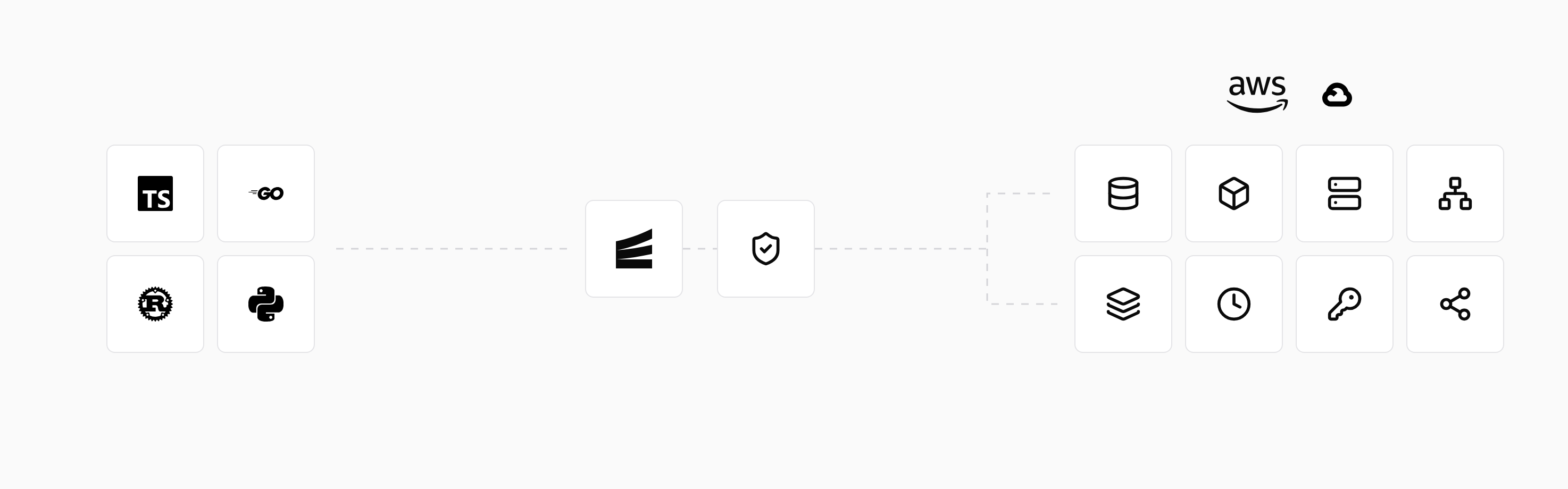
Encore is a backend framework with built-in infrastructure for Go and TypeScript. You declare databases, Pub/Sub topics, buckets and secrets in the application code, and pushing to git provisions them in your own AWS or GCP account: RDS, SNS and SQS, S3 and Secrets Manager on AWS, or Cloud SQL, Pub/Sub, GCS and Secret Manager on GCP. Per the AWS infrastructure docs, databases sit in private subnets with daily backups kept for 7 days, and each service gets its own database role.
Run in your terminal to get started locally.
The sample below reads a record and writes an access log row in the same transaction, behind an auth handler whose token is an Encore secret:
package records

import (
	"context"
	"encoding/json"

	"encore.dev/beta/auth"
	"encore.dev/storage/sqldb"
)

// Provisioned as RDS for PostgreSQL in your AWS account,
// or Cloud SQL in your GCP project.
var db = sqldb.NewDatabase("records", sqldb.DatabaseConfig{
	Migrations: "./migrations",
})

type Record struct {
	ID   int64           `json:"id"`
	Body json.RawMessage `json:"body"`
}

// Get returns a record and writes an access log entry in the same transaction.
//
//encore:api auth method=GET path=/records/:id
func Get(ctx context.Context, id int64) (*Record, error) {
	tx, err := db.Begin(ctx)
	if err != nil {
		return nil, err
	}
	defer tx.Rollback()

	r := &Record{ID: id}
	err = tx.QueryRow(ctx, `SELECT body FROM records WHERE id = $1`, id).Scan(&r.Body)
	if err != nil {
		return nil, err
	}
	uid, _ := auth.UserID()
	_, err = tx.Exec(ctx,
		`INSERT INTO access_log (record_id, actor, action) VALUES ($1, $2, 'read')`,
		id, string(uid))
	if err != nil {
		return nil, err
	}
	return r, tx.Commit()
}
The auth handler lives in its own service and compares the bearer token with an Encore secret:
package authn

import (
	"context"

	"encore.dev/beta/auth"
	"encore.dev/beta/errs"
)

var secrets struct {
	APIToken string
}

//encore:authhandler
func AuthHandler(ctx context.Context, token string) (auth.UID, error) {
	if token != secrets.APIToken {
		return "", &errs.Error{Code: errs.Unauthenticated, Message: "invalid token"}
	}
	return auth.UID("service-user"), nil
}
The databases, secrets and authentication docs cover each piece, and connecting your own cloud covers the AWS or GCP account setup. Secret values are set with encore secret set and stored in the cloud's secrets manager. Production values are not stored in the repository, so a coding agent working in the repo cannot read or leak those production values. A local override in .secrets.local.cue is a file on disk and is readable if it is present. Encore's security and compliance page describes controls aligned with the SOC 2 trust service criteria and a SOC 2 Type I target of Q4 2026; it lists no HIPAA certification. Encore holds no HIPAA certification or attestation. The regulated data stays in your account, and compliance stays with your team and the cloud provider, including any Business Associate Agreement you sign with AWS or GCP.
A coding agent that adds a table or a queue changes the Go code, and the next deploy provisions it in your account with the same networking and roles as the rest of the app.
Best fit: Go and TypeScript backends that hold sensitive data and want it in their own AWS or GCP account, with git-push deploys like Aptible.
2. Porter
Porter deploys apps from GitHub into a Kubernetes cluster it creates in your AWS, GCP or Azure account. Per Porter's pricing, it charges $6 per GB of RAM and $13 per vCPU per month for requested resources, on top of the cloud bill. It is the closest match to Aptible's workflow with the cluster in your account, and the trade is that you now own an EKS or GKE cluster.
3. Northflank
Northflank runs services, jobs and database addons on its own cloud or in your cloud account. Northflank's pricing lists $0.01667 per vCPU hour and $0.00833 per GB hour on Northflank Cloud, and $0.02083 per node vCPU hour when it manages nodes in your cloud. It fits teams that want one control plane across clouds and are comfortable with a container-first model.
4. Render
Render is the closest hosted PaaS to Aptible's Development and Production plans. Per Render's pricing, the Pro workspace is $25 a month plus compute, a 512 MB web service is $7 a month, and HIPAA-compliant workspaces come on the Scale plan at $499 a month with a 20% compute premium. Workloads stay in Render's cloud, not yours.
5. AWS ECS on Fargate
Running containers on ECS with Fargate behind an ALB, with RDS and Secrets Manager, is the do-it-yourself version of what Aptible manages. AWS offers a Business Associate Addendum for its HIPAA-eligible services, and you pay list prices with no platform fee. In exchange, you write and maintain the Terraform, the CI pipeline and the patching that a platform would otherwise own.
6. Google Cloud Run
Cloud Run with Cloud SQL and Secret Manager is the GCP equivalent: containers scale per request, and a Cloud SQL connector handles database access. It is less work than ECS for request-driven APIs, but VPC networking, IAM bindings and migrations are still yours to build and maintain.
How to choose
The choice follows where the workloads should run and how much of the platform you want to own. Stay on a hosted PaaS such as Render when you want Aptible's model without moving into your own cloud, including a HIPAA-enabled tier. Choose Encore when you want a git-push workflow with the database, queues and secrets in your own AWS or GCP account, declared in Go or TypeScript. Choose Porter or Northflank when you want a container platform in your cloud and can own a Kubernetes cluster. Choose ECS Fargate or Cloud Run when you have a platform team to build the rest.
Related guides
Frequently asked questions
What is the best alternative to Aptible?
It depends on where you want the workloads to run and how much of the platform you want to own: Encore if you want the database, queues and secrets provisioned in your own AWS or GCP account from Go or TypeScript code; Porter or Northflank if you want a container platform in your cloud and can own a Kubernetes cluster; Render if you want to stay on a hosted PaaS, including a HIPAA-enabled tier; and ECS Fargate or Cloud Run if you have a platform team to build the rest.
How much does Aptible cost?
As of November 18, 2026, Aptible's Development plan has no base fee, and Production costs $499 a month for one dedicated stack. Usage is billed on top: general purpose containers at $0.08 per GB of RAM per hour and endpoints at $0.06 per hour, so one 1 GB container behind one endpoint is about $102 a month before databases.
Can Aptible run in my own AWS account?
Yes, but only on the Enterprise plan, where Aptible's docs describe self-hosted dedicated stacks that run inside your own AWS account. The Development and Production plans run on stacks in Aptible's AWS accounts.
Does moving off Aptible mean losing HIPAA support?
No. Moving off Aptible does not automatically end HIPAA support, though the agreements and controls change hands. Aptible's Production plan applies HIPAA controls to a dedicated stack. If you run on your own AWS or GCP account instead, the cloud provider's BAA covers its eligible services, and your own team owns the controls and the audit, whichever deployment tool provisions the resources.
Deploy to your cloud on AWS and Google Cloud
without managing infrastructure
Encore lets developers and agents define application infrastructure directly in code, then automatically provisions it from local development to production in your AWS or GCP account.
