Upstash QStash Alternatives in 2026
Six alternatives to Upstash QStash for HTTP message delivery, retries and schedules, compared on delivery model, limits and pricing in November 2026, with a TypeScript webhook queue and cron job that run in your own AWS or GCP account.

Upstash QStash is an HTTP-based message queue and scheduler: you publish a message with a destination URL, and QStash calls that URL with retries, delays and cron schedules. It suits serverless functions that cannot run their own consumers, and it bills per message, including every retry.
Teams look for alternatives when message volume grows or when the 2-hour response limit on pay as you go gets in the way, and also when they want the queue in their own AWS or GCP account. This guide compares six alternatives on delivery model, limits and pricing as of November 18, 2026.
QStash alternatives at a glance
QStash is the baseline: Free allows 1,000 messages a day, pay as you go is $1 per 100,000 messages, and the Fixed 1M and Fixed 10M plans are $180 and $420 a month, per QStash pricing. By default QStash retries a failed delivery 3 times with backoff capped at one day.
1. Encore

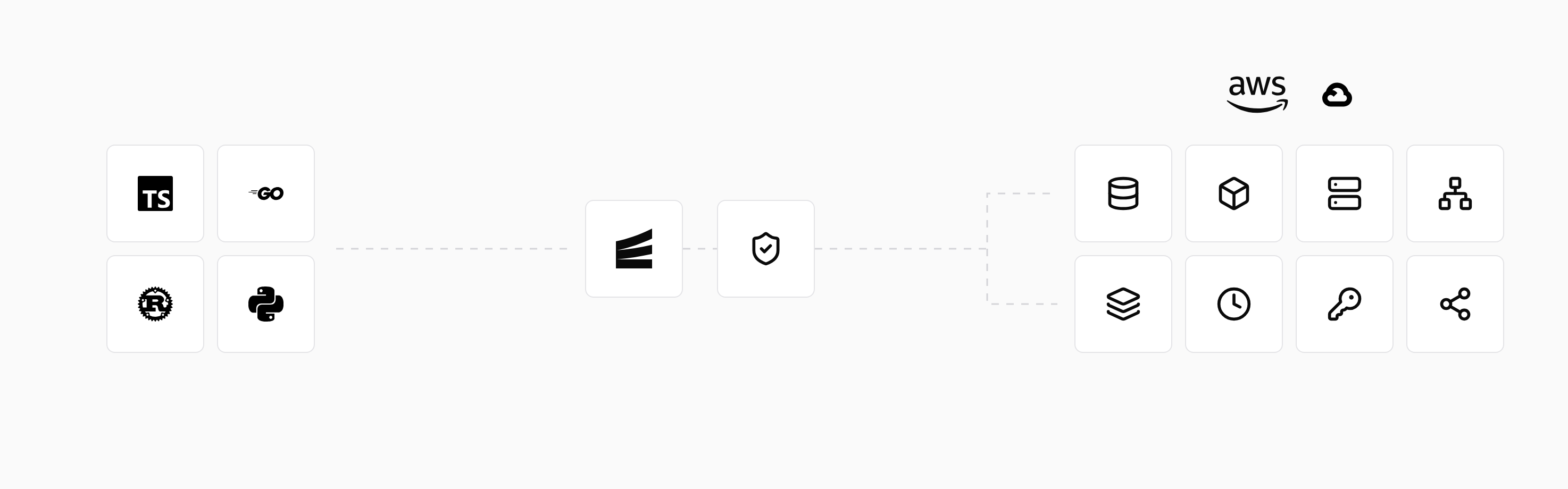
Encore is a backend framework with built-in infrastructure for TypeScript and Go. A QStash publish call becomes a Pub/Sub topic and a subscription in your code, and a QStash schedule becomes a cron job. Deploying provisions SNS and SQS on AWS or Pub/Sub on GCP in your own account, with dead-letter queues, and the Encore platform runs the cron schedule.
Run in your terminal to get started locally.
import { api, APIError } from "encore.dev/api";
import { Topic, Subscription } from "encore.dev/pubsub";
import { CronJob } from "encore.dev/cron";
import log from "encore.dev/log";

interface Delivery {
  url: string;
  payload: Record<string, unknown>;
}

const destinations: Record<string, string> = {
  billing: "https://billing.example.com/webhooks",
  crm: "https://crm.example.com/hooks",
};

// SNS and SQS on AWS, Pub/Sub on GCP, both with a dead-letter queue.
export const deliveries = new Topic<Delivery>("webhook-deliveries", {
  deliveryGuarantee: "at-least-once",
});

// Replaces a QStash publish call: enqueue a message for later delivery.
export const send = api(
  { expose: true, auth: true, method: "POST", path: "/webhooks" },
  async (d: { destination: string; payload: Record<string, unknown> }): Promise<void> => {
    const url = destinations[d.destination];
    if (!url) throw APIError.invalidArgument("unknown destination");
    await deliveries.publish({ url, payload: d.payload });
  },
);

// Throwing makes Encore redeliver the message with backoff.
new Subscription(deliveries, "deliver", {
  handler: async (d) => {
    const res = await fetch(d.url, {
      method: "POST",
      headers: { "content-type": "application/json" },
      body: JSON.stringify(d.payload),
    });
    if (!res.ok) {
      throw new Error(`delivery to ${d.url} failed with ${res.status}`);
    }
    log.info("delivered", { url: d.url });
  },
  maxConcurrency: 20,
  retryPolicy: { minBackoff: "5s", maxBackoff: "10m", maxRetries: 10 },
});

export const digest = api({}, async (): Promise<void> => {
  log.info("sending hourly digest");
});

// Replaces a QStash schedule. Scheduled by the Encore platform once deployed.
new CronJob("hourly-digest", {
  title: "Send the hourly digest",
  every: "1h",
  endpoint: digest,
});
In a local encore run test, a delivery to an endpoint that returned 500 on the first attempt was retried and logged as delivered on the second. The Pub/Sub docs cover retry policies, which default to a 10-second minimum and 10-minute maximum backoff, and the cron jobs docs cover schedules, which do not fire locally. Per-message delays like QStash's Upstash-Delay have no direct equivalent, so a delayed send is a row in a database with a due time that a cron job picks up. Connecting your own cloud covers the AWS and GCP setup.
A coding agent that adds a new background job writes a topic and a subscription in TypeScript, and the next deploy creates the queue, the dead-letter queue and the permissions in your account.
Best fit: TypeScript or Go backends on AWS or GCP that want background delivery, retries and schedules in their own account instead of a per-message service.
2. Amazon SQS
Amazon SQS is the AWS-native queue, with 1 million free requests a month and standard queues at $0.40 per million after that. Unlike QStash, SQS does not call a URL: a consumer polls it, usually a Lambda function through an event source mapping, and EventBridge Scheduler covers schedules. It is cheaper at volume, but the consumer, the dead-letter queue and the IAM policy are yours to set up.
3. Google Cloud Tasks
Google Cloud Tasks is the closest match to QStash's model: you create a task with an HTTP target and Cloud Tasks pushes it with retries, rate limits and scheduled delivery times. Pricing is free for the first 1 million billable operations a month and $0.40 per million after that, and Cloud Scheduler handles cron schedules.
4. Inngest
Inngest runs event-driven functions with durable steps, sleeps and retries, calling your app over HTTP the way QStash does. Per Inngest pricing, Free includes 50,000 executions a month and Pro starts at $99 a month with 1 million. Pick it when a message turns into a multi-step workflow rather than a single delivery.
5. Trigger.dev
Trigger.dev runs TypeScript tasks on its own workers with no timeouts, scheduled tasks and retries. Per Trigger.dev pricing, Free includes $5 of monthly credits, Hobby is $10 and Pro is $50 a month, with compute billed per second. It fits long jobs that do not fit inside a function's response limit.
6. Vercel Queues
Vercel Queues send messages to durable topics and deliver them to Vercel Functions with retries, and Vercel Schedules handle cron. The feature is marked Beta in Vercel's docs as of November 2026, and it only makes sense when the app already runs on Vercel.
How to choose
Match the alternative to the job QStash was doing. Choose Google Cloud Tasks for a like-for-like HTTP task queue on GCP, or Amazon SQS when the consumers are Lambda functions. Choose Encore when the backend runs on AWS or GCP and you want queues, retries and schedules declared in code and running in your own account. Choose Inngest or Trigger.dev when messages turn into durable multi-step jobs, and Vercel Queues if you already deploy on Vercel.
Related guides
Frequently asked questions
What is the best alternative to Upstash QStash?
It depends on what you need to replace: Encore if the backend runs on AWS or GCP and you want queues, retries and schedules declared in code and running in your own account; Google Cloud Tasks if you want a like-for-like HTTP task queue on GCP; Amazon SQS if the consumers are Lambda functions on AWS; Inngest or Trigger.dev if messages turn into durable multi-step jobs; and Vercel Queues if you already deploy on Vercel.
How much does QStash cost?
As of November 18, 2026, QStash Free allows 1,000 messages a day, pay as you go costs $1 per 100,000 messages, and fixed plans are $180 a month for 1 million messages a day and $420 for 10 million. Every delivery attempt counts as a message, so retries add to the bill.
How does QStash retry failed deliveries?
QStash retries a delivery 3 times by default when the endpoint does not return a 2XX status, with exponential backoff of e to the power of 2.5 times the retry count, capped at one day. You can change the count with the Upstash-Retries header and the delay with Upstash-Retry-Delay.
How long can a QStash delivery take?
QStash aborts a delivery attempt when the endpoint does not respond within the plan's maximum HTTP response duration: 15 minutes on Free, 2 hours on pay as you go, 6 hours on Fixed 1M and 12 hours on Fixed 10M, per the QStash pricing page on November 18, 2026. Longer work needs a worker that acknowledges quickly and processes in the background.
Deploy to your cloud on AWS and Google Cloud
without managing infrastructure
Encore lets developers and agents define application infrastructure directly in code, then automatically provisions it from local development to production in your AWS or GCP account.
