tRPC vs Encore.ts in 2026
Comparing two approaches to end-to-end type safety

tRPC and Encore.ts both promise end-to-end type safety, but they're fundamentally different tools. tRPC is an API layer that eliminates the need for schemas by inferring types directly from your backend code. Encore.ts is a full backend framework where infrastructure is defined in code and types flow through your entire system.
The choice isn't always either/or. They solve different problems, and this comparison helps you understand when each approach fits.
Quick Comparison
Understanding the Approaches
tRPC
tRPC removes the API boundary between frontend and backend in TypeScript projects. Instead of defining schemas or generating clients, you call backend procedures directly with full type inference:
// server/router.ts
import { initTRPC } from '@trpc/server';
import { z } from 'zod';

const t = initTRPC.create();

export const appRouter = t.router({
  getUser: t.procedure
    .input(z.object({ id: z.string() }))
    .query(async ({ input }) => {
      return { id: input.id, name: 'John', email: 'john@example.com' };
    }),

  createUser: t.procedure
    .input(z.object({
      email: z.string().email(),
      name: z.string(),
    }))
    .mutation(async ({ input }) => {
      return { id: '1', ...input };
    }),
});

export type AppRouter = typeof appRouter;
// client/index.ts
import { createTRPCClient, httpBatchLink } from '@trpc/client';
import type { AppRouter } from '../server/router';

const trpc = createTRPCClient<AppRouter>({
  links: [httpBatchLink({ url: 'http://localhost:3000/api/trpc' })],
});

// Full type safety - IDE autocomplete, type errors if mismatched
const user = await trpc.getUser.query({ id: '1' });
console.log(user.name); // TypeScript knows this is string
Types flow directly from your backend to your frontend without code generation or schema files.
Encore.ts
Encore.ts is a backend framework where types define your APIs and infrastructure:
users/users.ts// users/api.ts
import { api } from "encore.dev/api";
import { SQLDatabase } from "encore.dev/storage/sqldb";

const db = new SQLDatabase("users", { migrations: "./migrations" });

interface User {
  id: string;
  name: string;
  email: string;
}

interface GetUserRequest {
  id: string;
}

export const getUser = api(
  { method: "GET", path: "/users/:id", expose: true },
  async ({ id }: GetUserRequest): Promise<User> => {
    const user = await db.queryRow<User>`
      SELECT id, name, email FROM users WHERE id = ${id}
    `;
    if (!user) throw new Error("User not found");
    return user;
  }
);
service.ts// From another service
import { users } from "~encore/clients";

// Type-safe call
const user = await users.getUser({ id: "1" });
Encore generates type-safe clients for service-to-service communication and can also generate clients for external consumers.
Key Difference: tRPC connects your frontend directly to your backend in a monorepo. Encore connects services within a backend system and provides infrastructure automation.
Type Safety Approaches
tRPC
tRPC's type inference is its core feature:
// Define a procedure
const appRouter = t.router({
  greeting: t.procedure
    .input(z.object({ name: z.string() }))
    .query(({ input }) => {
      return `Hello, ${input.name}!`;
    }),
});

// Client automatically knows:
// - greeting.query takes { name: string }
// - greeting.query returns string
const message = await trpc.greeting.query({ name: 'World' });
The magic happens through TypeScript's type inference. Runtime type information doesn't cross the network, so it's purely a development-time feature. You use Zod for runtime validation.
Encore.ts
Encore validates types at runtime based on your TypeScript interfaces:
greeting/greeting.tsinterface GreetingRequest {
  name: string;
}

export const greeting = api(
  { method: "GET", path: "/greeting", expose: true },
  async ({ name }: GreetingRequest): Promise<string> => {
    return `Hello, ${name}!`;
  }
);
Invalid requests are rejected before your handler runs. The same types work for service-to-service calls:
service.tsimport { greetings } from "~encore/clients";

// Type-safe, validated at both ends
const message = await greetings.greeting({ name: "World" });
Verdict: tRPC provides seamless type inference for frontend-backend communication. Encore provides type safety across services with runtime validation. Both eliminate the need for manual API schemas.
Integration with Existing Code
tRPC
tRPC integrates with existing HTTP frameworks:
// With Express
import express from 'express';
import { createExpressMiddleware } from '@trpc/server/adapters/express';
import { appRouter } from './router';

const app = express();
app.use('/api/trpc', createExpressMiddleware({ router: appRouter }));
app.listen(3000);

// With Next.js (App Router)
// app/api/trpc/[trpc]/route.ts
import { fetchRequestHandler } from '@trpc/server/adapters/fetch';
import { appRouter } from '@/server/router';

const handler = (req: Request) =>
  fetchRequestHandler({
    endpoint: '/api/trpc',
    req,
    router: appRouter,
  });

export { handler as GET, handler as POST };
tRPC fits into your existing stack. It's an API layer, not a framework replacement.
Encore.ts
Encore is a standalone framework:
service.ts// users/encore.service.ts
import { Service } from "encore.dev/service";
export default new Service("users");

// users/api.ts
import { api } from "encore.dev/api";

export const getUser = api(/* ... */);
You build your entire backend with Encore. If you have existing services, you can call them via HTTP or gradually migrate.
Verdict: tRPC is easier to adopt incrementally. Encore requires more commitment but provides more features.
Frontend Integration
tRPC
tRPC shines in full-stack TypeScript apps, especially with React:
// With React Query integration
import { trpc } from './utils/trpc';

function UserProfile({ userId }: { userId: string }) {
  const { data: user, isLoading } = trpc.getUser.useQuery({ id: userId });

  if (isLoading) return <div>Loading...</div>;

  return (
    <div>
      <h1>{user?.name}</h1>
      <p>{user?.email}</p>
    </div>
  );
}
The React Query integration provides caching, refetching, and optimistic updates with full type safety.
Encore.ts
Encore can generate clients for external consumers:
# Generate TypeScript client
encore gen client my-app --lang=typescript --output=./client
import Client from './client';

const client = new Client({ baseURL: 'https://my-app.encr.app' });

const user = await client.users.getUser({ id: '1' });
For React integration, you'd use the generated client with React Query or similar:
import { useQuery } from '@tanstack/react-query';
import { client } from './api';

function UserProfile({ userId }: { userId: string }) {
  const { data: user } = useQuery({
    queryKey: ['user', userId],
    queryFn: () => client.users.getUser({ id: userId }),
  });

  return <div>{user?.name}</div>;
}
Verdict: tRPC has tighter React integration out of the box. Encore requires an extra step to generate clients, but works with any frontend framework.
Infrastructure
tRPC
tRPC doesn't include infrastructure, so you bring your own:
// With Prisma
import { PrismaClient } from '@prisma/client';

const prisma = new PrismaClient();

const appRouter = t.router({
  getUser: t.procedure
    .input(z.object({ id: z.string() }))
    .query(async ({ input }) => {
      return prisma.user.findUnique({ where: { id: input.id } });
    }),
});
You set up databases, manage connections, and handle infrastructure separately.
Encore.ts
Encore provides infrastructure primitives:
import { api } from "encore.dev/api";
import { SQLDatabase } from "encore.dev/storage/sqldb";
import { Topic, Subscription } from "encore.dev/pubsub";
import { CronJob } from "encore.dev/cron";

const db = new SQLDatabase("app", { migrations: "./migrations" });

const userCreated = new Topic<{ userId: string }>("user-created", {
  deliveryGuarantee: "at-least-once",
});

const _ = new CronJob("cleanup", {
  title: "Daily cleanup",
  every: "24h",
  endpoint: cleanupEndpoint,
});
Local development automatically provisions databases and supporting infrastructure.
Verdict: tRPC is infrastructure-agnostic. Encore provides integrated infrastructure with automatic provisioning.
Service-to-Service Communication
tRPC
tRPC is primarily designed for client-server communication, not service-to-service:
// Calling another service requires manual setup
const otherService = createTRPCClient<OtherServiceRouter>({
  links: [httpBatchLink({ url: process.env.OTHER_SERVICE_URL })],
});

const result = await otherService.someMethod.query({ /* ... */ });
You manage service URLs and handle the setup yourself.
Encore.ts
Service communication is a core feature:
orders/orders.ts// users/api.ts
export const getUser = api(/* ... */);

// orders/api.ts
import { users } from "~encore/clients";

export const createOrder = api(
  { method: "POST", path: "/orders", expose: true },
  async (req: CreateOrderRequest) => {
    // Type-safe, automatic service discovery
    const user = await users.getUser({ id: req.userId });
    return { orderId: '1', user };
  }
);
Services discover each other automatically. Calls are traced across service boundaries. The service catalog visualizes your architecture.
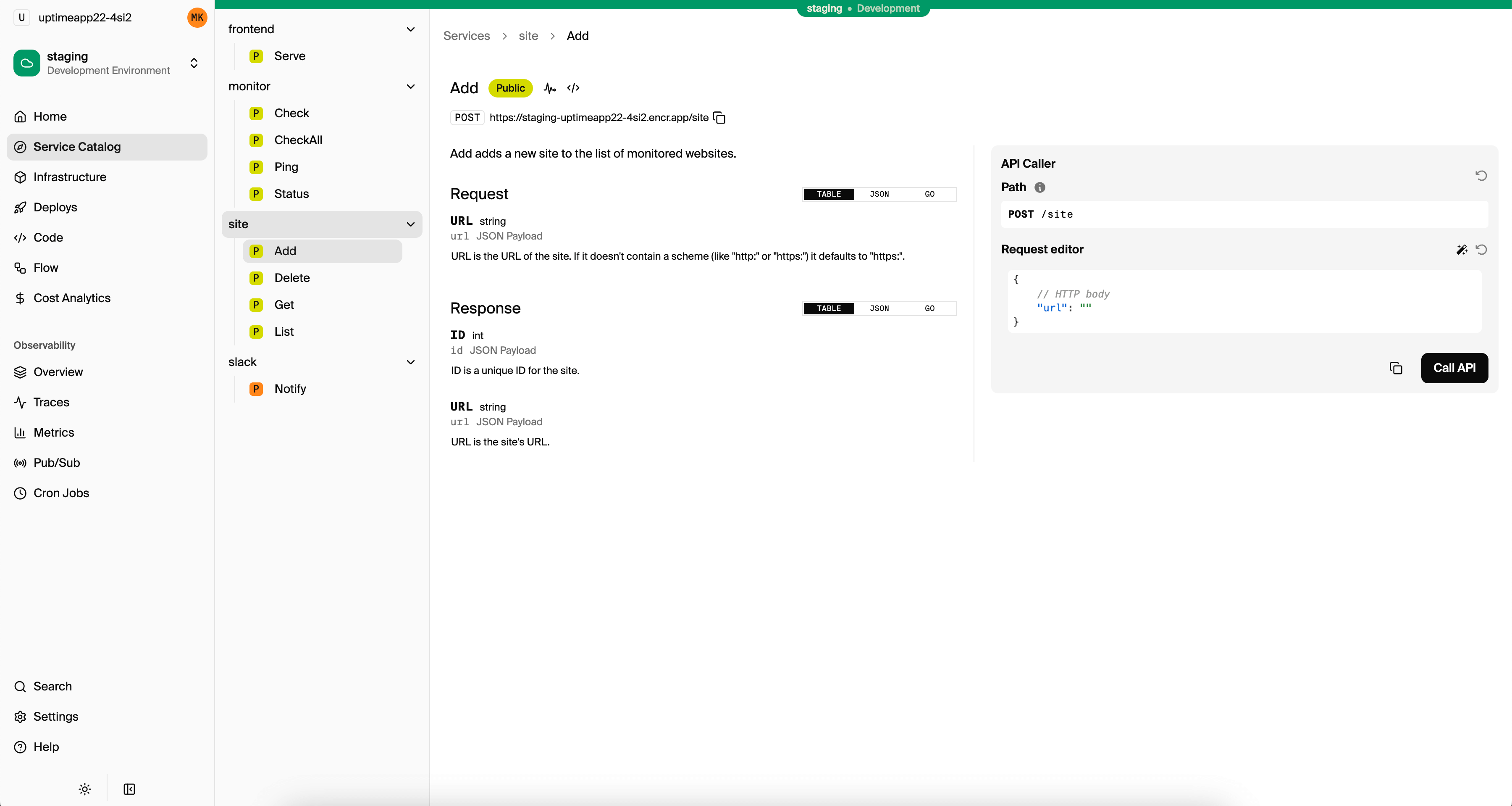
Verdict: Encore is designed for service-to-service communication. tRPC is designed for client-server communication.
Observability
tRPC
tRPC doesn't include observability:
// Manual logging
const appRouter = t.router({
  getUser: t.procedure
    .input(z.object({ id: z.string() }))
    .query(async ({ input }) => {
      console.log('Getting user:', input.id);
      // Add your own tracing, metrics, etc.
      return { /* ... */ };
    }),
});
You integrate logging, tracing, and metrics yourself.
Encore.ts
users/users.tsimport { api } from "encore.dev/api";
import log from "encore.dev/log";

export const getUser = api(
  { method: "GET", path: "/users/:id", expose: true },
  async ({ id }: { id: string }) => {
    log.info("fetching user", { userId: id });
    // Database queries and service calls are traced automatically
    return { /* ... */ };
  }
);
Distributed tracing works automatically across services and database calls.
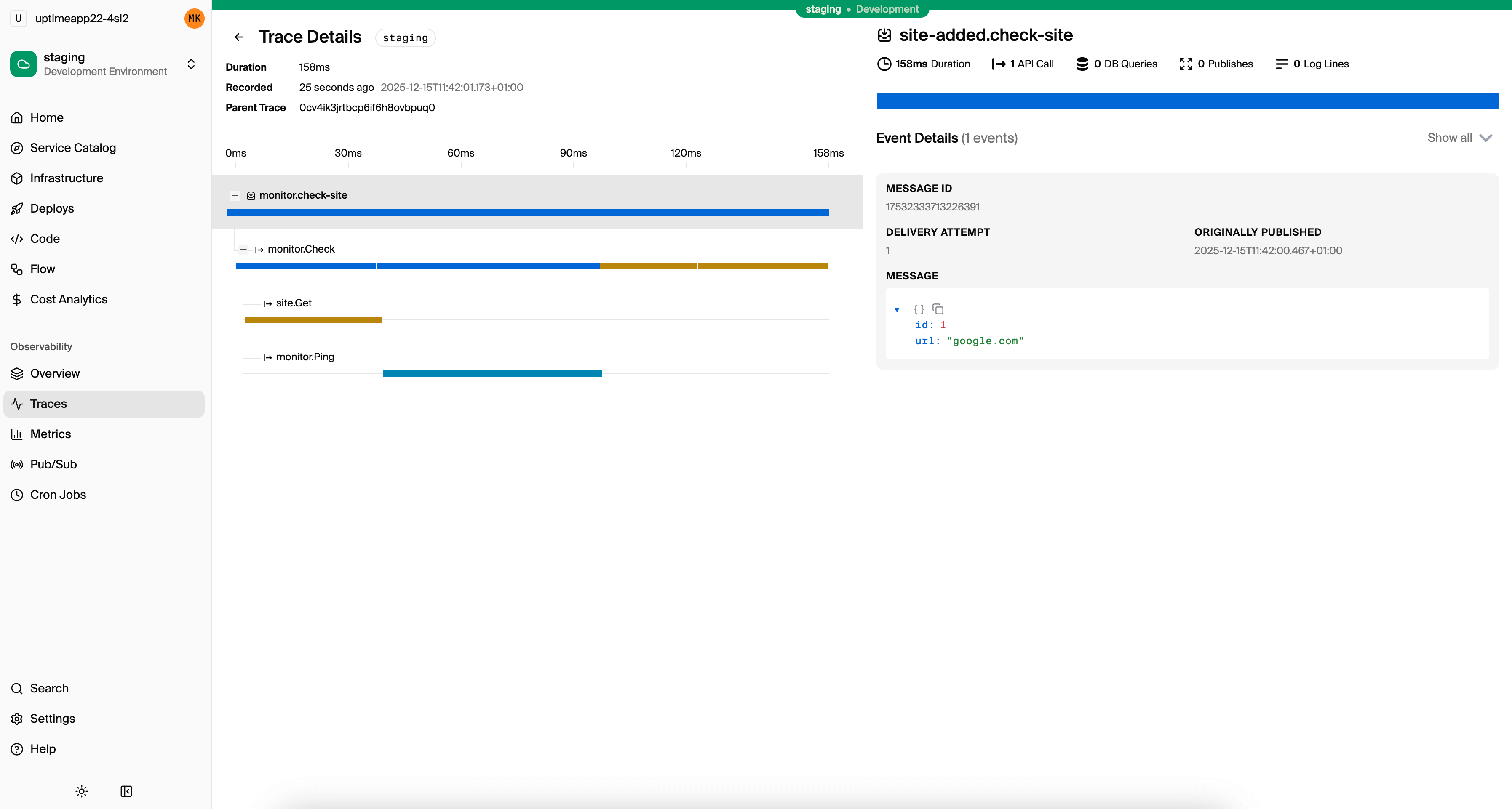
Verdict: Encore provides built-in observability. tRPC requires external tools.
AI Code Generation
TypeScript's backend ecosystem has more competing options at every layer than almost any other language, and AI agents will use a different combination of database client, auth setup, and deployment adapter on every prompt. The problem isn't that there's no structure available, it's that there are too many valid structures to choose from.
tRPC
tRPC is in a similar position to NestJS here: the router/procedure pattern gives agents a consistent structure, so an agent asked to "add an order creation endpoint" will reliably produce a t.procedure.input(z.object(...)).mutation(...) call. Where things diverge is everything around the router: which database client to use (Prisma, Drizzle, raw SQL), how to set up the auth context (custom context functions, session middleware, NextAuth integration), where to deploy (Express adapter, Next.js API route, standalone server), and how to manage connection pools and environment variables. tRPC solves the API layer, but the infrastructure decisions still vary.
// An agent asked to "add an order creation endpoint" will consistently generate:
// - A t.procedure with Zod input validation and .mutation()
//
// But the infrastructure decisions still vary:
// - Prisma client or Drizzle or a raw pg query
// - Custom createContext() with session lookup or NextAuth
// - Express adapter or Next.js route handler or standalone
// - Different environment variable patterns and connection setup
Encore.ts
With Encore, the project's API patterns, infrastructure declarations, and service structure are already defined. The agent reads the existing conventions and writes code that follows them. A prompt to "add an order creation endpoint" produces an api() function with typed request/response interfaces and a database call using the existing SQLDatabase declaration, not a new architecture.
orders/orders.ts// The agent sees existing patterns and follows them:
export const create = api(
  { expose: true, auth: true, method: "POST", path: "/orders" },
  async (req: CreateOrderRequest): Promise<Order> => {
    // Business logic only — the agent doesn't reinvent the structure
    const order = await db.queryRow<Order>`
      INSERT INTO orders (customer_id, total)
      VALUES (${req.customerId}, ${req.total})
      RETURNING id, customer_id as "customerId", total
    `;
    return order!;
  }
);
Encore also provides an MCP server and editor rules (encore llm-rules init) that give agents access to database schemas, distributed traces, and service architecture. This means agents can generate queries that match your actual tables, debug with real request data, and verify their own work. Read more in How AI Agents Want to Write TypeScript.
Verdict: tRPC provides consistent procedure definitions through its router pattern, but the infrastructure decisions (database client, auth context, deployment target) still vary between prompts. Encore gives agents both the application conventions and the infrastructure patterns to follow, plus live system context through MCP, which leads to more consistent, deployable code.
How to Choose
Start at the top and follow the first question you can answer with a yes:
Is your main goal end-to-end type safety between a Next.js frontend and its API routes?
 tRPCTypes flow from procedures to the frontendtRPCTypes flow from procedures to the frontend
Do you want infrastructure provisioned from your code, without building a DevOps team internally?
 EncoreInfrastructure automation in your own AWS or GCP accountEncoreInfrastructure automation in your own AWS or GCP account
Are you building several services that share databases, Pub/Sub, or cron jobs?
EncoreType-safe service calls and built-in tracingEncoreType-safe service calls and built-in tracingAre you adding type-safe APIs to an existing project without restructuring it?
tRPCDrops into an existing servertRPCDrops into an existing serverEncoreBackend systems with typed services and managed infrastructureEncore is open source with 12,000+ GitHub stars. It provisions infrastructure in your own AWS or GCP account, or you can build Docker images and deploy anywhere.
Can You Use Both?
Yes. tRPC and Encore solve different problems:
- Use Encore for your backend services with databases, Pub/Sub, and service communication
- Use tRPC (or Encore's generated clients) for your frontend-to-backend API layer
For example, you might have:
- Encore services handling your backend logic
- A Next.js frontend using Encore's generated TypeScript client
Or:
- tRPC for your Next.js API routes
- External services (whether Encore or something else) for background processing
Getting Started
Try both:
- tRPC Quickstart
- Encore.ts Quickstart
- Encore AI Integration for using Encore with AI coding agents
New to tRPC? Start with What Is tRPC?, which also compares it with gRPC and REST. See also: Best TypeScript Backend Frameworks for more options, or NestJS vs Encore.ts if you're considering a more traditional framework.
Or install the CLI and create a starter app to see Encore's type-safe APIs in action:
Run in your terminal to get started locally.
Have questions about choosing a framework? Join our Discord community where developers discuss architecture decisions daily.
Deploy to your cloud on AWS and Google Cloud
without managing infrastructure
Encore lets developers and agents define application infrastructure directly in code, then automatically provisions it from local development to production in your AWS or GCP account.
